ToolMage
Sign in

Best 1 Customer Engagement AI tools for Communication

Popular Customer Engagement AI tools in Communication include Personaliz, helping you work more efficiently.

Personaliz
Freemium

Personaliz

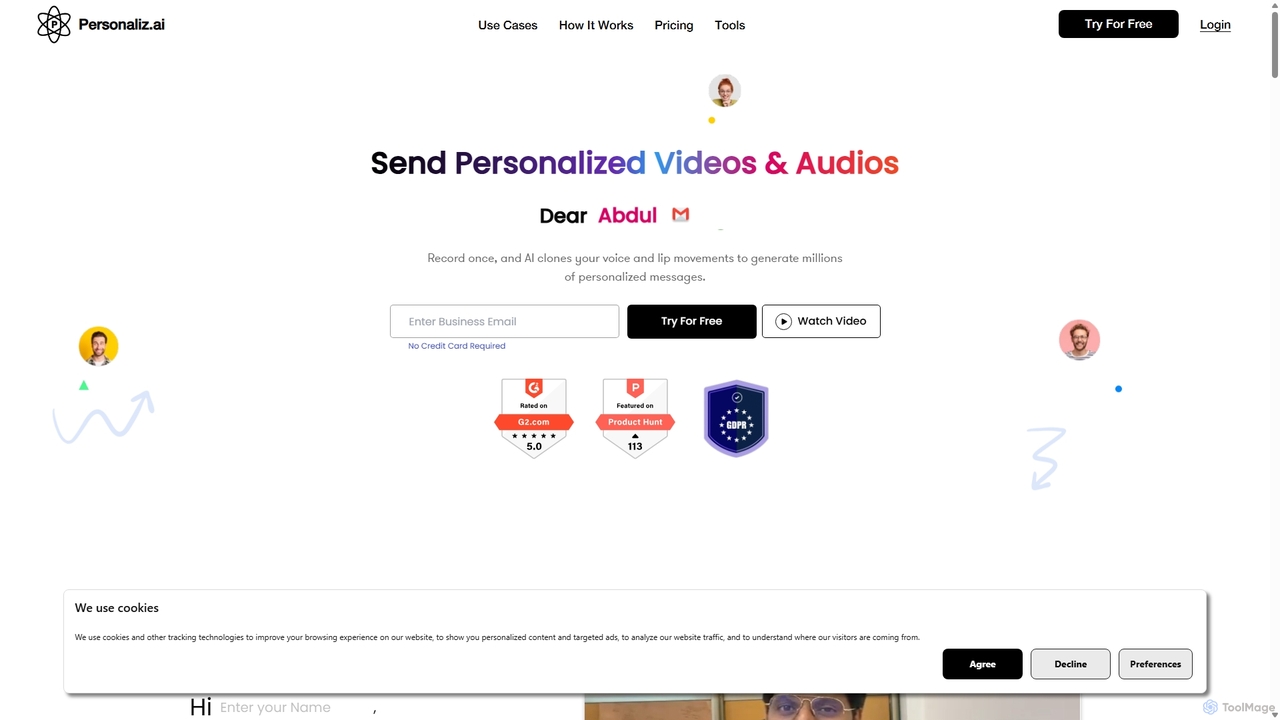
Personaliz is an AI-powered platform that enables businesses to create and send millions of personalized videos and audios at scale. By cloning your voice and lip movements, it dynamically inserts recipient names into a single recording, making outreach for sales, marketing, and recruitment highly engaging and effective.

Customer Engagement
Visits 6.5KFavorites 148Likes 145

About Customer Engagement

Customer Engagement AI tools are a category of artificial intelligence solutions designed to enhance and optimize interactions between businesses and their customers. These tools leverage advanced AI capabilities like natural language processing (NLP), machine learning, and predictive analytics to personalize communication, automate support, and gather actionable insights across various touchpoints. They empower businesses to build stronger relationships, improve satisfaction, and drive loyalty by delivering more relevant and timely customer experiences.

Core Features

  • AI Chatbots & Virtual Assistants: Provide instant, automated responses to customer inquiries, guide users through processes, and offer 24/7 support.
  • Personalized Communication: Dynamically tailor marketing messages, product recommendations, and service interactions based on individual customer data and behavior.
  • Sentiment Analysis: Analyze customer feedback from text, voice, and social media to understand emotions, identify pain points, and prioritize support needs.
  • Predictive Analytics for Churn: Identify customers at risk of leaving by analyzing historical data and interaction patterns, enabling proactive retention strategies.
  • Automated Feedback Collection: Streamline the process of gathering customer opinions through surveys, review requests, and post-interaction feedback mechanisms.

Use Cases

These tools are invaluable for businesses seeking to scale their customer interactions while maintaining a high degree of personalization. They are widely adopted in customer service centers for automating routine queries, in marketing departments for hyper-targeted campaigns, and by sales teams for lead qualification and nurturing. Industries such as e-commerce, SaaS, finance, and telecommunications heavily rely on Customer Engagement AI to manage large customer bases efficiently and effectively.

How to Choose

When selecting Customer Engagement AI tools, prioritize solutions with robust integration capabilities to seamlessly connect with existing CRM, marketing automation, and communication platforms. Evaluate the tool's scalability to ensure it can handle growing customer volumes and data, and assess its customization options to align with your brand's voice and specific business rules. Furthermore, consider the accuracy of its natural language processing (NLP) for understanding diverse customer queries and the depth of its analytics and reporting features for actionable insights.

Customer Engagement use cases

1

Automating Tier-1 Customer Support

Customer service departments can deploy AI chatbots to handle a high volume of common inquiries, such as order status checks, password resets, and FAQ answers. This frees up human agents to focus on complex issues, significantly reducing response times and improving overall customer satisfaction by providing instant, accurate support 24/7.

2

Personalizing Marketing Campaigns

Marketing teams utilize AI to analyze customer data and behavior, segment audiences, and dynamically generate personalized email content, product recommendations, or ad creatives. This ensures that each customer receives highly relevant messages, leading to higher engagement rates, increased conversion, and a stronger sense of brand connection.

3

Proactive Customer Service & Retention

Businesses can leverage AI to monitor customer activity and sentiment across various channels. If a customer shows signs of dissatisfaction or inactivity, the AI can trigger proactive outreach, such as a personalized offer or a check-in message, helping to address potential issues before they escalate and significantly improving customer retention rates.

4

Streamlining Onboarding & Product Adoption

SaaS companies and digital product providers use AI-powered guides and virtual assistants to walk new users through product setup, feature discovery, and best practices. This personalized, interactive onboarding experience helps users quickly understand the product's value, reduces churn during the initial stages, and accelerates product adoption.

5

Gathering & Analyzing Customer Feedback at Scale

Companies can automate the collection of feedback through AI-driven surveys, post-interaction prompts, and social media listening. AI then processes this vast amount of unstructured data, performing sentiment analysis and identifying key trends or recurring issues, providing invaluable insights for product development and service improvements.

6

Optimizing Sales Lead Qualification & Nurturing

Sales teams employ AI tools to interact with website visitors or inbound leads, asking qualifying questions and providing relevant information. The AI can then score leads based on their engagement and fit, and even nurture them with personalized content until they are ready for a human sales representative, significantly improving sales efficiency and conversion rates.

Customer Engagement FAQ

What are AI Customer Engagement tools?

AI Customer Engagement tools are software solutions that use artificial intelligence to automate, personalize, and optimize interactions between businesses and their customers. They leverage technologies like natural language processing, machine learning, and data analytics to understand customer needs, provide tailored responses, and enhance the overall customer experience across various communication channels.

How do AI tools enhance customer engagement?

AI tools enhance customer engagement by enabling instant, 24/7 support through chatbots, personalizing communications based on individual preferences and behavior, and proactively addressing customer needs identified through predictive analytics. They also help businesses gather and analyze vast amounts of feedback, leading to continuous improvements in products and services, ultimately fostering stronger customer relationships and loyalty.

What's the difference between AI Customer Engagement tools and traditional CRM?

Traditional CRM (Customer Relationship Management) systems primarily focus on managing customer data, sales processes, and service workflows. AI Customer Engagement tools, while often integrating with CRM, go a step further by actively *interacting* with customers using AI. They automate conversations, personalize outreach, and provide data-driven insights to *drive* engagement, whereas CRM is more about *managing* the relationship and its associated data.

What are the key benefits of using AI for customer engagement?

The key benefits include improved customer satisfaction due to faster, more personalized support and communication, increased operational efficiency by automating routine tasks, and enhanced customer retention through proactive problem-solving. AI also provides deeper insights into customer behavior and preferences, enabling more effective marketing and product development strategies, ultimately leading to higher revenue and brand loyalty.

How can I measure the ROI of AI customer engagement solutions?

Measuring the ROI involves tracking several key metrics. These include reductions in customer service costs (e.g., fewer human agent interactions), improvements in customer satisfaction scores (CSAT, NPS), increased conversion rates from personalized marketing, higher customer retention rates, and faster resolution times. Analyzing these metrics against the investment in AI tools provides a clear picture of their financial and operational impact.