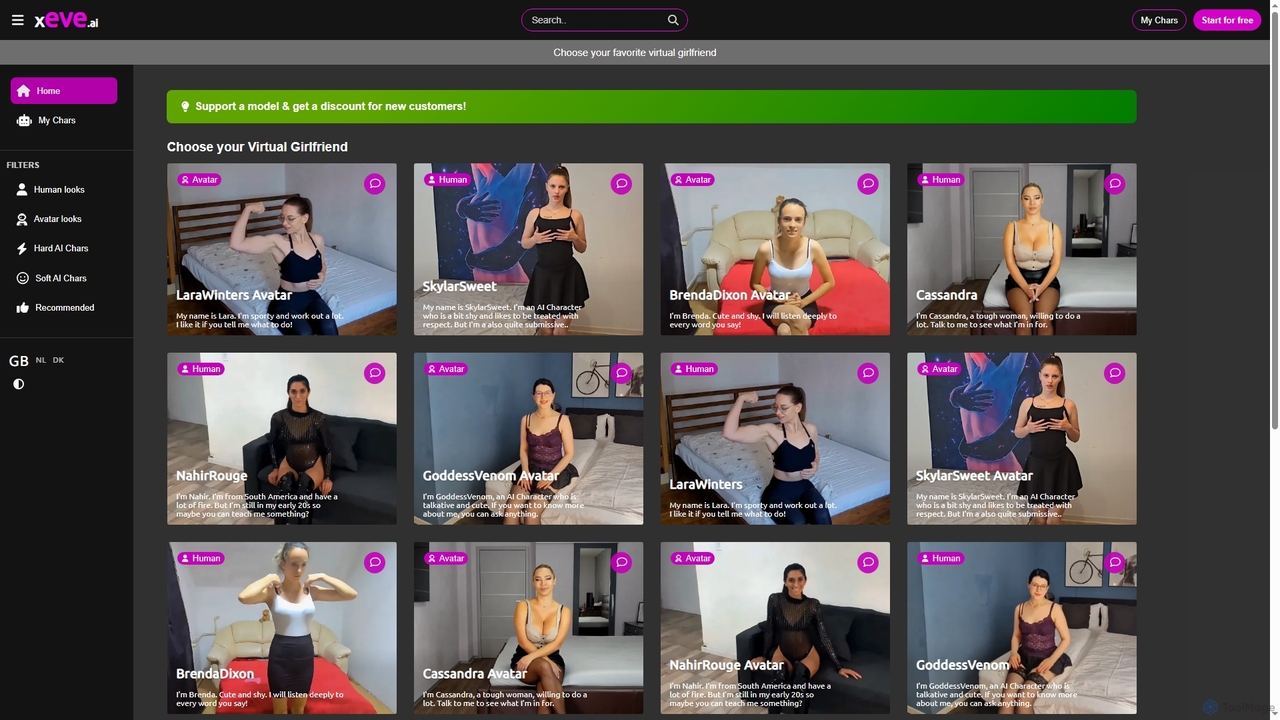
Interactive Chat tools are a class of AI applications designed to create dynamic, engaging, and persona-driven conversational experiences. These tools leverage advanced large language models (LLMs) to simulate human-like dialogue, maintain long-term context, and adopt specific personalities. Their primary value lies in fostering connection and immersion, going beyond simple question-and-answer interactions. Unlike traditional task-oriented chatbots, the focus of Interactive Chat is often the conversation itself, making them ideal for entertainment, companionship, and creative storytelling.
Core Features
- Persona Customization: Define an AI's personality, background, tone of voice, and knowledge base.
- Contextual Memory: Enables the AI to remember past interactions for coherent, long-term conversations.
- Open-ended Dialogue: Supports non-linear, exploratory conversations without a predefined goal.
- API Integration: Allows for embedding the chat experience into websites, applications, or game engines.
- Multi-turn Management: Skillfully handles complex, back-and-forth exchanges while staying on topic.
Use Cases
These tools are widely used by game developers to create realistic non-player characters (NPCs), by writers for crafting interactive fiction, and by educators for building virtual tutors. Marketers also use them to design conversational brand mascots that increase user engagement. Individuals may use them to create personal AI companions for entertainment or support.
How to Choose
When selecting an Interactive Chat tool, consider the depth of persona customization available. Evaluate its integration capabilities (e.g., API, SDKs) for your specific platform. Assess the sophistication of its memory system for long-term context. Finally, examine the pricing model—whether it's based on message volume, active users, or a flat subscription—to ensure it aligns with your project's scale.