Failspot
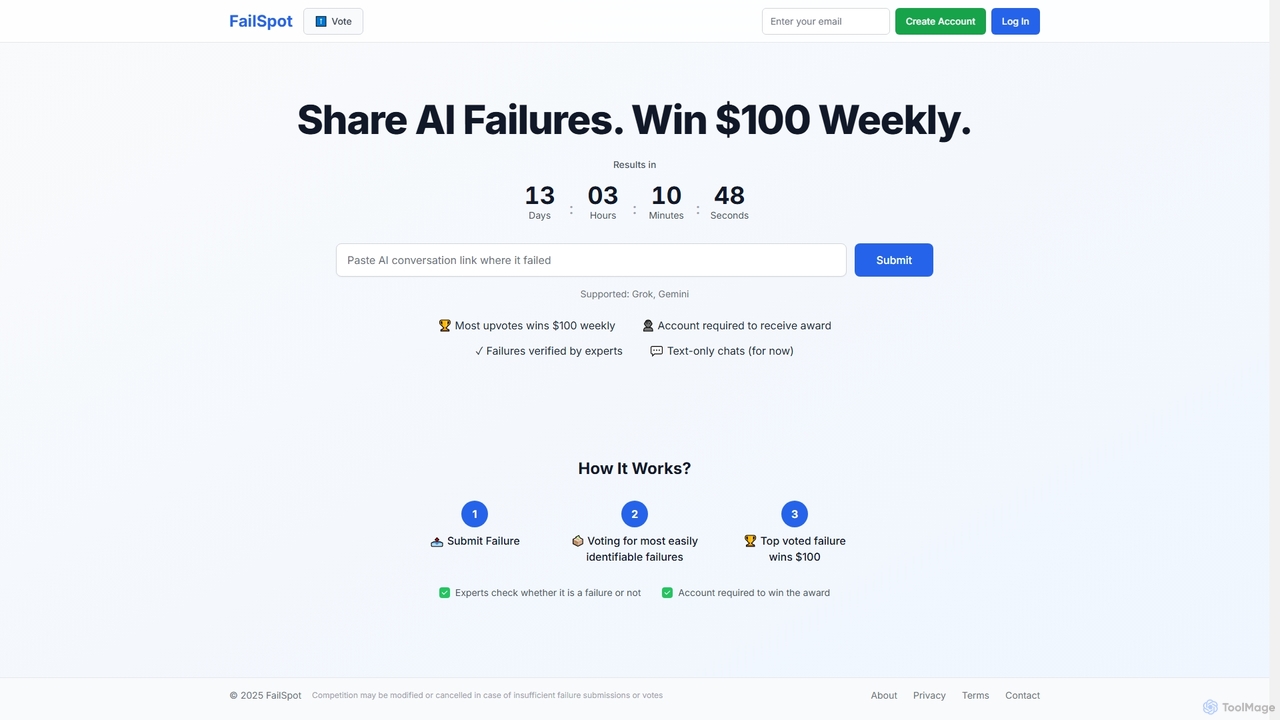
Failspot is a community platform where users submit and vote on AI model failures, with experts verifying submissions. …
Failspot is a community platform where users submit and vote on AI model failures, with experts verifying submissions. The most upvoted failure wins a weekly $100 prize, fostering a collaborative environment for identifying and understanding AI limitations, particularly for models like Grok and Gemini.
airportpianos
airportpianos is a free, community-driven online directory that helps travelers and musicians find public pianos in airports worldwide. …
airportpianos is a free, community-driven online directory that helps travelers and musicians find public pianos in airports worldwide. Search for pianos by airport, view their last confirmed locations, and contribute by submitting new sightings. It's a simple, valuable resource for making airport layovers more enjoyable.
About Crowdsourcing
Crowdsourcing AI tools are platforms that harness collective human intelligence to perform tasks, generate data, or solve problems, often integrating artificial intelligence to optimize the process. These tools leverage a distributed workforce to handle tasks that require human perception, judgment, or creativity, which AI alone cannot yet fully replicate. They are invaluable for creating high-quality datasets for AI model training, validating AI outputs, and scaling complex human-centric operations. By combining human capabilities with AI efficiency, they enable organizations to tackle large-scale projects with speed and accuracy.
Core Features
- Task Distribution & Management: Efficiently breaks down large projects into microtasks and distributes them to a global crowd, managing workflows and deadlines.
- Quality Control Mechanisms: Implements AI-assisted and human-driven validation processes to ensure the accuracy and consistency of crowd-contributed data or solutions.
- Workforce Matching: Uses AI to match specific tasks with crowd workers possessing relevant skills, experience, or language proficiency.
- Data Labeling & Annotation: Facilitates the creation of high-quality labeled datasets (images, text, audio) essential for training machine learning models.
- Payment & Incentivization: Manages secure and fair payment systems for crowd workers, often incorporating gamification or performance-based incentives.
Applicable Scenarios
Crowdsourcing AI tools are widely used across various sectors. Data science teams utilize them for annotating vast amounts of raw data to build robust AI models. E-commerce businesses employ them for product categorization, content moderation, and sentiment analysis. Researchers and developers leverage these platforms for human-in-the-loop validation of AI outputs, ensuring ethical and accurate model performance.
How to Choose
When selecting a Crowdsourcing AI tool, consider the specific type of tasks (e.g., data labeling, content moderation, creative tasks) and the required quality level. Evaluate the platform's workforce size and diversity, its quality assurance mechanisms, and the flexibility of its task design and management features. Additionally, assess the pricing model, integration capabilities with existing systems, and the level of support provided for complex projects.

CrowdsourcingUse Cases
Accelerate AI Model Training Data Labeling
Data science teams often require vast, accurately labeled datasets to train machine learning models. Crowdsourcing AI platforms allow them to upload raw data (images, text, audio) and distribute labeling tasks to thousands of human annotators globally. AI assists by pre-labeling, identifying ambiguous cases for human review, and ensuring consistency, significantly reducing the time and cost of preparing high-quality training data for computer vision or NLP models.
Enhance E-commerce Product Categorization
For large e-commerce platforms, accurately categorizing millions of products is crucial for search and user experience. Crowdsourcing AI tools enable retailers to submit product descriptions and images to a crowd for categorization, attribute extraction, and even quality checks. AI algorithms can then learn from these human inputs to automate future categorization, while human oversight ensures accuracy for complex or new product lines, improving data quality and customer navigation.
Scale Content Moderation for Online Platforms
Social media networks and online communities face the immense challenge of moderating user-generated content for policy violations, hate speech, or spam. Crowdsourcing AI platforms provide a scalable solution by distributing content moderation tasks to a trained crowd. AI can flag potentially problematic content, prioritize it, and learn from human decisions, allowing human moderators to focus on nuanced cases and ensuring a safer online environment at scale.
Validate and Refine AI Chatbot Responses
Developing intelligent AI chatbots requires continuous feedback to improve their conversational abilities and accuracy. Crowdsourcing AI tools can be used to present chatbot responses to human evaluators who assess their relevance, coherence, and helpfulness. This human-in-the-loop feedback loop helps identify areas where the AI struggles, providing valuable data for model retraining and ensuring the chatbot delivers more natural and effective interactions.
Conduct Large-Scale Market Research & Sentiment Analysis
Businesses need to understand public opinion and market trends. Crowdsourcing AI platforms facilitate large-scale sentiment analysis by having crowd workers evaluate social media posts, customer reviews, or news articles for emotional tone and key themes. AI can then aggregate and analyze these human-labeled sentiments, providing businesses with actionable insights into brand perception, product feedback, and competitive landscapes more efficiently than traditional methods.
Generate Diverse Creative Content & Ideas
For marketing agencies or product development teams, generating a wide array of creative ideas or content variations can be time-consuming. Crowdsourcing AI tools can solicit creative inputs from a diverse global crowd, such as slogan suggestions, design concepts, or short story plots. AI can then help filter, categorize, and even combine these human-generated ideas, accelerating the creative process and leading to more innovative and varied outputs.