
Told
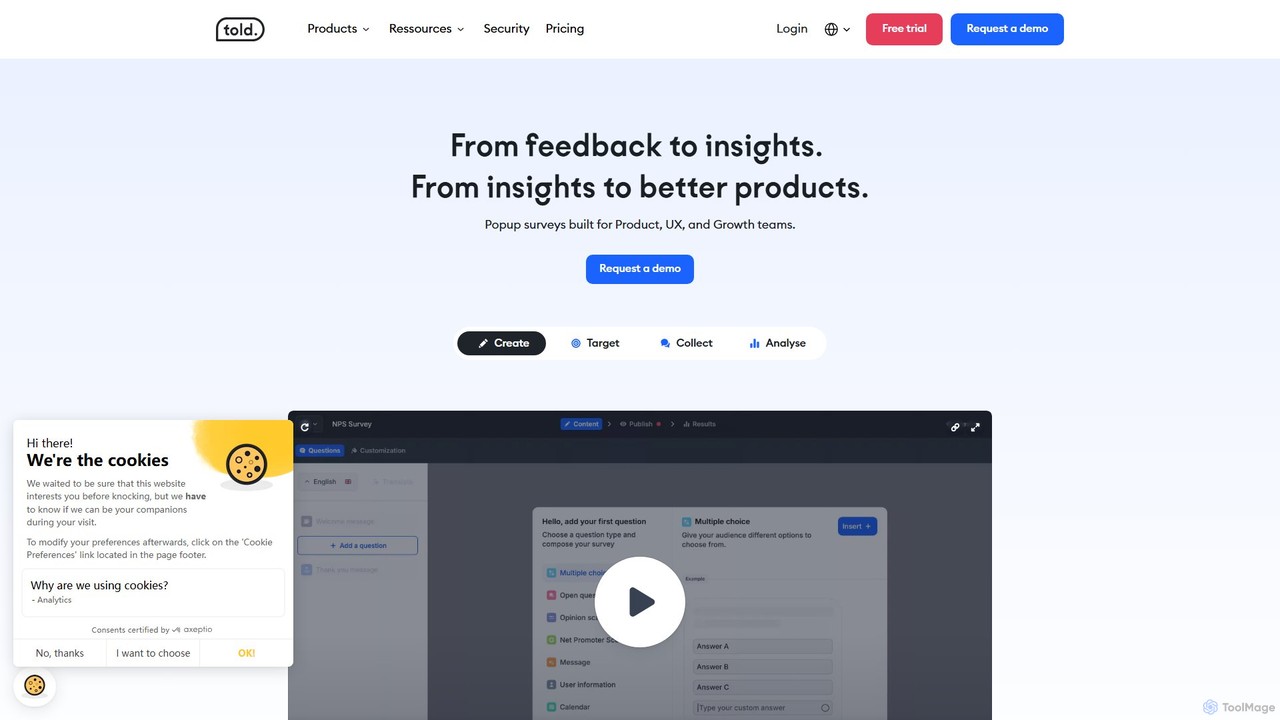
Told is an AI-powered popup survey tool designed for product, UX, and growth teams. It enables businesses to …
Told is an AI-powered popup survey tool designed for product, UX, and growth teams. It enables businesses to collect real-time, contextual user feedback through various channels like in-app, website, email, and mobile surveys. Featuring AI-driven reporting, smart triggering, and seamless no-code integration, Told helps teams turn user insights into actionable product improvements, measure satisfaction (NPS, CSAT), and optimize the customer journey.
About Customer Satisfaction
AI Customer Satisfaction tools are a specialized category of customer support software designed to analyze customer interactions and feedback to measure, understand, and predict satisfaction levels. These tools utilize Natural Language Processing (NLP) and sentiment analysis to automatically interpret the emotion and intent behind text and speech. By quantifying qualitative data from emails, chats, surveys, and reviews, they provide actionable insights to improve service quality and reduce customer churn. This proactive approach allows businesses to identify at-risk customers and address root causes of dissatisfaction before they escalate.
Core Features
- Sentiment Analysis: Automatically detects and categorizes the emotional tone (positive, negative, neutral) within customer communications.
- Predictive CSAT/NPS Scoring: Uses AI models to forecast customer satisfaction scores based on interaction data, without needing a survey.
- Feedback Topic & Trend Analysis: Aggregates and classifies open-ended feedback to identify recurring issues, product requests, and emerging trends.
- Churn Prediction: Identifies customers at high risk of leaving by analyzing patterns in their support history and sentiment.
- Automated Quality Assurance: Scores agent performance on metrics like empathy, problem resolution, and adherence to scripts across all interactions.
Applicable Scenarios
These tools are invaluable for data-driven organizations, particularly in sectors like SaaS, e-commerce, telecommunications, and finance. Customer success teams use them to proactively manage account health. Product managers leverage them to distill user feedback into development priorities. Quality assurance managers use them to automate and scale their performance reviews of support agents.
Selection Criteria
When choosing a tool, consider its integration capabilities with your existing CRM or helpdesk (e.g., Zendesk, Salesforce). Evaluate the accuracy and language support of its AI models. Assess the clarity and customizability of its reporting dashboards. Finally, consider the scalability of the platform to handle your volume of customer interactions and its pricing model.
Customer SatisfactionUse Cases
Proactive Churn Prevention for SaaS Companies
A Customer Success Manager (CSM) at a B2B SaaS company uses an AI Customer Satisfaction tool integrated with their helpdesk. The tool continuously analyzes all incoming support tickets, emails, and chat logs for their portfolio of accounts. It flags an account whose overall sentiment score has dropped by 20% in the last month, despite low ticket volume. The CSM receives an alert, investigates the interactions, and discovers the customer is frustrated with a niche feature's performance. They proactively reach out with a workaround and escalate the feedback to the product team, preventing a potential churn and strengthening the client relationship.
Distilling Product Feedback from Support Channels
A Product Manager for a mobile app wants to understand the primary drivers of user frustration. Instead of manually reading thousands of app store reviews and support tickets, they feed this data into an AI Customer Satisfaction tool. The tool's topic analysis feature automatically clusters feedback into categories like 'UI/UX issues', 'Login problems', and 'Feature requests'. It reveals that 35% of all negative feedback mentions the 'confusing checkout process'. Armed with this quantitative data, the Product Manager can build a strong business case to prioritize a redesign of the checkout flow in the next development sprint.
Automating Quality Assurance in a Call Center
A Quality Assurance (QA) manager in a large e-commerce call center is tasked with monitoring agent performance but can only manually review 2% of calls. By implementing an AI Customer Satisfaction tool, they can now automatically analyze 100% of call transcripts. The AI scores each interaction based on custom criteria like 'empathy shown', 'correct resolution provided', and 'compliance script followed'. The dashboard highlights agents who consistently score low on 'empathy', allowing the QA manager to provide targeted coaching and training modules, leading to a 15% increase in average CSAT scores within a quarter.
Identifying Root Causes of Negative Reviews
An e-commerce brand manager notices a sudden spike in 1-star reviews on a popular product review site. Manually sifting through hundreds of reviews is time-consuming. They use an AI satisfaction tool to ingest all reviews for the past month. The AI's trend analysis quickly identifies a new, recurring theme: 'damaged packaging', which was not a problem before. This insight allows the manager to immediately investigate their shipping department's new packaging supplier, pinpoint the issue, and revert to the old supplier, resolving the problem in days instead of weeks and protecting the brand's reputation.
Improving Agent Training with Interaction Data
A support team lead wants to make their agent coaching sessions more data-driven. They use an AI satisfaction tool's interaction scoring feature, which evaluates every customer chat. The dashboard reveals that while the team excels at first-response time, they score poorly on 'closing the loop' (confirming the customer's issue is fully resolved). The lead filters for conversations with low scores in this specific area and uses these real, anonymized examples in a team training session. This targeted approach helps agents understand the exact behavior to improve, leading to more thorough and satisfactory resolutions.
Real-time Mood Monitoring in Live Chat Support
A support agent for a telecommunications company is handling a complex billing issue via live chat. Their chat interface is enhanced with a real-time sentiment indicator from an AI satisfaction tool. As the agent explains the charges, they see the customer's sentiment shift from neutral to negative. This visual cue prompts the agent to immediately change their approach. Instead of just stating facts, they express more empathy, acknowledge the customer's frustration, and proactively offer a small service credit as a gesture of goodwill. The sentiment indicator shifts back to neutral and then positive as the issue is resolved, helping the agent de-escalate a potentially volatile situation.