Data Management Best in category 1 results Archiving AI Tool

Popular AI tools in the Archiving field of Data Management include Twillot, etc., helping you quickly improve efficiency.

Twillot

Twillot

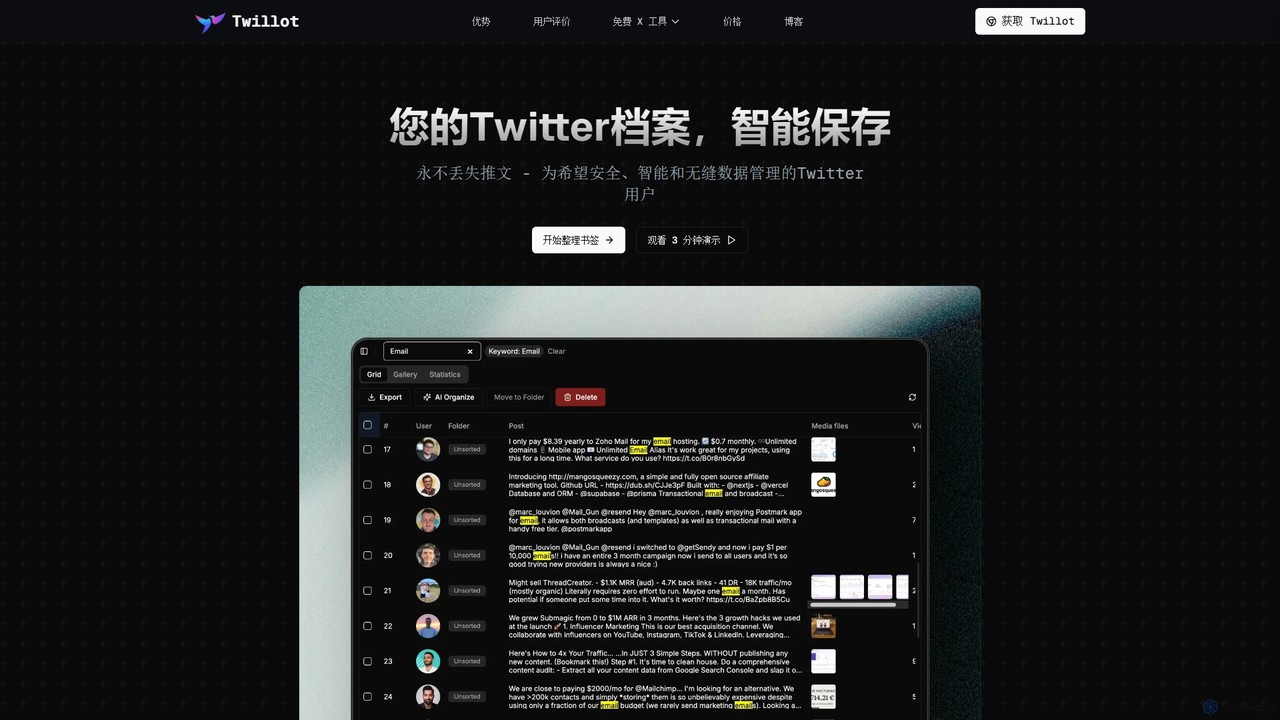
Twillot is an AI-powered browser extension for Twitter/X, designed to intelligently save, manage, and search your entire Twitter …

224.8K

About Archiving

AI Archiving tools are a specialized category within Data Management that leverage artificial intelligence to intelligently preserve, manage, and retrieve digital information for long-term retention. These tools automate the classification, indexing, deduplication, and secure storage of vast datasets, ensuring data integrity and compliance with regulatory requirements. They provide efficient solutions for historical record-keeping, legal discovery, and future analytical needs, transforming passive storage into an active, searchable knowledge base.

Core Features

  • Automated Classification & Indexing: AI algorithms automatically categorize and tag data based on content, metadata, and context, enabling efficient organization and retrieval.
  • Intelligent Deduplication: Identifies and eliminates redundant data across various storage locations, optimizing storage space and reducing costs.
  • Compliance & Governance: Ensures data retention policies are met, supports legal hold requirements, and provides audit trails for regulatory compliance.
  • Advanced Search & Retrieval: Utilizes natural language processing and machine learning to enable quick, precise searching and retrieval of archived information, even from unstructured data.
  • Data Integrity & Security: Employs encryption, access controls, and integrity checks to protect archived data from corruption, unauthorized access, and loss.

Use Cases

Organizations across various sectors utilize AI archiving for managing vast amounts of digital assets, ensuring regulatory compliance, and preserving institutional knowledge. This includes legal firms archiving case files, healthcare providers retaining patient records, and financial institutions storing transaction histories.

How to Choose

When selecting an AI archiving tool, consider its integration capabilities with existing systems, scalability to handle future data growth, compliance features for specific industry regulations, and the robustness of its search and retrieval functionalities. Evaluate the security measures, data integrity checks, and cost-effectiveness of storage and retrieval operations.

ArchivingUse Cases

1

Automated Legal Document Archiving

Legal firms and corporate legal departments use AI archiving tools to automatically classify, index, and store vast volumes of legal documents, including contracts, case files, and correspondence. The AI ensures compliance with retention policies, facilitates rapid e-discovery through advanced search, and maintains an immutable audit trail, significantly reducing manual effort and legal risks.

2

Healthcare Patient Record Retention

Healthcare providers leverage AI archiving to securely store and manage electronic health records (EHRs) and medical images over decades, adhering to strict privacy regulations like HIPAA. AI assists in categorizing diverse data types, ensuring long-term accessibility for patient care, research, and regulatory audits, while protecting sensitive patient information from unauthorized access.

3

Financial Transaction History Preservation

Financial institutions employ AI archiving solutions to retain billions of transaction records, communications, and regulatory reports for compliance with financial regulations (e.g., SEC, FINRA). The tools intelligently index data, detect anomalies, and provide immutable storage, enabling quick retrieval for audits, fraud investigations, and historical analysis, minimizing compliance risks.

4

Corporate Email & Communication Archiving

Businesses utilize AI archiving to automatically capture, classify, and store all corporate emails, instant messages, and collaborative platform communications. This ensures comprehensive record-keeping for legal discovery, internal investigations, and compliance with data retention policies, allowing for efficient search and retrieval of specific conversations or attachments when needed.

5

Research Data & Scientific Record Preservation

Research institutions and scientific organizations use AI archiving to manage and preserve large datasets generated from experiments, simulations, and studies. AI helps in structuring unstructured data, ensuring long-term accessibility, reproducibility of research, and compliance with funding body requirements, making valuable scientific data available for future analysis and collaboration.

6

Digital Asset Management for Media Archives

Media companies and broadcasters deploy AI archiving to intelligently store, tag, and manage vast libraries of video footage, audio recordings, and images. AI automatically extracts metadata, identifies content (e.g., faces, objects, spoken words), and enables precise search and retrieval, transforming raw media assets into a highly organized and accessible archive for future production and monetization.

ArchivingFrequently Asked Questions