Text-2-ICS
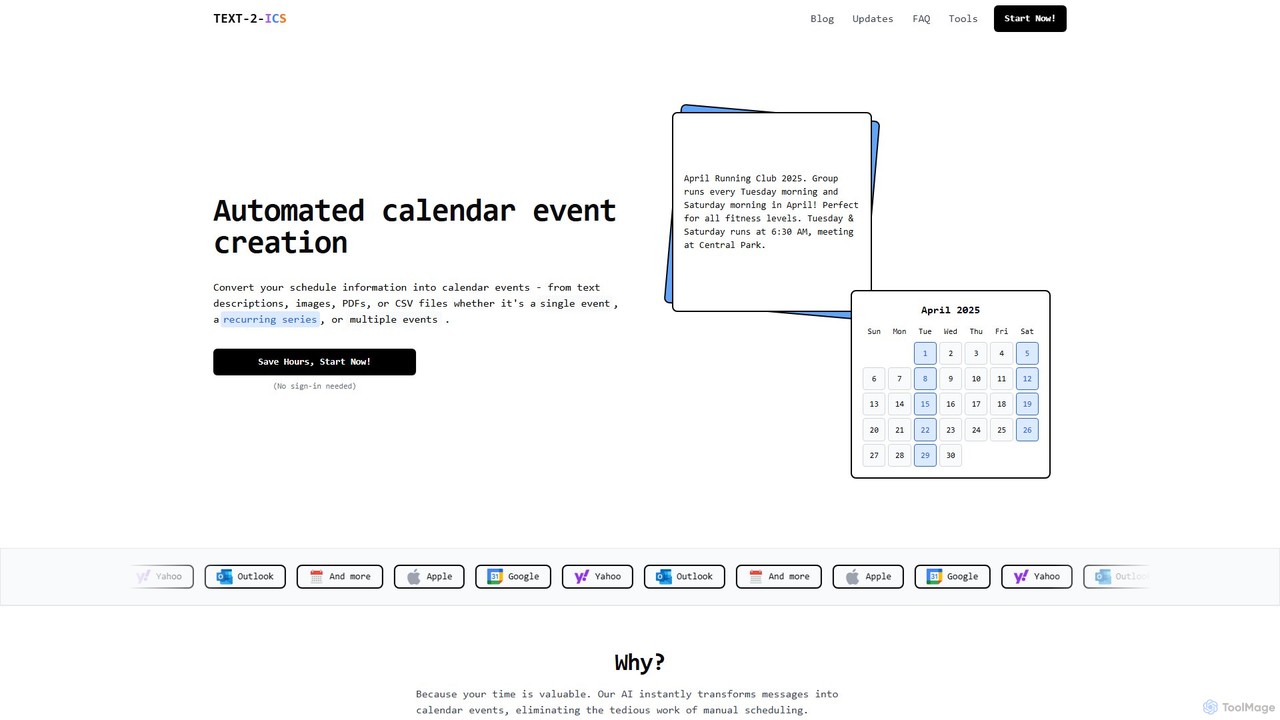
An AI-powered tool that instantly converts text, images, PDFs, and CSV files into calendar events (.ics files). It …
An AI-powered tool that instantly converts text, images, PDFs, and CSV files into calendar events (.ics files). It uses natural language processing to automatically extract event details, saving you from tedious manual scheduling. Supports single, recurring, and multiple events.
About Converter
AI Converters are specialized tools designed to automate the transformation of data from one format, structure, or system to another. Leveraging machine learning, these tools can intelligently parse complex data, recognize patterns, and map fields between disparate schemas, a key function within data management. They significantly reduce the manual effort required for data migration, integration, and interoperability tasks. Unlike simple format changers, AI Converters can handle unstructured data, infer relationships, and validate outputs for greater accuracy.
Core Features
- Intelligent Format Recognition: Automatically detects the input file format and structure, such as JSON, XML, CSV, or PDF.
- Automated Schema Mapping: Suggests or automatically creates mappings between source and target data structures, even with complex nesting.
- Content-Aware Transformation: Modifies data content during conversion, such as standardizing date formats, extracting entities, or translating values.
- Batch Processing: Converts large volumes of files or data records in a single, automated operation.
- Data Validation & Error Handling: Checks the converted data for integrity and consistency, flagging or correcting errors automatically.
Use Cases
AI Converters are widely used by data engineers, developers, and business analysts. They are essential in scenarios like migrating legacy systems to cloud platforms, integrating third-party APIs with different data schemas, or converting unstructured documents like invoices and reports into structured formats for analysis.
How to Choose
When selecting an AI Converter, consider the range of supported input and output formats. Evaluate the sophistication of its mapping and transformation logic capabilities. For enterprise use, check for API access for automation, robust security protocols for sensitive data, and its ability to scale with large datasets.

ConverterUse Cases
Migrating Legacy System Data to the Cloud
An IT specialist is tasked with migrating customer data from an on-premise legacy database, which exports data as complex XML files, to a modern cloud-based CRM that requires JSON format. Instead of writing complex custom scripts, the specialist uses an AI Converter. The tool automatically analyzes the XML schema, suggests accurate field mappings to the JSON structure, and handles data type conversions (e.g., string dates to ISO 8601 format). This process reduces migration time from weeks to days and minimizes data loss risk.
Extracting Data from PDF Invoices for Accounting
An accounting clerk needs to process hundreds of PDF invoices from various suppliers each month. Manually entering data like invoice number, date, amount, and line items into accounting software is tedious and error-prone. By using an AI Converter with OCR capabilities, the clerk can batch-upload all PDF files. The AI identifies and extracts the key data points from each invoice, regardless of its layout, and converts them into a structured CSV file. This file can then be directly imported into the accounting system, saving over 80% of manual data entry time.
Automating API Payload Transformation
A developer is integrating a new third-party logistics service with their e-commerce platform. The platform's API sends order data in a specific JSON format, but the logistics service's API expects data in an XML format with a different structure. The developer uses an AI Converter as a middleware service. They define the mapping rules once, and the converter automatically intercepts API calls, transforms the JSON payload to the required XML format in real-time, and forwards it. This decouples the systems and avoids writing and maintaining brittle, custom transformation code.
Converting Research Data for Cross-Disciplinary Analysis
A data scientist in a biomedical research institute needs to combine datasets from different departments. One dataset is in CSV format from a clinical trial, while another is in a specialized hierarchical data format (HDF5) from genetic sequencing. Using an AI Converter, the scientist can define rules to flatten the HDF5 structure and map it to corresponding fields in the CSV. The tool intelligently handles large numerical arrays and complex metadata, merging them into a unified format suitable for analysis in tools like R or Python, accelerating the pace of research.
Batch Converting Media Files for a Website
A web content manager needs to upload a gallery of 500 images provided by a photographer in a high-resolution TIFF format. To optimize website loading speed, these images must be converted to a web-friendly format like WebP, resized, and compressed. The manager uses an AI Converter that supports image processing. They set up a conversion profile once (output to WebP, max-width 1200px, 80% quality) and then drag-and-drop the entire folder of TIFF files. The tool processes all images in the background, applying the transformations consistently and saving hours of manual work in photo editing software.
Standardizing IoT Sensor Data for Analytics Platforms
An IoT solutions architect is collecting data from thousands of sensors from different manufacturers. Each sensor type sends data in a unique binary or text format. To feed this data into a central analytics platform, it must be standardized into a common JSON structure. The architect deploys an AI Converter at the data ingestion gateway. The tool is configured to recognize data from different sensor models, parse their unique formats, extract key metrics (like temperature, pressure), and transform them into a standardized JSON object with consistent naming conventions and units, enabling real-time monitoring and analysis.