ToolMage
Sign in

Best 1 Data Engineering AI tools for Data Management

Popular Data Engineering AI tools in Data Management include 0101 Digital, helping you work more efficiently.

0101 Digital

0101 Digital

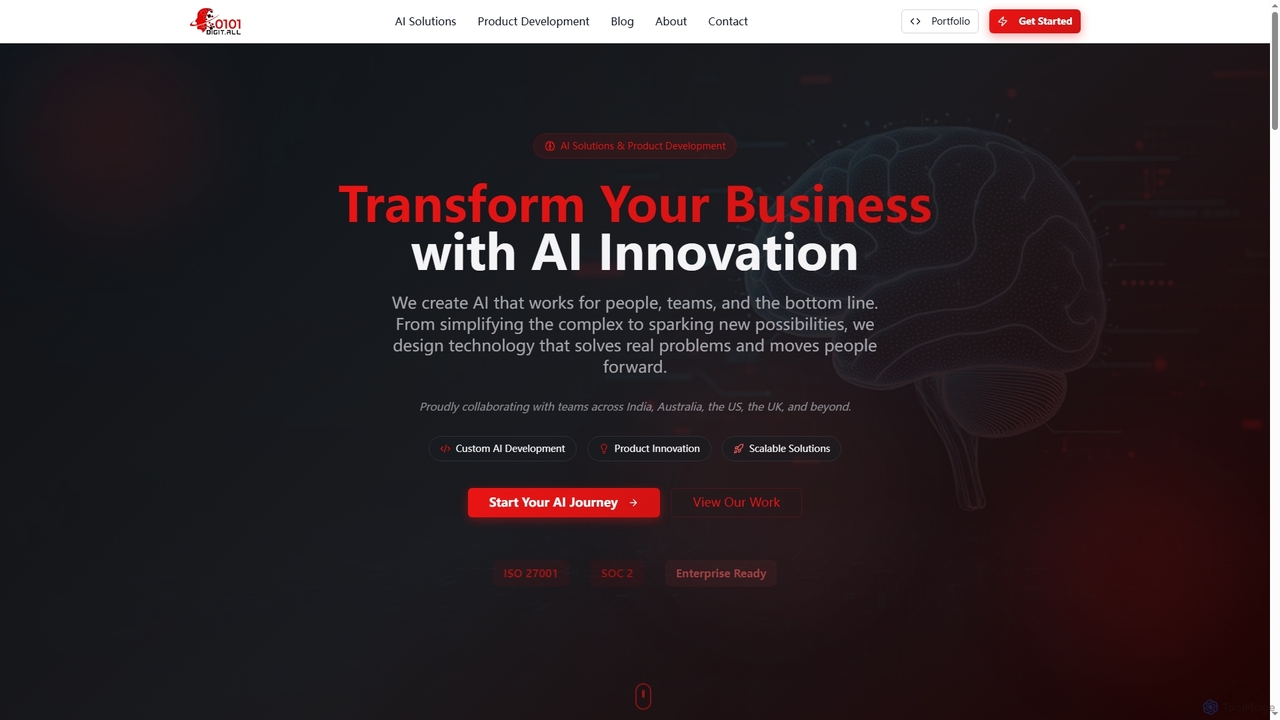
0101 Digital is a leading AI solutions provider specializing in transforming businesses through custom AI development, product innovation, and strategic AI consulting. They deliver scalable, outcome-focused solutions, including their unique DPaaS (Delivery Pods as a Service) model, to clients across various industries globally, ensuring measurable ROI and competitive advantage.

Custom Development
Visits 4.3KFavorites 129Likes 127

About Data Engineering

Data Engineering tools are designed to build, manage, and optimize robust data pipelines, ensuring data is collected, processed, and delivered efficiently. These AI-powered solutions streamline the complex processes of data ingestion, transformation (ETL/ELT), and storage, making data reliable and ready for analysis, machine learning, and business intelligence. They enable organizations to construct scalable and resilient data infrastructures, crucial for deriving insights and powering data-driven applications.

Core Features

  • Data Ingestion & Integration: Connects to diverse data sources, extracts, and loads data into target systems.
  • Data Transformation (ETL/ELT): Cleans, enriches, aggregates, and restructures raw data into usable formats.
  • Workflow Orchestration: Schedules, monitors, and manages complex data pipelines and processing jobs.
  • Data Warehousing & Lake Management: Builds and maintains scalable data storage solutions like data warehouses and data lakes.
  • Real-time Data Processing: Handles high-velocity data streams for immediate insights and operational decisions.

Applicable Scenarios

Data Engineering tools are essential for organizations building centralized data platforms, powering advanced analytics, and supporting machine learning initiatives. They are used by data engineers, architects, and developers to ensure data availability and quality across various business functions, from finance to marketing and operations.

How to Choose

When selecting Data Engineering tools, consider their scalability to handle growing data volumes, integration capabilities with existing data sources and cloud platforms, and ease of use for pipeline development and management. Evaluate features for data governance, quality, and security, alongside cost-effectiveness and community support.

Featured tool rankings

Data Engineering use cases

1

Automated ETL for Business Intelligence

Data engineers implement automated ETL (Extract, Transform, Load) pipelines to regularly pull sales, marketing, and operational data from various source systems. These pipelines clean, transform, and load the data into a centralized data warehouse, ensuring that business analysts and decision-makers have access to up-to-date, high-quality information for daily reporting and strategic business intelligence dashboards. This automation significantly reduces manual data preparation time and improves data consistency.

2

Real-time Data Pipelines for Fraud Detection

Financial institutions leverage Data Engineering tools to build real-time data pipelines that ingest transaction data streams from various payment gateways and banking systems. These pipelines process data with low latency, applying rules and feeding anomaly detection models to identify suspicious activities instantly. This enables immediate alerts and actions, significantly reducing financial losses due to fraud and enhancing security for customers.

3

Customer 360 Data Unification

Marketing and customer experience teams use Data Engineering solutions to unify disparate customer data from CRM systems, web analytics platforms, social media interactions, and transaction histories. Data engineers build pipelines that cleanse, deduplicate, and link these diverse datasets to create a comprehensive 'Customer 360' view. This unified profile enables personalized marketing campaigns, improved customer service, and more accurate customer segmentation for targeted engagement strategies.

4

IoT Device Data Ingestion & Processing

Manufacturers and smart city operators deploy Data Engineering tools to manage the massive influx of data from IoT sensors and devices. Data engineers design pipelines capable of ingesting high-volume, high-velocity streaming data, performing real-time processing to filter noise, aggregate metrics, and detect anomalies. This processed data is then stored in data lakes for further analysis, enabling predictive maintenance, operational optimization, and new data-driven services.

5

Data Lakehouse Construction for AI/ML

Data architects and engineers utilize Data Engineering tools to design and implement data lakehouse architectures. This involves building pipelines that ingest raw, unstructured data into a data lake, then transforming and curating it into structured formats within the same platform for both traditional analytics and machine learning workloads. This approach provides the flexibility of a data lake with the performance and governance of a data warehouse, accelerating AI/ML model development and deployment.

6

Cloud Data Migration & Modernization

Enterprises undergoing digital transformation use Data Engineering tools to migrate their legacy on-premise data infrastructure to modern cloud-native platforms. Data engineers plan and execute the migration of databases, data warehouses, and data lakes, optimizing for cloud scalability, cost-efficiency, and performance. This involves re-architecting data pipelines, implementing new data governance frameworks, and leveraging cloud services to build a flexible and future-proof data ecosystem.

Data Engineering FAQ

What is Data Engineering?

Data Engineering is the discipline of designing, building, and maintaining systems and infrastructure for collecting, storing, processing, and transforming large volumes of data. Its core purpose is to ensure data is reliable, accessible, and ready for use by data scientists, analysts, and business applications. This involves creating robust data pipelines, managing data warehouses or data lakes, and implementing data governance strategies to maintain data quality and integrity across an organization's data ecosystem.

How do Data Engineering tools differ from Data Analytics tools?

Data Engineering tools primarily focus on building and maintaining the infrastructure and pipelines that make data available and usable. They deal with data collection, storage, transformation, and orchestration. In contrast, Data Analytics tools are used *after* the data has been prepared by data engineers. They focus on exploring, visualizing, and interpreting data to extract insights and support decision-making. Data Engineering provides the clean, structured foundation upon which data analytics can effectively operate.

What are the key components of a Data Engineering pipeline?

A typical Data Engineering pipeline consists of several key components. It begins with Data Ingestion, where raw data is collected from various sources. Next is Data Storage, often involving data lakes or data warehouses. Data Transformation (ETL/ELT) processes clean, enriches, and structures the data. Finally, Data Delivery makes the processed data available to downstream applications, analytics tools, or machine learning models. Orchestration and Monitoring components oversee the entire workflow, ensuring efficiency and reliability.

Why is Data Quality important in Data Engineering?

Data Quality is paramount in Data Engineering because the reliability of any downstream analysis, machine learning model, or business decision directly depends on the quality of the underlying data. Poor data quality can lead to inaccurate insights, flawed predictions, and misguided strategies, resulting in significant financial losses and reputational damage. Data engineers implement robust validation, cleansing, and monitoring processes within their pipelines to ensure data accuracy, consistency, completeness, and timeliness, thereby building trust in the data assets.

Which industries benefit most from Data Engineering tools?

Virtually all data-intensive industries benefit significantly from Data Engineering tools. Financial services rely on them for fraud detection and risk management. E-commerce and retail use them for customer analytics and personalized recommendations. Healthcare leverages them for patient data management and research. Manufacturing and IoT sectors utilize them for operational efficiency and predictive maintenance. Any industry that generates and consumes large volumes of data to drive decisions and innovation finds Data Engineering tools indispensable for building a robust data foundation.