
ToolMage
Sign in

Best 1 Privacy Tools for Data Management

Popular Privacy Tools in Data Management include Primary, helping you work more efficiently.

Primary
Freemium

Primary

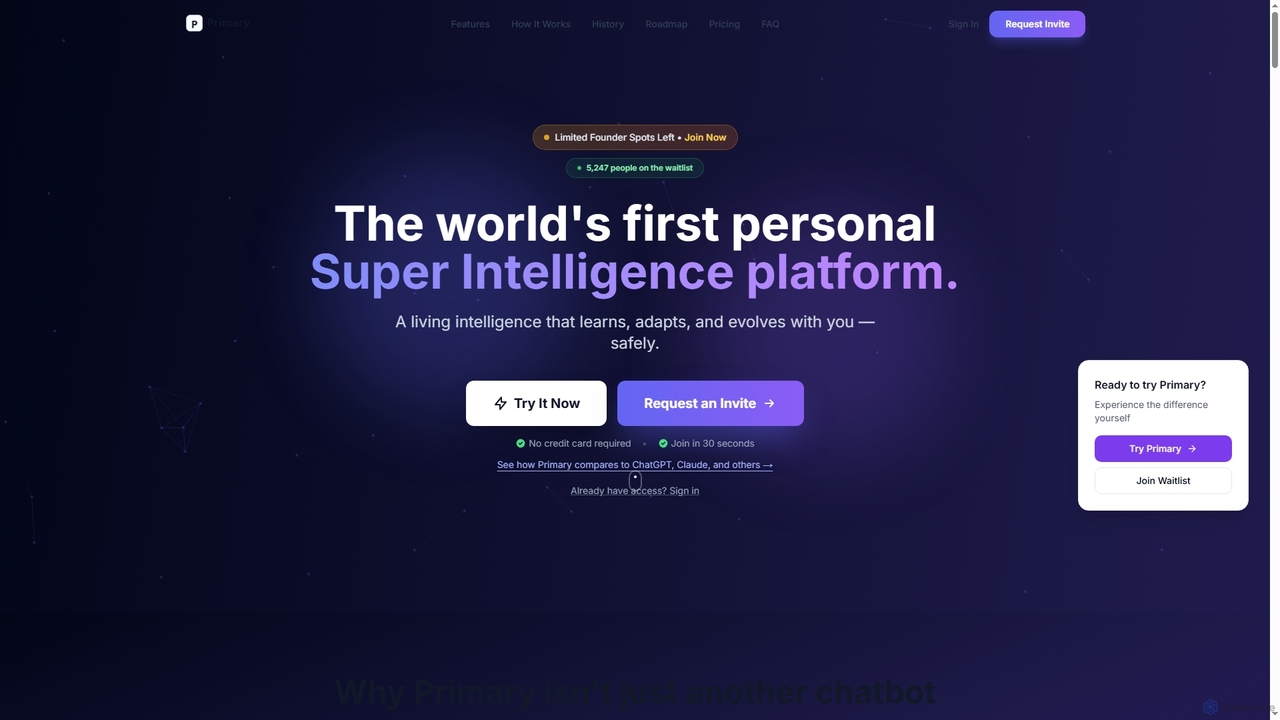
Primary is the world's first personal Super Intelligence platform, designed to learn, adapt, and evolve with you while prioritizing privacy. It automates repetitive tasks, manages complex workflows, and provides deep personalization to save users over 10 hours per week, acting as a symbiotic AI companion.

Workflow Automation
Visits 6KFavorites 144Likes 139

About Privacy Tools

AI Privacy Tools are a specialized category of software that leverage artificial intelligence to protect sensitive information and ensure data confidentiality. These tools employ advanced techniques like data anonymization, synthetic data generation, and differential privacy to de-identify personal data without sacrificing its analytical value. They are essential for organizations that need to analyze large datasets for insights, train machine learning models, or share data while complying with strict privacy regulations such as GDPR and CCPA. By transforming raw data into a privacy-safe format, these tools enable secure data utilization and innovation.

Core Features

  • Data Anonymization & Masking: Automatically identifies and removes or obfuscates Personally Identifiable Information (PII) from datasets.
  • Synthetic Data Generation: Creates statistically representative, artificial datasets that mimic the properties of real data without containing any actual sensitive information.
  • Differential Privacy: Adds mathematical noise to data queries to protect individual records while allowing for accurate aggregate analysis.
  • Privacy-Preserving Computation: Enables analysis and model training on encrypted data, ensuring information remains confidential throughout the process.

Use Cases

These tools are critical in regulated industries like healthcare for analyzing patient outcomes, in finance for fraud detection on transaction data, and in technology for testing software with realistic user profiles. They also support academic research and government agencies in sharing valuable datasets with the public safely.

How to Choose

When selecting an AI Privacy Tool, consider the specific privacy-enhancing technology (PET) it uses and its suitability for your data type. Evaluate the trade-off between data utility and the level of privacy protection. Also, assess its integration capabilities with your existing data pipelines, scalability for large datasets, and its certified compliance with relevant regulations.

Featured tool rankings

Privacy Tools use cases

1

Secure AI Model Training in Healthcare

A medical research institute needs to train a diagnostic AI model on thousands of patient records. Using an AI Privacy Tool, they generate a high-fidelity synthetic dataset that mirrors the statistical patterns of the real patient data, including demographics and clinical markers. This allows data scientists to build and validate the model effectively without ever accessing the actual Protected Health Information (PHI), ensuring full HIPAA compliance and protecting patient confidentiality.

2

Compliant Customer Analytics for Financial Services

A bank's marketing team wants to understand customer spending habits to design new credit card rewards programs. To comply with GDPR, they use a privacy tool that applies k-anonymization and differential privacy to their transaction database. Analysts can then query the data for aggregate trends, such as popular spending categories by region, without being able to identify or track any individual customer's financial activity, balancing business intelligence with privacy obligations.

3

Realistic Software Testing with Synthetic User Data

A software development company is preparing to launch a new mobile application. Instead of using risky, real customer data in their staging environment, the QA team uses an AI Privacy Tool to generate a database of millions of synthetic users. This data includes realistic names, addresses, and usage patterns, enabling them to conduct thorough performance, load, and bug testing across all features without violating user privacy or risking a data breach.

4

Sharing Government Data for Public Research

A national statistics agency wants to release census microdata to universities for social science research. To prevent re-identification of individuals, they employ a privacy tool to apply advanced anonymization techniques and add controlled statistical noise. The resulting public-use dataset allows researchers to study population trends and correlations while providing a mathematical guarantee that the privacy of individual citizens is protected.

5

Internal Fraud Detection without Exposing Employee Data

A large corporation needs to analyze internal communications and access logs to detect potential insider threats or fraudulent activity. To protect employee privacy, the security team uses a privacy tool that allows them to run analytics on encrypted data. The system can identify anomalous patterns indicative of fraud without decrypting the content of emails or messages, ensuring investigations are targeted and employee privacy is respected.

6

Cross-Border Data Collaboration for Market Research

A multinational consumer goods company wants to consolidate customer feedback from Europe and North America to analyze global trends. Due to differing data residency laws like GDPR, direct data pooling is complex. They use a privacy tool to create anonymized and standardized datasets in each region. These privacy-safe datasets can then be legally combined and analyzed by a central team, unlocking global insights while adhering to international data transfer regulations.

Privacy Tools FAQ

What are AI Privacy Tools?

AI Privacy Tools are software solutions that use artificial intelligence to protect sensitive data. Their primary function is to enable data usage—such as for analytics or machine learning—while minimizing the risk of exposing individual identities. They achieve this through techniques like automatically discovering and masking personal information, generating artificial but realistic synthetic data, and applying mathematical guarantees like differential privacy. These tools are distinct from traditional security measures as they focus on making data safe to use, not just preventing unauthorized access.

How do I choose the right AI Privacy Tool?

Choosing the right tool depends on your specific needs. Consider these key factors:

  • Data Utility vs. Privacy: Assess how much analytical accuracy you need to retain. Some techniques offer stronger privacy but may slightly reduce data fidelity.
  • Technology Used: Determine if you need anonymization, synthetic data, or differential privacy based on your use case (e.g., synthetic data for software testing, differential privacy for public queries).
  • Scalability: Ensure the tool can handle the volume and velocity of your data.
  • Compliance Needs: Select a tool that helps you meet specific regulations like GDPR, HIPAA, or CCPA, and can provide auditable proof of compliance.
What is the difference between data anonymization and synthetic data generation?

Both are privacy-enhancing techniques, but they work differently. Data anonymization modifies an existing, real dataset by removing or altering personally identifiable information (PII). The goal is to make it difficult to re-identify individuals from the data. Synthetic data generation, on the other hand, does not modify real data at all. Instead, it learns the statistical patterns and correlations from the real data and then creates a completely new, artificial dataset from scratch. This new dataset can be used for analysis and testing without containing any real individual records.

How do AI Privacy Tools differ from traditional security tools like firewalls?

They address different aspects of data protection. Traditional security tools, like firewalls, encryption-at-rest, and access controls, are designed to create a perimeter to prevent unauthorized access to data. Their focus is on keeping intruders out. AI Privacy Tools, however, operate on the assumption that data will be accessed and used by authorized personnel. Their purpose is to protect the privacy of individuals *within* the data itself, making it safe for analysis, sharing, or model training without revealing sensitive information. They are complementary, not mutually exclusive.

Who should use AI Privacy Tools?

AI Privacy Tools are valuable for any organization that handles sensitive personal data. Key users include:

  • Data Scientists and Analysts who need to explore datasets and build models without violating privacy.
  • Software Developers and QA Engineers who require realistic data for testing applications.
  • Compliance and Legal Officers responsible for ensuring adherence to regulations like GDPR or HIPAA.
  • Healthcare and Financial Institutions that analyze sensitive customer or patient data.
  • Government Agencies that need to share data with the public or other departments securely.