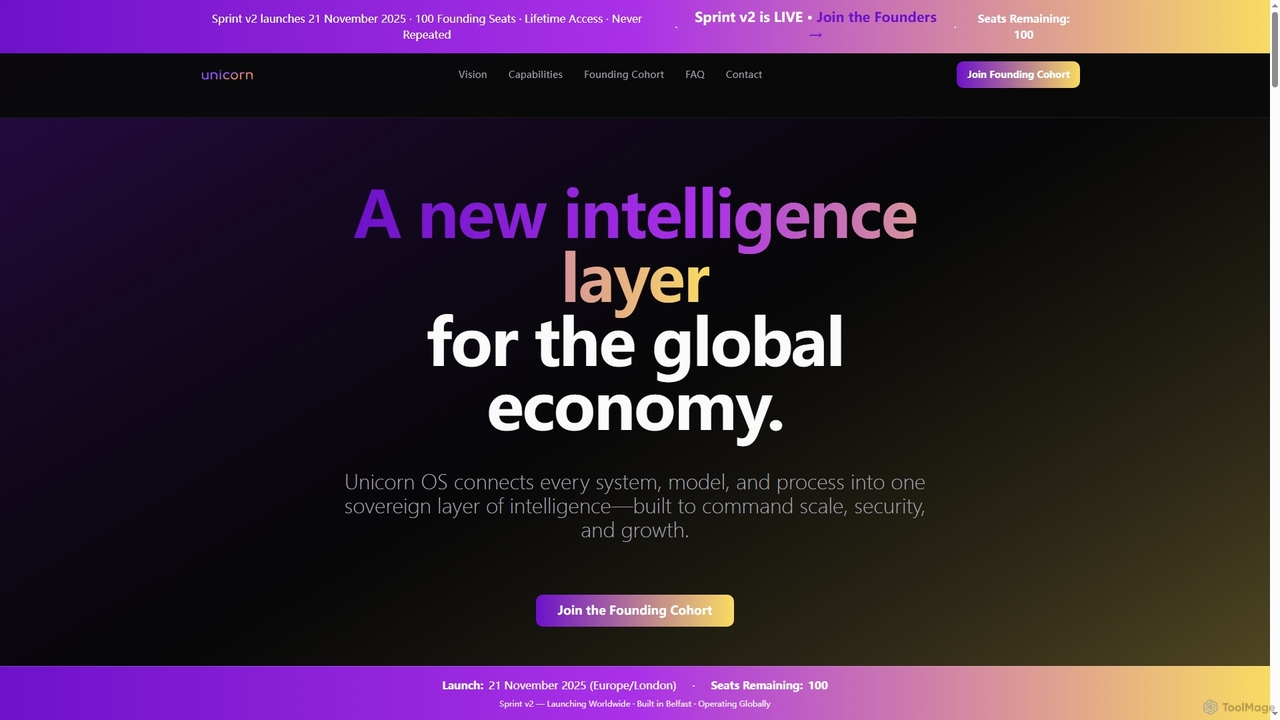
Unicorn OS
Unicorn OS is an advanced AI-powered creation and deployment engine designed to unify business, data, and artificial intelligence …
Unicorn OS is an advanced AI-powered creation and deployment engine designed to unify business, data, and artificial intelligence into a single, sovereign intelligence layer. It enables users to design, launch, and monetize intelligent websites, e-commerce stores, and applications from simple prompts, providing cross-platform reach and integrated commerce capabilities through Unicorn Pay.
About Unified Data Platform
Unified Data Platforms are comprehensive AI-powered solutions that integrate diverse data sources into a single, cohesive environment for streamlined data management and analytics. These platforms leverage advanced technologies like machine learning and automation to ingest, process, store, and govern data from various origins, breaking down traditional data silos. They provide organizations with a holistic, real-time view of their data assets, enabling more accurate insights, faster decision-making, and enhanced operational efficiency across the entire data lifecycle.
Core Features
- Universal Data Ingestion: Connects and ingests data from a multitude of structured, semi-structured, and unstructured sources, including databases, data lakes, streaming feeds, and applications.
- Integrated Data Storage: Consolidates data into a unified repository, often combining data lake flexibility with data warehouse performance for diverse analytical needs.
- Automated Data Processing: Utilizes AI and machine learning for automated data cleansing, transformation, enrichment, and cataloging, ensuring data quality and readiness.
- Robust Data Governance: Implements centralized policies for data security, privacy, compliance, and access control across all integrated data assets.
- Advanced Analytics & AI/ML Integration: Provides built-in tools or seamless integration with analytics, business intelligence, and machine learning platforms for deep insights and predictive modeling.
Use Cases
Businesses across industries, from finance to retail, utilize Unified Data Platforms to gain a competitive edge. They are particularly valuable for enterprises struggling with fragmented data landscapes, enabling them to build comprehensive customer 360 views, optimize supply chains, or power real-time fraud detection systems.
How to Choose
When selecting a Unified Data Platform, consider its data source compatibility to ensure it integrates with all your existing systems. Evaluate its scalability and performance to handle growing data volumes and complex workloads. Assess the level of automation and AI capabilities for data preparation and governance, which can significantly reduce manual effort. Finally, examine its ecosystem and integration with existing analytics tools to ensure a smooth transition and maximize value.

Unified Data PlatformUse Cases
Real-time Customer 360 View
Marketing and sales teams in e-commerce or financial services leverage Unified Data Platforms to consolidate customer interaction data from CRM, web analytics, social media, and transaction systems. This creates a comprehensive, real-time customer profile, enabling personalized marketing campaigns, proactive customer service, and accurate churn prediction, leading to improved customer satisfaction and retention.
Supply Chain Optimization
Manufacturing and logistics companies use Unified Data Platforms to integrate data from inventory management, production lines, shipping logistics, and supplier networks. By centralizing this diverse data, they can gain end-to-end visibility, predict demand fluctuations, optimize inventory levels, identify bottlenecks, and improve delivery efficiency, significantly reducing operational costs.
Fraud Detection and Risk Management
Financial institutions deploy Unified Data Platforms to ingest and process vast amounts of transactional data, customer behavior patterns, and external threat intelligence in real-time. The platform's ability to unify and analyze disparate data sources allows for the rapid identification of suspicious activities and anomalies, enhancing fraud detection capabilities and strengthening overall risk management frameworks.
Personalized Healthcare Delivery
Healthcare providers utilize Unified Data Platforms to integrate patient electronic health records (EHRs), wearable device data, genomic information, and clinical research findings. This unified view supports personalized treatment plans, predictive diagnostics, and population health management, leading to more effective patient care and improved health outcomes.
IoT Data Analytics for Smart Cities
Urban planners and city administrators employ Unified Data Platforms to collect and analyze data from various IoT sensors across a smart city, including traffic cameras, environmental monitors, and utility meters. This enables real-time monitoring of urban infrastructure, optimization of public services, intelligent traffic management, and proactive maintenance, enhancing urban living quality.
Enterprise Resource Planning (ERP) Data Consolidation
Large enterprises use Unified Data Platforms to consolidate data from disparate ERP modules (finance, HR, operations, procurement) and other business applications. This provides a single source of truth for enterprise-wide reporting, financial analysis, and strategic planning, eliminating data inconsistencies and improving cross-departmental collaboration and decision-making.