WriterCasa
WriterCasa is an AI-powered book writing studio designed for authors to craft beautiful manuscripts with intelligent assistance. It …
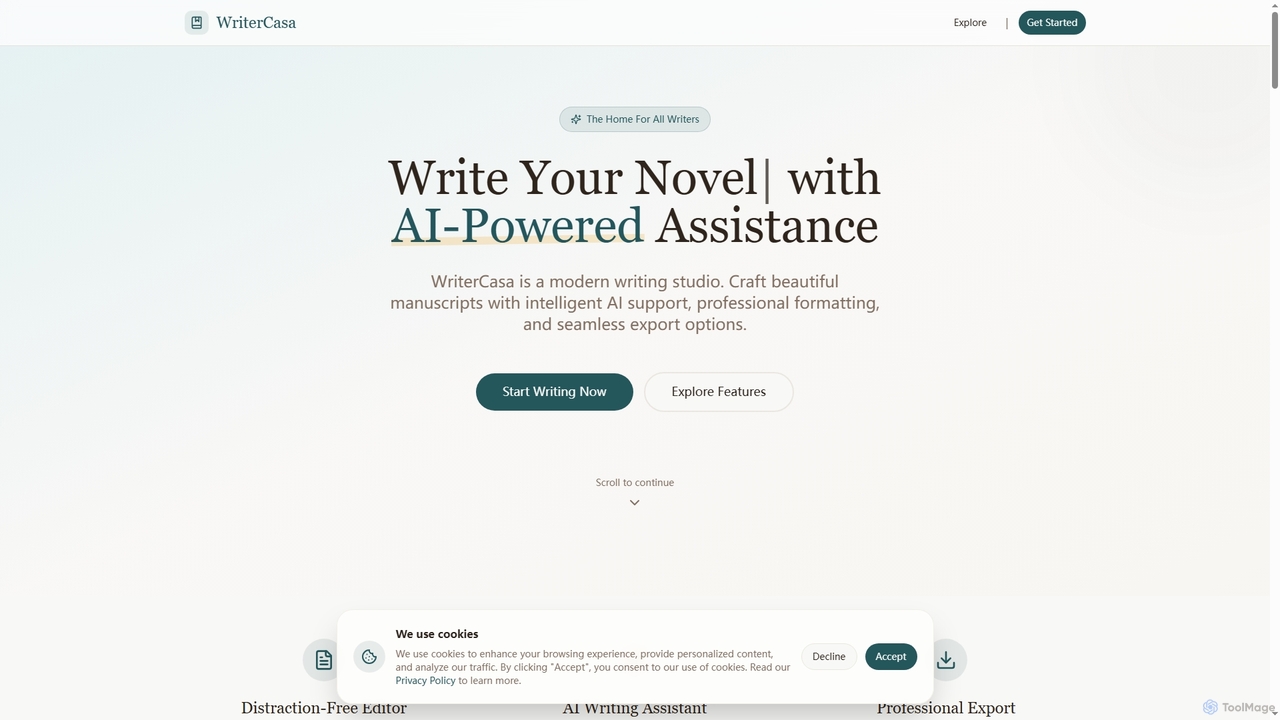
WriterCasa is an AI-powered book writing studio designed for authors to craft beautiful manuscripts with intelligent assistance. It offers a distraction-free editor, context-aware AI writing suggestions, real-time grammar checking, and professional export options. Additionally, it features an AI Book Cover Studio to design stunning covers in seconds, making it a comprehensive tool for aspiring and established writers.
About Book Cover Design
Book Cover Design tools are AI-powered platforms specifically engineered to streamline and enhance the creation of visually compelling book covers. Leveraging advanced artificial intelligence, these tools can generate unique design concepts, suggest optimal layouts, integrate text and imagery, and even produce 3D mockups. They significantly accelerate the design process for authors, publishers, and marketers, transforming complex graphic design tasks into intuitive, accessible workflows for professional-quality covers.
Core Features
- AI-Driven Concept Generation: Automatically creates diverse cover ideas based on genre, keywords, and style preferences.
- Typography Optimization: Suggests and applies suitable fonts, sizes, and placements for titles, author names, and taglines.
- Image & Asset Integration: Provides access to vast libraries of stock images, illustrations, and design elements, often with AI-assisted placement.
- Layout & Composition Assistance: Guides users in arranging visual elements and text for balanced and impactful cover designs.
- 3D Mockup Creation: Instantly renders realistic 3D book mockups for marketing and promotional purposes.
Applicable Scenarios
AI Book Cover Design tools are invaluable for self-published authors needing professional covers on a budget, independent publishers seeking to rapidly prototype and iterate designs, and marketing teams requiring quick, high-quality visuals for promotional campaigns. They are also used by established authors for concept exploration and by small presses to manage a high volume of new releases efficiently.
How to Choose
When selecting an AI book cover design tool, consider its AI generation capabilities and the level of customization offered for generated designs. Evaluate the breadth and quality of its integrated asset library (images, fonts, templates) and its output formats (e.g., print-ready PDFs, web-optimized JPEGs). Assess the user interface for ease of use and whether it provides features like 3D mockups or direct integration with publishing platforms.

Book Cover DesignUse Cases
Generate Diverse Cover Concepts for a New Novel
A self-published author with a new fantasy novel needs a captivating cover. By inputting the genre, key themes, and character descriptions into an AI book cover design tool, they can instantly generate dozens of unique visual concepts. This allows the author to explore various artistic directions and styles, saving weeks of traditional brainstorming and iteration with a human designer, ultimately helping them find the perfect visual representation for their story.
Create Professional 3D Mockups for Marketing Campaigns
A small independent publisher needs to promote their upcoming book releases across various social media platforms and online stores. Using an AI book cover design tool, they can upload their finished 2D cover art and instantly generate realistic 3D mockups of the book in different settings (e.g., on a bookshelf, held in hand, open on a table). This capability allows them to create engaging marketing visuals quickly and cost-effectively, enhancing their promotional efforts without needing complex 3D rendering software.
Rapidly Iterate and Refine Cover Designs for Series
A publisher managing a book series needs to maintain a consistent visual brand while introducing unique elements for each new installment. AI book cover design tools allow their design team to quickly generate variations of a base template, experimenting with different color schemes, imagery, and typography for each book. This rapid iteration capability ensures brand consistency across the series while efficiently adapting designs to reflect the individual themes of each volume, significantly reducing design cycle times.
Customize Pre-designed Templates for Niche Genres
An author writing in a very specific niche genre (e.g., steampunk romance or cozy mystery) often struggles to find suitable pre-made cover templates. AI book cover design tools offer a wide array of customizable templates that can be adapted. Users can select a template, then use AI features to swap out elements, adjust color palettes, and integrate genre-specific imagery or typography suggestions, ensuring the cover accurately reflects the book's unique appeal without starting from scratch.
Optimize Cover Text for Readability and Impact
Ensuring that the title, author name, and tagline are legible and impactful on a book cover is crucial for attracting readers. AI book cover design tools can analyze the chosen imagery and background, then suggest optimal font choices, sizes, colors, and placements for text elements. This optimization helps designers and authors create covers where the text stands out clearly, enhancing readability and ensuring key information is easily digestible, even at thumbnail sizes on online retail platforms.
Generate Back Cover and Spine Designs Automatically
Beyond the front cover, a complete book design includes the spine and back cover, which require careful alignment and integration of text (blurb, ISBN, author bio). Some advanced AI book cover design tools can extend the front cover design seamlessly to the spine and back, or generate complementary designs. Users can input their back cover copy and spine text, and the AI will automatically format and place it, ensuring a cohesive and professional look for the entire book jacket, ready for print.