ToolMage
Sign in

Best 1 Packaging AI tools for Design

Popular Packaging AI tools in Design include Package Design, helping you work more efficiently.

Package Design
Freemium

Package Design

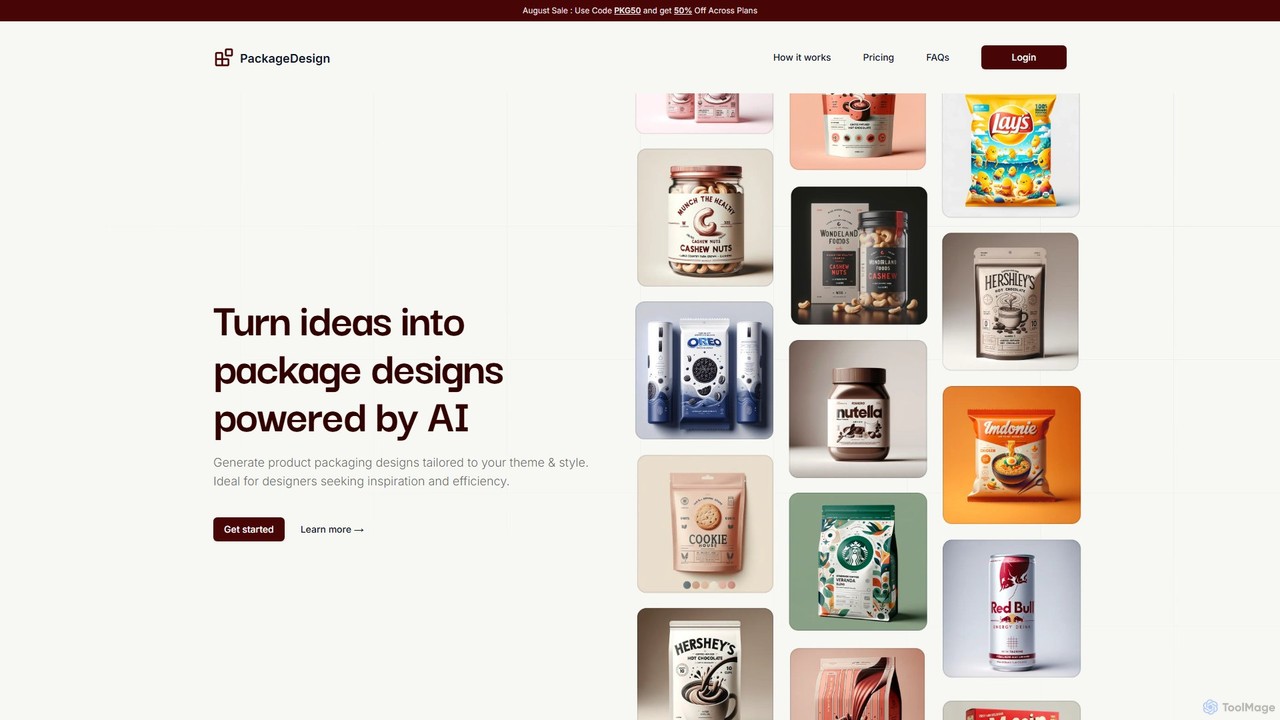
An AI-powered tool that transforms your ideas into unique, professional product packaging designs. Simply input your product details, choose a theme and style, and instantly generate custom concepts. Ideal for designers, startups, and e-commerce businesses looking for inspiration and efficiency in their branding process.

Packaging
Visits 8.8KFavorites 157Likes 145

About Packaging

AI Packaging tools are specialized applications that use artificial intelligence to generate, visualize, and refine product packaging designs. These tools leverage generative models and 3D rendering engines to create unique concepts, realistic mockups, and structural die-lines from simple text prompts or design parameters. They empower brands and designers to rapidly explore countless creative variations, test designs in virtual environments, and significantly shorten the product launch cycle. This technology streamlines the entire process from initial idea to production-ready files.

Core Features

  • Generative Concept Creation: Instantly produces numerous design variations for labels, boxes, and containers based on brand guidelines and product descriptions.
  • 3D Mockup Visualization: Renders photorealistic 3D models of the packaging on various products and in different settings for realistic previews.
  • Structural & Die-line Generation: Automatically creates technical, print-ready templates (die-lines) for boxes and other structural packaging.
  • Content & Compliance Assistance: Helps place and format required elements like nutritional information, barcodes, and warning labels according to standards.

Applicable Scenarios

These tools are widely used by Consumer Packaged Goods (CPG) companies, design agencies, e-commerce businesses, and freelance packaging designers. For instance, a beverage company can generate dozens of can designs for a new flavor in minutes, or an e-commerce startup can create professional product mockups for their online store without expensive photoshoots.

Selection Criteria

When choosing an AI Packaging tool, consider the quality of its 3D rendering, the diversity of its generative design output, and its ability to export production-ready files like die-lines and high-resolution graphics. Also, evaluate its integration capabilities with other design software (like Adobe Illustrator) and the scope of its pre-built template and material libraries.

Packaging use cases

1

Generate Packaging Concepts for a New Product Launch

A brand manager for a snack company is tasked with launching a new line of organic chips. Instead of a lengthy traditional design process, they use an AI packaging tool. They input key parameters: product name, flavor profiles (e.g., 'Sea Salt', 'Spicy Jalapeño'), brand colors, target audience ('health-conscious millennials'), and desired packaging type (flexible pouch). The AI generates over 50 unique design concepts in minutes, showcasing different typography, imagery, and color combinations. The manager can then immediately use these visuals in a survey to gauge consumer interest, accelerating market research by weeks.

2

Create Realistic 3D Mockups for E-commerce Listings

An e-commerce entrepreneur selling artisanal coffee needs high-quality product images for their online store. Professional photoshoots are costly and time-consuming. Using an AI packaging tool, they upload their 2D label design and select a pre-made 3D model of a coffee bag. The tool instantly wraps the label around the model, creating a photorealistic 3D mockup. They can then adjust lighting, shadows, and background scenes to generate a variety of lifestyle images and product shots for their website and social media, all without a physical product or camera.

3

Automate Die-line Generation for Structural Packaging

A packaging engineer at a cosmetics company needs to create a custom box for a new perfume bottle. Traditionally, this involves complex calculations and manual drafting in CAD software. With an AI packaging tool, the engineer inputs the bottle's dimensions (height, width, depth) and selects a box style (e.g., 'tuck-end box'). The AI instantly generates a precise, production-ready 2D die-line file. It also provides a 3D animated preview of how the box folds, allowing the engineer to verify the structure and fit before sending the file to the manufacturer, preventing costly errors and saving hours of technical work.

4

Visualize Sustainable Packaging Material Options

A CPG company's sustainability team wants to explore replacing their plastic packaging with eco-friendly alternatives. Using an AI packaging tool with a material library, they can apply different sustainable textures and finishes to their existing 3D product models. They can instantly visualize how their product would look in packaging made from recycled cardboard, molded pulp, or biodegradable film. This allows stakeholders to compare the aesthetic appeal of various green options side-by-side, facilitating faster and more informed decisions on sustainable transitions without needing physical samples.

5

Rapidly Create Seasonal and Promotional Packaging

A marketing team for a chocolate brand needs to design limited-edition packaging for the holiday season. Time is short. They use an AI tool, starting with their standard box design. They input prompts like 'add festive snowflakes and gold ribbons,' 'use a Christmas color palette,' and 'incorporate a vintage holiday illustration style.' The AI generates dozens of holiday-themed variations in seconds. The team can quickly select the best options for a short production run, ensuring they can capitalize on seasonal demand without a long design cycle.

6

Perform A/B Testing on Packaging Designs Before Production

A beverage company is undecided between two packaging directions for a new energy drink: one minimalist and one bold and colorful. Instead of producing costly physical prototypes for focus groups, they use an AI tool to generate high-fidelity 3D mockups of both designs. These digital mockups are then used in online A/B testing platforms to gather quantitative data on which design has a higher click-through rate or purchase intent. This data-driven approach allows the company to make a confident, evidence-based decision on the final packaging, minimizing risk and maximizing market appeal.

Packaging FAQ

What are AI Packaging tools?

AI Packaging tools are software applications that use artificial intelligence to automate and enhance the process of creating product packaging. They go beyond traditional design software by actively generating new design ideas, creating realistic 3D visualizations instantly, and producing technical files like die-lines based on simple inputs. Key features often include generative design, 3D mockups, and structural template creation, helping users accelerate their workflow from concept to production.

How to choose the right AI Packaging tool?

Choosing the right tool depends on your specific needs. Consider the following factors:

  • Primary Use Case: Do you need more help with creative ideation (generative design) or with technical aspects like 3D mockups and die-lines?
  • Output Quality: Evaluate the realism of the 3D renders and the accuracy of the technical files it generates.
  • Integration: Check if it can export to or integrate with your existing design software, such as Adobe Illustrator or CAD programs.
  • Ease of Use: Assess the user interface. Some tools are designed for designers, while others are simple enough for marketers or brand managers.
How do AI Packaging tools differ from general graphic design software?

General graphic design software like Adobe Photoshop or Illustrator are powerful manual tools that require users to create everything from scratch. AI Packaging tools are different because they automate specific, high-value tasks within the packaging workflow. Instead of just providing a canvas, they act as a creative partner, generating hundreds of design options, automatically applying designs to 3D models, and creating technical die-lines, which are highly specialized functions not typically found in general design software.

What are the key benefits of using AI for packaging design?

Using AI for packaging design offers several significant benefits. The primary advantage is speed; AI can generate hundreds of concepts in the time it takes a human to create a few. This leads to increased creative exploration, allowing brands to consider more diverse options. It also reduces costs by automating tasks like 3D mockup creation, eliminating the need for expensive photoshoots. Finally, it enables data-driven decisions by making it easy to create multiple variations for A/B testing with consumers before committing to production.

Who can benefit from using AI Packaging tools?

A wide range of professionals can benefit from these tools. Brand Managers and Marketers can quickly visualize new ideas and conduct market research. Packaging Designers can augment their creativity and automate repetitive tasks, freeing up time for high-level creative work. E-commerce Entrepreneurs can create professional product imagery without a large budget. Packaging Engineers can streamline the creation of technical die-lines and structural prototypes. Essentially, anyone involved in the lifecycle of a physical product's packaging can find value in these tools.