
ToolMage
Sign in

Best 1 Product Customization AI tools for Design

Popular Product Customization AI tools in Design include DesignNBuy, helping you work more efficiently.

DesignNBuy
Paid

DesignNBuy

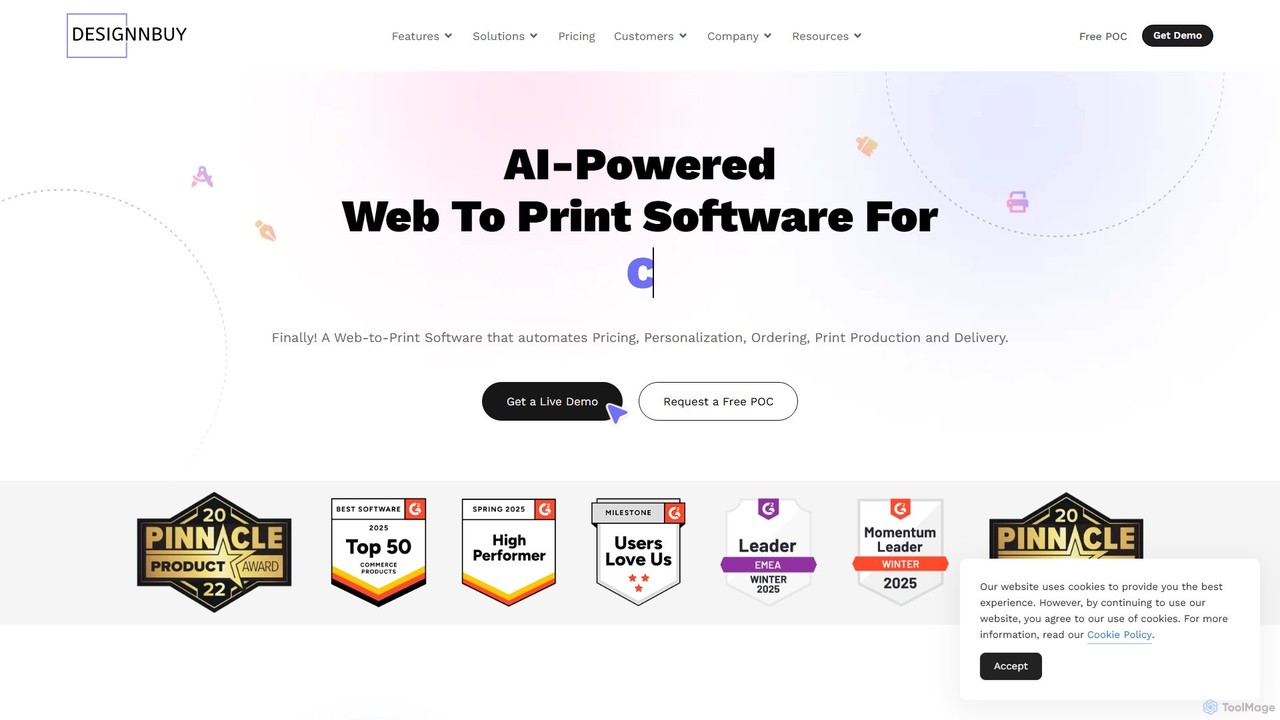
DesignNBuy is an AI-powered, all-in-one web-to-print software solution that automates the entire print lifecycle. It enables printing and packaging businesses to offer online product personalization, streamline ordering, manage production workflows, and integrate seamlessly with major e-commerce platforms to boost sales and efficiency.

Product Customization
Visits 16.6KFavorites 149Likes 138

About Product Customization

AI Product Customization tools are a specialized category of design software that uses artificial intelligence to enable real-time personalization of products. These tools leverage generative AI to create unique designs, patterns, or text styles from user input and apply them to 2D or 3D product models. Their primary value is automating the design process for e-commerce and manufacturing, allowing customers to create one-of-a-kind items and businesses to offer mass customization at scale. Unlike general design tools, they are specifically built with product templates and e-commerce integrations in mind.

Core Features

  • Generative Design Engine: Creates unique visuals, patterns, or text from simple prompts.
  • Real-time 2D/3D Preview: Instantly shows customizations on a realistic product model.
  • Product Template Integration: Works with predefined models like apparel, mugs, and phone cases.
  • Automated Design Placement: Intelligently fits generated designs to product contours and constraints.
  • Print-Ready File Export: Generates high-resolution files optimized for manufacturing or printing.

Applicable Scenarios

These tools are ideal for the e-commerce sector, particularly for print-on-demand (POD) businesses, personalized gift shops, and corporate merchandise suppliers. They are also used in industries like furniture and automotive, where customers can visualize custom configurations before purchasing. Any business wanting to offer a high degree of product personalization without manual design work can benefit.

Selection Criteria

When choosing a tool, evaluate its product compatibility to ensure it supports your inventory. Assess the quality and style of its AI generation capabilities. Prioritize seamless integration with your e-commerce platform (e.g., Shopify, WooCommerce). Finally, consider the intuitiveness of the user interface for your end customers, as a simple experience is key to conversion.

Featured tool rankings

Product Customization use cases

1

Automating T-Shirt Designs for an Online Store

An e-commerce store owner specializing in print-on-demand apparel integrates an AI product customization tool into their Shopify store. Instead of pre-designing hundreds of graphics, they offer a text prompt field. A customer can type 'a Shiba Inu wearing sunglasses on a skateboard' and the AI generates several unique, high-quality images. The customer selects their favorite, sees it instantly mocked up on a t-shirt, and completes the purchase. This process offers infinite design variety, reduces upfront design costs, and creates a highly engaging shopping experience.

2

Creating Custom Corporate Merchandise Previews

A sales representative at a promotional products company uses an AI customizer during a client meeting. The client wants to see their new logo on various items like mugs, pens, and notebooks. The rep uploads the logo, and the tool instantly generates realistic mockups across the entire product catalog. The AI also suggests optimal placement and color variations that complement the logo. This allows for real-time collaboration and decision-making, significantly shortening the sales cycle from weeks to a single meeting.

3

Personalizing Engraved Jewelry Designs

A direct-to-consumer jewelry brand offers custom engravings on necklaces and bracelets. Their website features an AI tool where a customer can input a name or a meaningful date. The AI doesn't just use a standard font; it generates several artistic calligraphy styles and decorative flourishes that uniquely fit the entered text. The customer can cycle through different AI-generated options and see a live 3D preview of the engraving on the jewelry piece, ensuring the final product is a truly personal and unique keepsake.

4

Visualizing Custom Furniture Upholstery

An online furniture retailer wants to help customers visualize custom fabrics on their sofas. Their product page includes an AI customizer where shoppers can describe a pattern, such as 'a minimalist floral pattern with blue and grey tones'. The AI generates a seamless, high-resolution pattern and applies it to a 3D model of the sofa. Users can rotate the model and zoom in to see the texture, helping them make a confident purchase decision for a high-value item without needing physical fabric samples.

5

Designing Personalized Fan Jerseys

A platform for local sports teams allows players and fans to order custom jerseys. Using an integrated AI tool, a user enters their name and preferred number. The AI then presents the name and number in several dynamic font styles—from classic block letters to modern, aggressive designs—that match the team's branding. It also automatically adjusts the size and arch of the name to fit perfectly on different jersey sizes, providing an accurate and professional-looking preview before the order is placed for production.

6

Generating Custom Phone Case Designs from Photos

A personalized gift shop offers custom phone cases. Their online tool allows a customer to upload a personal photo. The integrated AI provides options to transform the photo into different art styles, such as 'watercolor painting,' 'comic book,' or 'stained glass.' The AI processes the image, applies the chosen style, and perfectly maps the result onto the 3D model of the specific phone case. This empowers customers with no artistic skill to create a unique, artistically styled product from their own memories, increasing conversion rates for personalized goods.

Product Customization FAQ

What are AI Product Customization tools?

AI Product Customization tools are applications that use artificial intelligence to allow users or customers to personalize products in real-time. They typically combine a generative AI engine, which creates designs from text or images, with a visualization tool that shows the custom design on a 2D or 3D product model. Their main purpose is to automate the creation of unique products for e-commerce, print-on-demand, and configurable goods, making mass customization accessible and scalable.

How to choose the right AI product customizer?

To choose the right tool, consider these factors:

  • E-commerce Integration: Does it seamlessly connect with your platform (e.g., Shopify, WooCommerce, or via API)?
  • Product Types Supported: Ensure it works with your specific products, whether they are apparel, drinkware, or other items.
  • AI Generation Quality: Evaluate the style, resolution, and relevance of the designs the AI creates. Some are better for photorealism, others for graphic art.
  • User Experience: The interface for the end customer must be simple and intuitive to encourage use and drive sales.
  • Pricing Model: Understand the cost structure. Is it a monthly subscription, a per-design fee, or a percentage of sales?
What's the difference between an AI Product Customizer and a standard design tool like Photoshop?

The key difference is specialization and workflow. A standard design tool like Photoshop or Canva is a general-purpose creative suite requiring manual design skills. An AI Product Customizer is a specialized application built for a specific workflow: personalizing a product within an e-commerce environment. It automates the design creation process using AI, integrates directly with product templates (like a t-shirt or mug), and is designed to be used by end-customers who have no design experience, not just professional designers.

Who can benefit from using AI Product Customization tools?

A wide range of businesses can benefit, primarily those in e-commerce. Key users include:

  • Print-on-Demand (POD) Sellers: They can offer an infinite catalog of unique designs without creating any artwork upfront.
  • Personalized Gift Shops: They can automate the process of creating custom items like mugs, phone cases, and apparel.
  • Promotional Product Companies: They can quickly generate mockups for corporate clients to visualize logos on merchandise.
  • Brands Offering Configurable Products: Furniture, automotive, or fashion brands can allow customers to visualize custom colors, patterns, and features.
Do I need design skills to use these tools?

Generally, no. These tools are specifically designed to empower users without any formal design training. For business owners, the setup might require some technical configuration, but the day-to-day use is straightforward. For the end customer, the interface is typically very simple, often just a text box for prompts or a few buttons for style selection. The AI handles the complex creative work, translating simple user inputs into visually appealing designs.