Design Best in category 1 results Prompt Generation AI Tool

Popular AI tools in the Prompt Generation field of Design include CuePrompt, etc., helping you quickly improve efficiency.

CuePrompt

CuePrompt

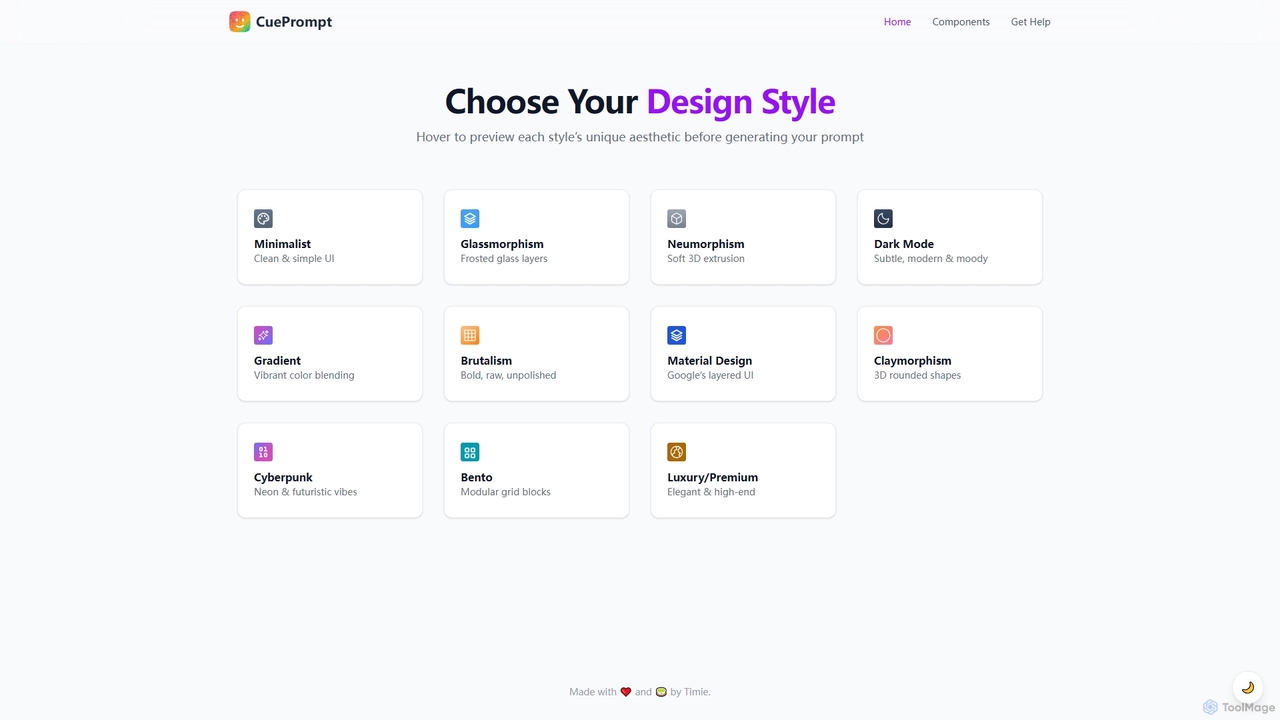
CuePrompt is an intuitive AI-powered tool designed to help designers and creators generate powerful and specific prompts for …

2.9K

About Prompt Generation

Prompt Generation tools are AI-powered utilities designed to create, refine, and optimize text-based instructions (prompts) for other generative AI models. They analyze simple user inputs and expand them into detailed, structured commands that AI systems can better understand. This process helps users achieve more precise, creative, and consistent results from platforms like image generators or large language models, bridging the gap between a simple idea and a high-quality AI-generated output. As a key part of the creative design process, these tools focus on crafting the perfect input to guide the AI's creation.

Core Features

  • Prompt Expansion: Automatically adds descriptive details, artistic styles, and technical parameters to a basic concept.
  • Style & Keyword Libraries: Offers pre-built collections of styles, artist names, camera settings, and other keywords to easily append to prompts.
  • Negative Prompt Generation: Suggests terms to exclude, helping to prevent unwanted elements, colors, or themes in the final output.
  • Prompt Optimization: Analyzes existing prompts for clarity and effectiveness, suggesting structural improvements for better AI model performance.
  • Multi-Model Syntax Support: Generates prompts formatted correctly for specific AI models, such as Midjourney, Stable Diffusion, or DALL-E.

Use Cases

These tools are widely used by digital artists, content creators, marketers, and writers. For example, an artist can use a prompt generator to ensure character consistency across multiple images. A marketer can create numerous variations of a prompt to generate diverse ad copy for A/B testing. Writers can use them to craft detailed scenarios for story generation.

How to Choose

When selecting a Prompt Generation tool, consider its compatibility with your preferred AI models. Evaluate the depth of its keyword libraries and customization options. Assess the user interface—some are simple generators, while others are complex builders. Finally, consider whether the tool has a community or sharing features, which can be a valuable source of inspiration and pre-made prompts.

Prompt GenerationUse Cases

1

Crafting Detailed Prompts for AI Art

A digital artist wants to create a photorealistic image of a 'cyberpunk detective in a rainy city' but keeps getting generic results. Using a prompt generation tool, they expand this basic idea. The tool suggests adding specific details like 'neon-lit alley,' 'glowing holographic signs,' 'dynamic lighting,' and technical parameters like '8K resolution.' It also recommends style keywords inspired by artists like 'Syd Mead' and adds negative prompts such as '-cartoon, -blurry, -painting' to refine the output. The resulting detailed prompt guides the AI to produce a highly specific, atmospheric image that matches the artist's vision, saving significant time on trial-and-error iterations.

2

Generating Diverse Marketing Copy Variations

A marketing specialist needs to create multiple ad headlines and social media posts for a new product launch. Instead of brainstorming manually, they use a prompt generator. They input a core product description, target audience ('young professionals'), and desired outcome ('drive website traffic'). The tool then constructs several prompt variations for a large language model, each specifying a different tone (e.g., 'professional and confident,' 'playful and witty,' 'urgent and benefit-driven'). This process generates over ten distinct ad copy options in minutes, providing a rich set of materials for A/B testing and accelerating the campaign deployment timeline.

3

Building Complex Prompts for Technical Writing

A developer needs to generate documentation for a complex API using a large language model. A simple request might yield incomplete or poorly formatted results. By using a prompt generator, the developer can structure a multi-part prompt. The tool helps them define the context (e.g., 'You are a senior software engineer writing documentation'), specify the programming language, provide examples of input and expected output (few-shot prompting), and set constraints on the output format (e.g., 'Format the response as a Markdown table'). This structured approach ensures the AI produces accurate, well-formatted technical content that requires minimal manual editing, improving both speed and quality.

4

Designing Consistent Characters for Storytelling

An author or game designer needs to generate multiple images of the same character in different poses and settings. Achieving consistency manually is challenging. A prompt generator helps create a detailed 'base prompt' for the character, locking in specific traits like 'wavy red hair, green eyes, a silver locket, and a leather jacket.' The tool then allows the user to easily add variables for actions or backgrounds (e.g., '...sitting at a desk,' or '...running through a forest') without altering the core character description. This method ensures the character's appearance remains consistent across dozens of generated images, which is critical for visual storytelling in graphic novels or game development.

5

Optimizing Prompts for Academic Research

A researcher is using a large language model to summarize scientific literature and extract key data points. Simple queries like 'summarize papers on climate change' are too broad. A prompt generation tool helps formulate a more precise and structured query. It assists in adding context ('acting as a research assistant'), defining the scope ('focus on papers published between 2020-2023'), specifying the required output ('extract the methodology, sample size, and key findings'), and requesting a specific format ('present in a table'). This turns a vague request into a robust research instruction, yielding highly relevant, structured information and significantly improving the efficiency of the literature review process.

6

Creating Structured Prompts for Business Reports

A business analyst needs to use an LLM to analyze quarterly sales data and generate a summary report. To ensure a comprehensive output, they use a prompt generator to build a step-by-step prompt. The tool helps structure the request into logical parts: 1) 'First, analyze the provided CSV data.' 2) 'Next, identify the top three performing products and the region with the highest growth.' 3) 'Then, summarize any significant downward trends.' 4) 'Finally, structure the entire output with an "Executive Summary", "Key Findings", and "Recommendations" section.' This structured prompting method guides the AI to perform a multi-step analysis and deliver a well-organized, actionable business report, automating a previously time-consuming task.

Prompt GenerationFrequently Asked Questions