ToolMage
Sign in

Best 1 Full Stack AI tools for Development

Popular Full Stack AI tools in Development include TemplateAI, helping you work more efficiently.

Paid

TemplateAI

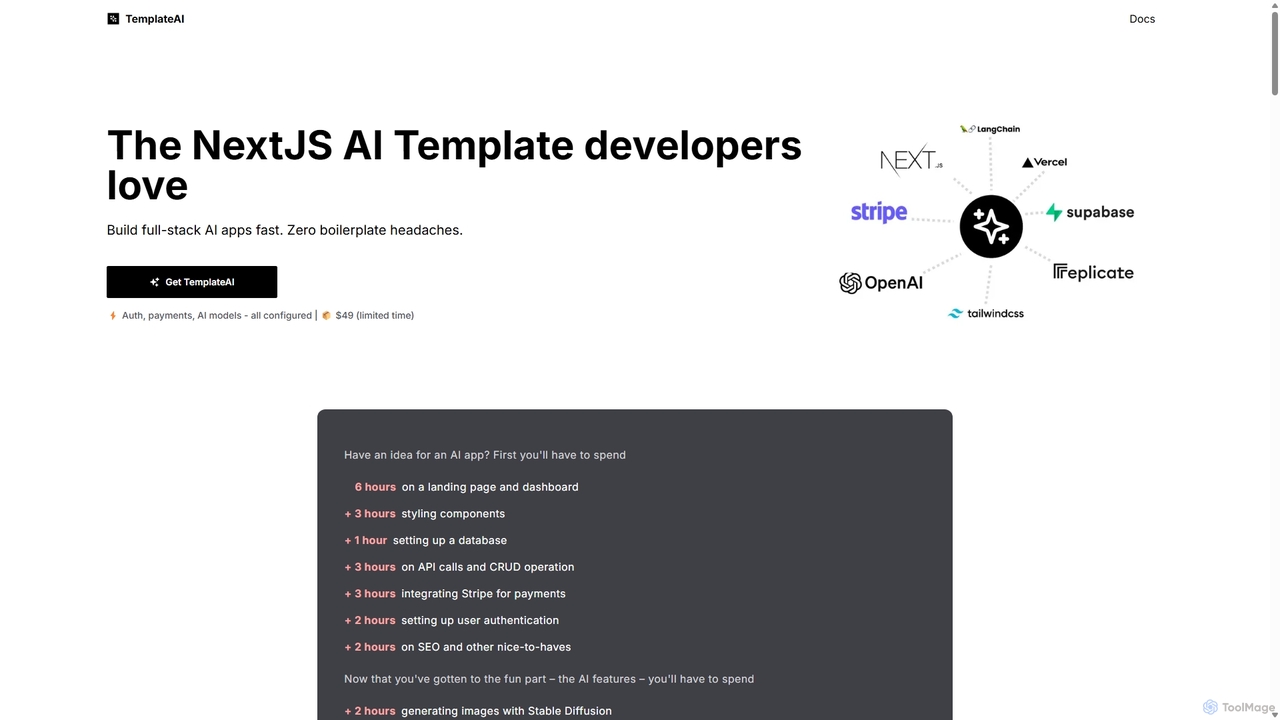
TemplateAI is a Next.js boilerplate for developers to rapidly build and launch full-stack AI applications. It eliminates tedious setup by providing pre-configured modules for user authentication, payments via Stripe, database management with Supabase, and a suite of AI integrations. This allows developers to focus on creating unique AI features like text generation, image creation, and vector search, significantly accelerating the development lifecycle from idea to production.

Boilerplate
Visits 4.4KFavorites 84Likes 97

About Full Stack

Full Stack AI tools are integrated platforms designed to manage the entire lifecycle of an AI application, from data preparation to model deployment and monitoring. These tools provide a unified environment that combines data engineering, model development, MLOps, and application deployment capabilities. Their primary value lies in streamlining the complex workflow of building production-ready AI, reducing the friction between different development stages. This end-to-end approach accelerates development cycles and simplifies the management of AI systems.

Core Features

  • Integrated Development Environment (IDE): A unified workspace for data exploration, coding, model training, and testing.
  • End-to-End MLOps Automation: Automates the entire machine learning lifecycle, including CI/CD for models, versioning, and governance.
  • Scalable Model Deployment: Tools to easily deploy models as scalable APIs, microservices, or on edge devices.
  • Multi-Framework Support: Compatibility with popular machine learning libraries like TensorFlow, PyTorch, and scikit-learn.
  • Performance Monitoring: Dashboards and alerts for tracking model accuracy, data drift, and operational health in real-time.

Use Cases

Full Stack AI platforms are ideal for teams and enterprises building complex, production-grade AI systems. They are commonly used by AI engineers and data science teams to develop recommendation engines, predictive analytics systems, and sophisticated conversational AI. Startups also leverage these platforms to rapidly prototype and deploy AI-powered MVPs (Minimum Viable Products) by consolidating their toolchain.

How to Choose

When selecting a Full Stack AI tool, consider the scope of its integration; ensure it covers all stages of your workflow. Evaluate its support for your preferred programming languages and ML frameworks. Assess the scalability and flexibility of its deployment options (cloud, on-premise, hybrid). Finally, consider the platform's learning curve and whether it aligns with your team's technical expertise, offering either code-first or low-code interfaces.

Featured tool rankings

Full Stack use cases

1

Build a Customer Churn Prediction System

A data science team at a SaaS company needs to develop a system to predict which customers are likely to cancel their subscriptions. Using a Full Stack AI platform, they can ingest customer usage data, preprocess it, train several classification models, and compare their performance in a unified environment. The best-performing model is then deployed as a REST API with a single click. The platform continuously monitors the model's accuracy and can trigger automatic retraining when performance degrades, ensuring the prediction system remains effective over time.

2

Develop an E-commerce Recommendation Engine

An AI engineer at an online retail company is tasked with creating a personalized product recommendation system. A Full Stack platform provides all the necessary tools in one place. It facilitates the management of large product catalogs and user interaction data, offers built-in algorithms for training collaborative filtering models, and simplifies deploying the engine for real-time inference. The integrated MLOps features also allow for continuous retraining of the model with new user data, keeping recommendations fresh and relevant, which helps increase user engagement and sales.

3

Rapid Prototyping of an AI-Powered Application

A startup founder wants to quickly build a Minimum Viable Product (MVP) for an AI-driven content summarization service. Instead of stitching together multiple separate services for data storage, model hosting, and an API gateway, they use a Full Stack AI platform. This allows them to upload a pre-trained summarization model, wrap it in a secure API endpoint, and connect it to a simple front-end application, all within hours. This integrated approach significantly accelerates time-to-market, enabling faster validation of the business idea with real users.

4

Automate Document Processing and Data Extraction

An enterprise IT department in a financial institution needs to automate the extraction of key information from thousands of invoices. A Full Stack AI platform allows them to build a complete pipeline. They can use the platform's data labeling tools to annotate a sample of documents, train a custom OCR and NLP model to identify fields like names and amounts, deploy this model as a microservice, and integrate it into their existing document management system. The platform's monitoring tools help track accuracy and flag documents that require manual review, creating a seamless human-in-the-loop workflow.

5

Manage and Govern AI Models at Scale

A large enterprise with multiple data science teams needs a centralized way to manage and govern their AI models. A Full Stack AI platform serves as a central model registry, providing version control, lineage tracking, and access control for all models. MLOps leads can enforce development standards, track model performance across different business units, and generate audit reports for compliance purposes. This centralized governance reduces operational risks, ensures consistency, and provides a single source of truth for all AI assets within the organization.

6

Create and Manage a Conversational AI Chatbot

A customer support manager wants to develop a sophisticated chatbot to handle common queries. A Full Stack AI platform provides an end-to-end solution. It includes tools for designing conversation flows, training a Natural Language Understanding (NLU) model on company-specific data, and integrating the chatbot with various channels like a website or messaging apps. The platform also offers analytics dashboards to monitor conversation logs, identify areas for improvement, and continuously refine the chatbot's performance without needing to manage separate NLU services, databases, and deployment infrastructure.

Full Stack FAQ

What are Full Stack AI tools?

Full Stack AI tools are integrated software platforms that provide an end-to-end environment for building, deploying, and managing AI applications. Unlike specialized tools that focus on a single task (like data labeling or model training), Full Stack platforms aim to cover the entire machine learning lifecycle. This typically includes data ingestion and preparation, model development and training, MLOps for automation and versioning, one-click deployment, and ongoing performance monitoring.

How do Full Stack AI tools differ from specialized AI development tools?

The primary difference is scope and integration. Specialized tools excel at one specific part of the AI workflow, such as a vector database for search or a library for model training. Full Stack AI tools integrate multiple of these functions into a single, cohesive platform. The main advantage of a Full Stack approach is reduced complexity and streamlined workflows, as teams don't need to manage and integrate multiple disparate tools. However, a specialized tool might offer deeper functionality or better performance for its specific task.

Who should use Full Stack AI platforms?

Full Stack AI platforms are best suited for:

  • Data Science and AI Teams: To streamline collaboration and accelerate the path from experimentation to production.
  • Enterprises: To standardize their AI development process, manage models at scale, and ensure governance and compliance.
  • Startups: To rapidly build and deploy AI-powered MVPs without the overhead of managing a complex tech stack.
  • Developers: Who want an integrated environment to build and deploy complete AI applications without needing to be an expert in every underlying technology.
What are the key features to look for in a Full Stack AI tool?

When evaluating a Full Stack AI tool, look for a comprehensive feature set that supports your entire workflow. Key features include a collaborative development environment (like Jupyter notebooks), robust data versioning and processing capabilities, integrated MLOps for CI/CD, flexible deployment options (e.g., cloud, on-premise, serverless), and real-time monitoring dashboards for tracking model performance and data drift. Also, consider support for popular frameworks (TensorFlow, PyTorch) and scalability to handle growing data and traffic.

Do I need strong coding skills to use Full Stack AI tools?

It depends on the specific platform. Many Full Stack AI tools are designed for developers and data scientists and require proficiency in languages like Python. However, a growing number of platforms offer low-code or no-code interfaces. These allow users with less technical expertise, such as business analysts or product managers, to build and deploy AI models using visual workflows and pre-built components. When choosing a tool, it's important to match its interface and required skill level to your team's capabilities.