metastory
metastory is an AI-powered platform designed for Product Owners and Business Analysts to accelerate and streamline the requirement …
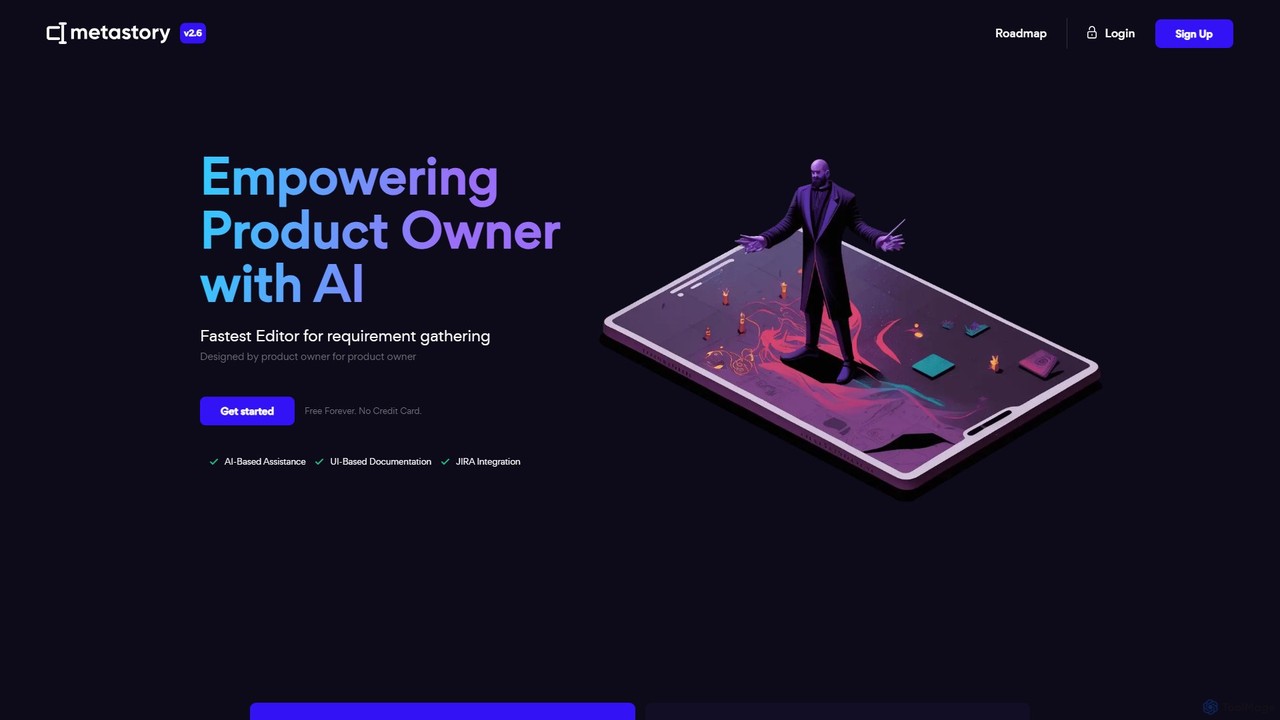
metastory is an AI-powered platform designed for Product Owners and Business Analysts to accelerate and streamline the requirement gathering process. It combines AI assistance for generating user stories and specs with UI-based documentation and seamless JIRA and Figma integration, acting as an intelligent pre-Jira tool.
About Requirements Management
Requirements Management tools are AI-powered solutions designed to streamline and enhance the entire lifecycle of project and product requirements. Leveraging advanced Natural Language Processing (NLP) and machine learning, these tools automate the extraction, analysis, documentation, and traceability of requirements. They significantly improve clarity, reduce ambiguities, and ensure alignment across development teams, ultimately accelerating project delivery and minimizing costly rework in software development and product management.
Core Features
- Automated Requirement Extraction: Intelligently identifies and extracts requirements from various unstructured sources like documents, emails, and user feedback.
- Intelligent Consistency & Completeness Checks: AI algorithms analyze requirements for ambiguities, conflicts, and missing information, suggesting improvements.
- Dynamic Traceability Management: Automatically establishes and maintains links between requirements, design elements, test cases, and code, ensuring comprehensive coverage.
- Predictive Impact Analysis: Assesses the potential ripple effect of proposed requirement changes on project scope, timeline, and resources.
- Version Control & Collaboration: Provides robust versioning for requirements and facilitates real-time collaboration among stakeholders with AI-assisted conflict resolution.
Use Cases
These tools are indispensable for software development teams, product managers, and project managers seeking to bring structure and intelligence to complex projects. They are particularly valuable in agile environments where requirements evolve rapidly, and in large-scale enterprise projects demanding rigorous compliance and traceability.
How to Choose
When selecting an AI Requirements Management tool, consider its core AI capabilities (e.g., NLP accuracy, machine learning models for analysis), integration with your existing ALM/PLM ecosystem, scalability to handle project complexity, and the flexibility of its customization and reporting features. Evaluate the user interface for ease of adoption and the vendor's support for continuous improvement of AI models.
Requirements ManagementUse Cases
Automated Requirement Gathering from User Feedback
Product managers can leverage AI Requirements Management tools to automatically analyze vast amounts of unstructured customer feedback from support tickets, social media, and forums. The AI extracts key pain points, feature requests, and user needs, transforming raw data into actionable, prioritized requirements for product development, saving hundreds of hours of manual review.
Ensuring Requirement Consistency in Large-Scale Projects
For complex software projects involving multiple teams and modules, software architects and business analysts use AI to scan thousands of requirements for inconsistencies, ambiguities, and potential conflicts. The AI flags problematic statements, suggests clarifications, and identifies overlaps, significantly reducing misinterpretations and costly rework during development.
Accelerating Traceability Link Creation and Maintenance
QA leads and project managers utilize AI tools to automatically establish and maintain traceability links between high-level business requirements, detailed functional specifications, design documents, and test cases. This ensures comprehensive test coverage and simplifies impact analysis, allowing teams to quickly identify affected components when a requirement changes, drastically cutting down manual linking efforts.
Predictive Impact Analysis for Change Requests
When a change request arises, project managers employ AI Requirements Management tools to instantly assess its potential impact. The AI analyzes existing requirements, dependencies, and historical project data to predict the effect on project scope, timeline, budget, and resource allocation, enabling informed decision-making and proactive risk mitigation.
Generating Detailed User Stories from High-Level Epics
Business analysts can input high-level epic requirements, and AI tools can automatically generate detailed, well-structured user stories with acceptance criteria. This capability accelerates the backlog refinement process, ensures consistency in story format, and helps development teams quickly understand and estimate work, bridging the gap between business needs and technical implementation.
Real-time Risk Identification in Requirement Specifications
Development leads and project managers use AI to continuously monitor requirement specifications for inherent risks. The AI identifies patterns indicative of high complexity, technical debt, or potential scope creep based on keyword analysis, historical project data, and dependency mapping. This allows teams to address potential issues early, before they escalate into major project blockers.