ToolMage
Sign in

Best 1 Web Applications for Development

Popular Web Applications in Development include Spaculus, helping you work more efficiently.

Spaculus
Paid

Spaculus

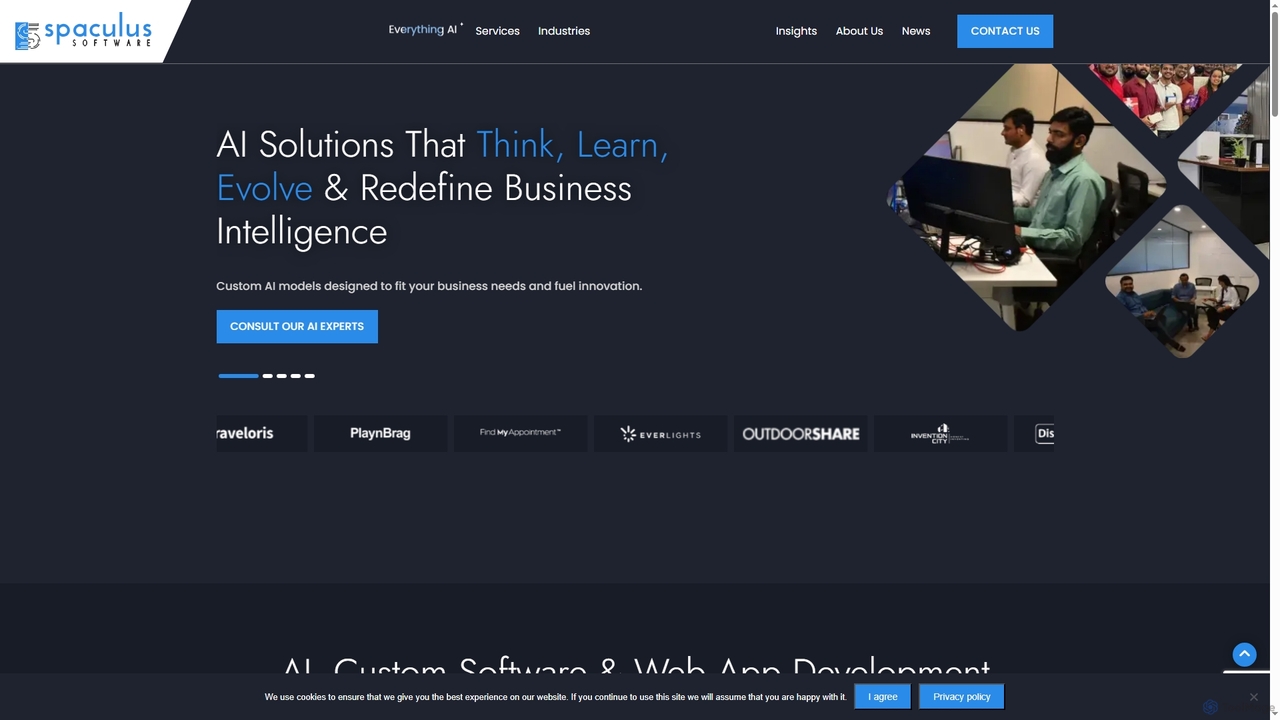
Spaculus is a leading technology company specializing in AI, custom software, and web app development. They provide tailored solutions including advanced AI models, machine learning, generative AI, and intelligent chatbots to help businesses automate processes, enhance decision-making, and drive innovation. They also offer mobile app development and expert AI engineering talent.

Generative Models
Visits 5.7KFavorites 111Likes 109

About Web Applications

Web Applications are AI-powered software solutions accessible directly through web browsers, eliminating the need for local installation. These tools integrate advanced AI models, such as natural language processing, computer vision, or machine learning, to deliver specialized functionalities. They serve as user-friendly interfaces for complex AI capabilities, enabling individuals and businesses to leverage artificial intelligence for various tasks without deep technical expertise. As a key outcome within the broader field of AI development, web applications democratize access to cutting-edge AI technologies.

Core Features

  • Browser-based Access: Users can access and utilize AI functionalities from any device with an internet connection and a web browser.
  • Intuitive User Interfaces: Designed for ease of use, often featuring drag-and-drop elements, clear input fields, and visual outputs.
  • Scalable AI Models: Leverage cloud-based AI infrastructure, allowing for dynamic scaling of computational resources based on demand.
  • Real-time Processing: Many web applications offer immediate feedback or results, processing user inputs and generating outputs in real-time.
  • API Integration: Often provide APIs for seamless integration with other software systems and workflows, enhancing automation.

Applicable Scenarios

Web applications are widely adopted across various sectors. Content creators use them for AI-driven writing assistance, image generation, or video editing directly in their browser. Marketing teams leverage AI web apps for sentiment analysis of customer feedback, automated ad copy generation, and predictive analytics. Developers and small businesses utilize these platforms for rapid prototyping of AI features, data analysis, and deploying custom AI models without extensive infrastructure setup.

How to Choose

When selecting an AI web application, consider its specific functionalities and how well they align with your needs. Evaluate the user interface for intuitiveness and ease of learning. Assess the underlying AI model's accuracy, speed, and customization options. Check for integration capabilities with your existing tools and workflows. Finally, compare pricing models, scalability options, and the level of customer support offered to ensure it meets both current and future requirements.

Featured tool rankings

Web Applications use cases

1

Automating Content Creation for Marketing

A digital marketing specialist needs to generate diverse social media posts, blog outlines, and email subject lines daily. Using an AI web application for content generation, they input keywords and topics, and the tool automatically drafts multiple variations. This significantly reduces the time spent on initial content ideation and drafting, allowing the specialist to focus more on strategy and refinement, boosting content output by 50%.

2

Enhancing Customer Support with AI Chatbots

An e-commerce business aims to provide 24/7 customer support without increasing staffing costs. They deploy an AI-powered web application chatbot on their website. This chatbot handles common customer inquiries, processes returns, and guides users through product selection, freeing up human agents for complex issues and improving customer satisfaction by reducing response times.

3

Streamlining Data Analysis for Business Intelligence

A business analyst needs to quickly extract insights from large datasets without extensive coding. An AI web application for data analysis allows them to upload data, select AI models for tasks like anomaly detection or predictive modeling, and visualize results through interactive dashboards. This accelerates the insight generation process, enabling faster, data-driven decision-making across departments.

4

Rapid Prototyping of AI Features for Developers

A software developer wants to test a new AI feature, such as an image recognition module, for a client project. Instead of building from scratch, they use an AI web application that provides pre-trained models or low-code AI development environments. This enables them to quickly integrate, test, and demonstrate the AI functionality, drastically cutting down development cycles and proof-of-concept time.

5

Personalizing User Experiences on Websites

An online publisher seeks to offer personalized content recommendations to its readers. They integrate an AI web application that analyzes user browsing history and preferences in real-time. The application then dynamically suggests articles, videos, or products tailored to each user, increasing engagement and time spent on the site by up to 30%.

6

Optimizing Supply Chain Logistics with Predictive AI

A logistics manager needs to forecast demand and optimize delivery routes to reduce operational costs. They utilize an AI web application that processes historical sales data, weather patterns, and traffic information. The application predicts future demand fluctuations and suggests optimal routing, leading to a 15% reduction in fuel consumption and improved delivery efficiency.

Web Applications FAQ

What are AI Web Applications?

AI Web Applications are software tools that leverage artificial intelligence capabilities and are accessible directly through a web browser. Unlike desktop software, they require no installation and run entirely online, utilizing cloud-based AI models for tasks such as natural language processing, image generation, data analysis, and automation. They provide user-friendly interfaces to complex AI technologies.

How do AI Web Applications differ from traditional web applications?

The primary difference lies in their core intelligence. Traditional web applications perform predefined tasks based on explicit programming rules. AI Web Applications, however, integrate machine learning models to learn from data, adapt, and perform tasks that require human-like intelligence, such as understanding natural language, recognizing patterns, or making predictions, often improving over time.

What are the main benefits of using AI Web Applications?

AI Web Applications offer several key benefits: ease of access (browser-based, no installation), scalability (cloud infrastructure handles varying loads), cost-effectiveness (often subscription-based, reducing upfront investment), and continuous updates (providers regularly improve AI models and features). They democratize AI, making powerful tools available to users without deep technical expertise.

How can I choose the best AI Web Application for my business?

To choose the best AI Web Application, first define your specific problem or task. Then, evaluate tools based on their core AI functionalities, accuracy, and relevance to your needs. Consider the user interface's intuitiveness, integration capabilities with your existing tech stack, and the provider's data privacy and security policies. Finally, compare pricing, scalability, and customer support.

Are AI Web Applications secure for sensitive data?

The security of AI Web Applications depends heavily on the provider. Reputable providers implement robust security measures, including data encryption (in transit and at rest), strict access controls, compliance with industry standards (like GDPR, HIPAA), and regular security audits. Always review a provider's privacy policy and security practices, especially when dealing with sensitive or proprietary data, to ensure they meet your organizational requirements.