
Onison
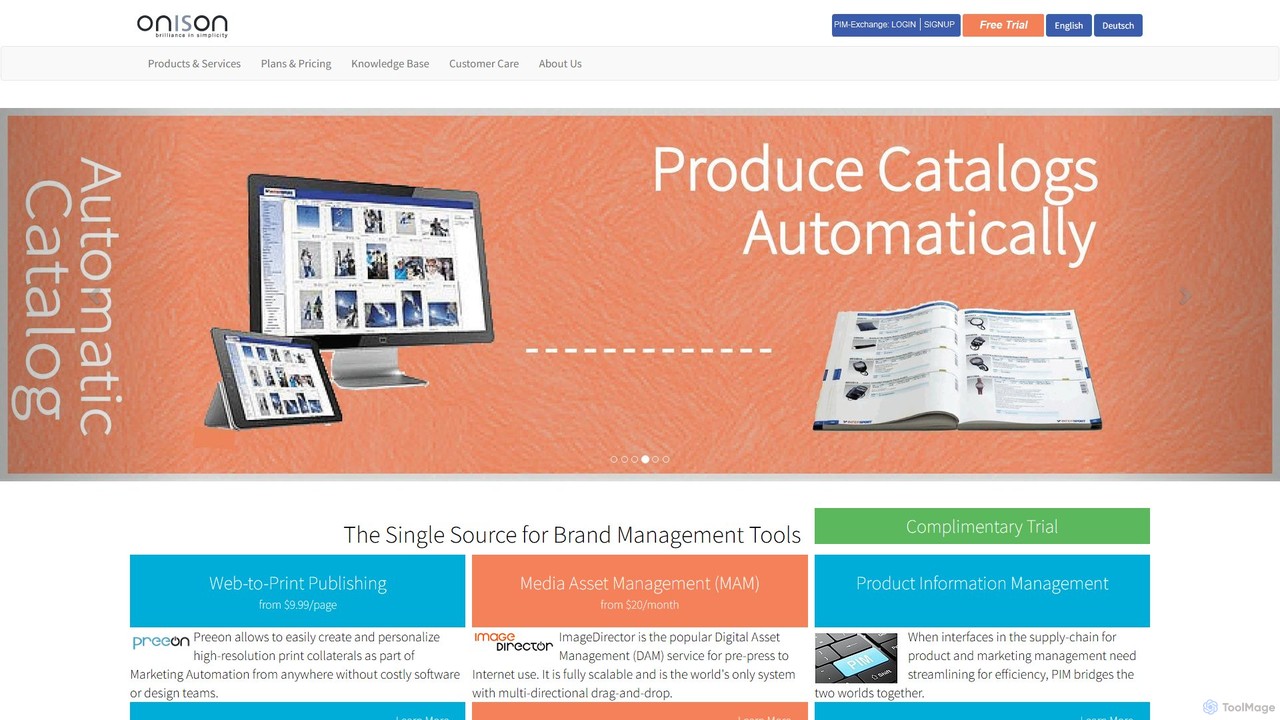
Onison is an integrated brand management and marketing automation platform. It combines Digital Asset Management (DAM), Web-to-Print (W2P), …
Onison is an integrated brand management and marketing automation platform. It combines Digital Asset Management (DAM), Web-to-Print (W2P), and Product Information Management (PIM) into a single source of truth. AI-powered features like background removal and semantic search help streamline workflows, ensure brand consistency, and automate the creation of marketing collateral.
About Catalog Management
Catalog Management tools are AI-powered solutions designed to centralize, enrich, and optimize product information for e-commerce businesses. These tools leverage artificial intelligence to automate data entry, categorize products, and enhance content quality across various sales channels. They significantly streamline the complex process of maintaining accurate and compelling product catalogs, ensuring consistency and improving customer experience in online retail.
Core Features
- Automated Data Ingestion: Automatically imports product data from diverse sources, reducing manual effort and errors.
- AI-Powered Categorization: Intelligently classifies products into appropriate categories and subcategories, improving searchability and navigation.
- Content Enrichment & Generation: Generates or enhances product descriptions, attributes, and tags using AI, ensuring rich and consistent product information.
- Image & Media Optimization: Automatically processes, tags, and optimizes product images and videos for various platforms.
- Data Quality & Validation: Identifies and corrects inconsistencies, duplicates, and missing information to maintain a high-quality catalog.
Applicable Scenarios
E-commerce businesses with extensive product portfolios utilize these tools to manage thousands of SKUs efficiently. Retailers expanding into new online marketplaces or international markets rely on them to quickly adapt product data to different platform requirements and languages. Brands aiming for a unified product presentation across their website, social media, and third-party sellers also benefit from centralized catalog control.
How to Choose
When selecting an AI Catalog Management tool, consider its integration capabilities with existing e-commerce platforms and ERP systems. Evaluate the breadth and depth of its AI features, such as automated content generation and data validation accuracy. Assess scalability to handle future catalog growth and the level of customization offered for specific product attributes. Finally, review user-friendliness and the quality of support provided.
Catalog ManagementUse Cases
Automating Product Data Onboarding for New SKUs
An e-commerce manager frequently adds new products to their online store. Instead of manually entering each product's details, they use an AI Catalog Management tool to automatically extract information from supplier feeds, generate initial descriptions, and assign categories, significantly reducing the time from product arrival to online availability.
Enhancing Product Descriptions for SEO and Conversion
A marketing specialist needs to optimize thousands of product descriptions for better search engine visibility and customer engagement. The AI tool analyzes existing data, suggests relevant keywords, and generates compelling, unique descriptions that highlight key features and benefits, leading to improved organic rankings and higher conversion rates.
Ensuring Consistent Product Information Across Multiple Channels
A multi-channel retailer sells products on their website, Amazon, and eBay. They leverage AI Catalog Management to maintain a single source of truth for all product data. The tool automatically synchronizes updates, adjusts formatting for each platform, and ensures brand consistency, preventing discrepancies and customer confusion.
Streamlining Product Categorization for Improved Navigation
A large online fashion store struggles with manually categorizing new apparel items, leading to inconsistent navigation. An AI Catalog Management system automatically analyzes product attributes and images to accurately assign items to the correct categories and subcategories, making it easier for customers to find what they're looking for.
Detecting and Correcting Data Quality Issues in Large Catalogs
A data analyst for a home goods retailer faces challenges with duplicate entries, missing attributes, and inconsistent pricing in their vast product catalog. The AI tool proactively scans the entire catalog, flags data quality issues, and suggests automated corrections, ensuring data accuracy and preventing costly errors.
Personalizing Product Recommendations with Enriched Data
An e-commerce platform aims to offer highly personalized product recommendations. By using AI Catalog Management to enrich product data with detailed attributes and tags, the platform's recommendation engine gains deeper insights, leading to more relevant suggestions for customers and increased sales.