Customily
Customily is a leading product personalization software for e-commerce businesses. It allows online stores to offer customers advanced …
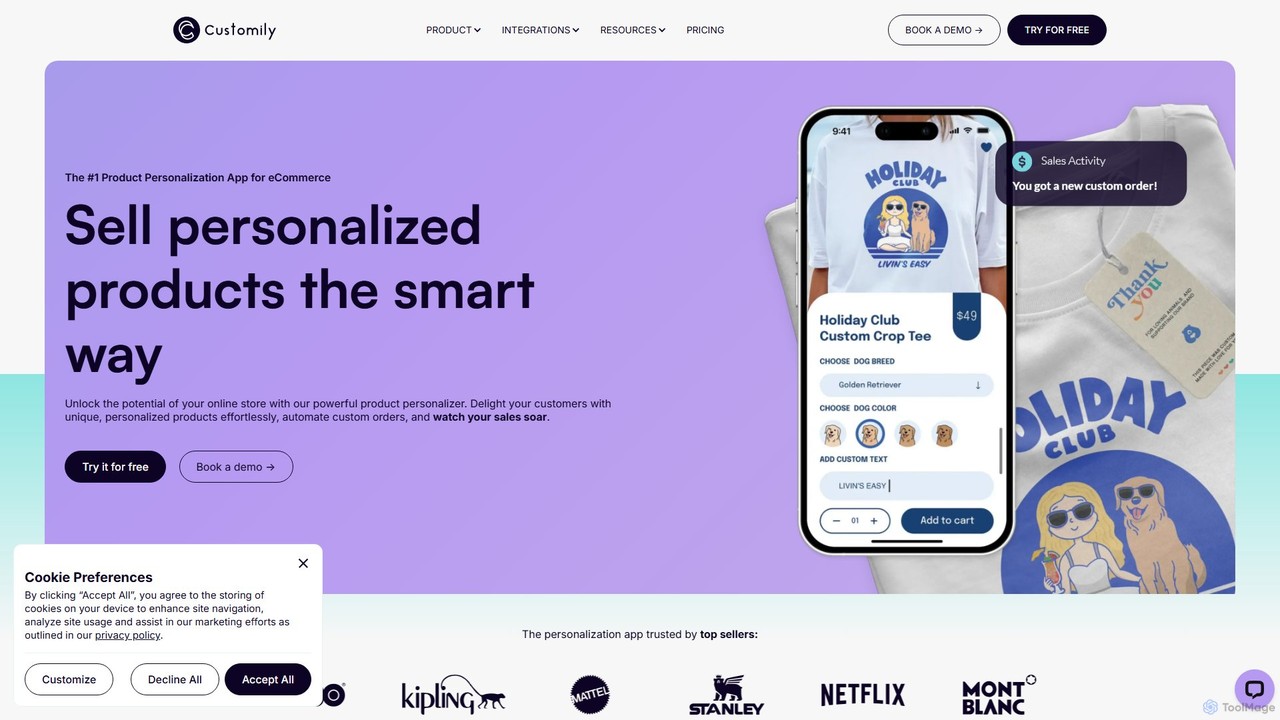
Customily is a leading product personalization software for e-commerce businesses. It allows online stores to offer customers advanced customization options with live previews, automating the creation of print-ready files to streamline fulfillment and boost sales.
About Product Customization
Product Customization tools are a specialized category of e-commerce software that enables customers to personalize products in real-time using artificial intelligence. These tools leverage technologies like generative AI, 3D rendering, and augmented reality to create interactive and dynamic customization experiences. By offering features such as virtual try-on and AI-driven design suggestions, they empower brands to increase customer engagement, reduce returns, and command higher prices for unique items. This moves beyond simple text or color pickers, allowing for truly co-created products.
Core Features
- Generative Design: Automatically creates unique patterns, images, or text styles based on user input.
- 3D & AR Visualization: Provides realistic 3D models and augmented reality previews of the customized product.
- Virtual Try-On (VTO): Allows customers to see how apparel, accessories, or cosmetics look on themselves.
- Dynamic Pricing: Instantly calculates and displays the price based on the complexity of the customizations selected.
- Automated Production File Generation: Creates print-ready or manufacturing-ready files from the customer's final design.
Use Cases
These tools are essential for direct-to-consumer (DTC) brands in industries like fashion, jewelry, home decor, and promotional products. E-commerce managers use them to offer personalized apparel, custom-engraved accessories, or configurable furniture. Print-on-demand businesses rely on them to automate the customer design process, from creation to production.
How to Choose
When selecting a tool, evaluate its integration capabilities with your e-commerce platform (e.g., Shopify, Magento). Consider the range and quality of customization options offered, such as 3D rendering vs. simple image overlays. Also, assess the user interface's intuitiveness for the end customer and the scalability of the platform to handle traffic and complex rendering tasks.

Product CustomizationUse Cases
Interactive T-Shirt Design for POD Stores
A print-on-demand (POD) store owner uses an AI Product Customization tool to empower customers. Instead of choosing from pre-made designs, a customer can type a prompt like 'a cat astronaut in a pop art style.' The AI generates several unique images, which the customer can then place on a t-shirt, adjust the size, and add text. The tool provides a live 3D preview on a model, ensuring satisfaction. This process transforms a passive shopping experience into an active co-creation, significantly boosting conversion rates and product appeal.
Virtual Try-On for Online Eyewear Retailers
An online eyewear brand integrates a Virtual Try-On (VTO) tool into its product pages. Customers can activate their webcam to see a live, realistic 3D model of any pair of glasses on their own face. The AI accurately maps the frames to their facial features, allowing them to turn their head and see the fit from different angles. This experience replicates the in-store mirror, builds purchasing confidence, and has been shown to reduce return rates by helping customers make more informed decisions about style and size.
Customizing Engagement Rings with 3D Previews
A high-end online jeweler allows clients to design their own engagement rings. Using a product customization tool, a customer can select the diamond cut, carat, clarity, and color, then choose the metal type and setting style. The tool renders a photorealistic 3D model of the ring in real-time with each selection. The customer can rotate and zoom in on the model to inspect every detail, including how the light reflects off the diamond. This detailed visualization is crucial for high-value purchases, providing transparency and a premium user experience.
AR Visualization for Furniture Customization
A home decor e-commerce site uses an AI tool to let customers customize sofas. A user can select the model, then choose from dozens of fabrics and colors. The key feature is the Augmented Reality (AR) button. By using their smartphone, the customer can project a true-to-scale 3D model of the customized sofa directly into their living room. This helps them verify if the size, style, and color match their existing decor, removing major purchase barriers and increasing average order value.
Personalizing Corporate Swag in Real Time
A marketing manager for a tech company needs to order branded merchandise for an upcoming event. They use a promotional products website equipped with a customization tool. The manager uploads the company logo, and the AI automatically suggests optimal placement on various items like notebooks, water bottles, and hoodies. They can change colors, add event-specific text, and see an instant 3D preview of each item. The tool also provides a bulk order quote that updates dynamically, streamlining the entire procurement process.
Configuring Custom Sneakers for Enthusiasts
A direct-to-consumer sneaker brand offers a 'design your own' experience. Sneakerheads can use a configurator to individually select the color and material for each part of the shoe—the sole, laces, tongue, heel, and side panels. The tool displays a high-fidelity 3D model that updates instantly with every change. The AI can also suggest trending color combinations or generate unique patterns for specific panels. This level of personalization creates a loyal community and allows the brand to sell premium, one-of-a-kind products.