E Commerce Best in category 1 results Product Data Management AI Tool

Popular AI tools in the Product Data Management field of E Commerce include CatalogIQ, etc., helping you quickly improve efficiency.

CatalogIQ

CatalogIQ

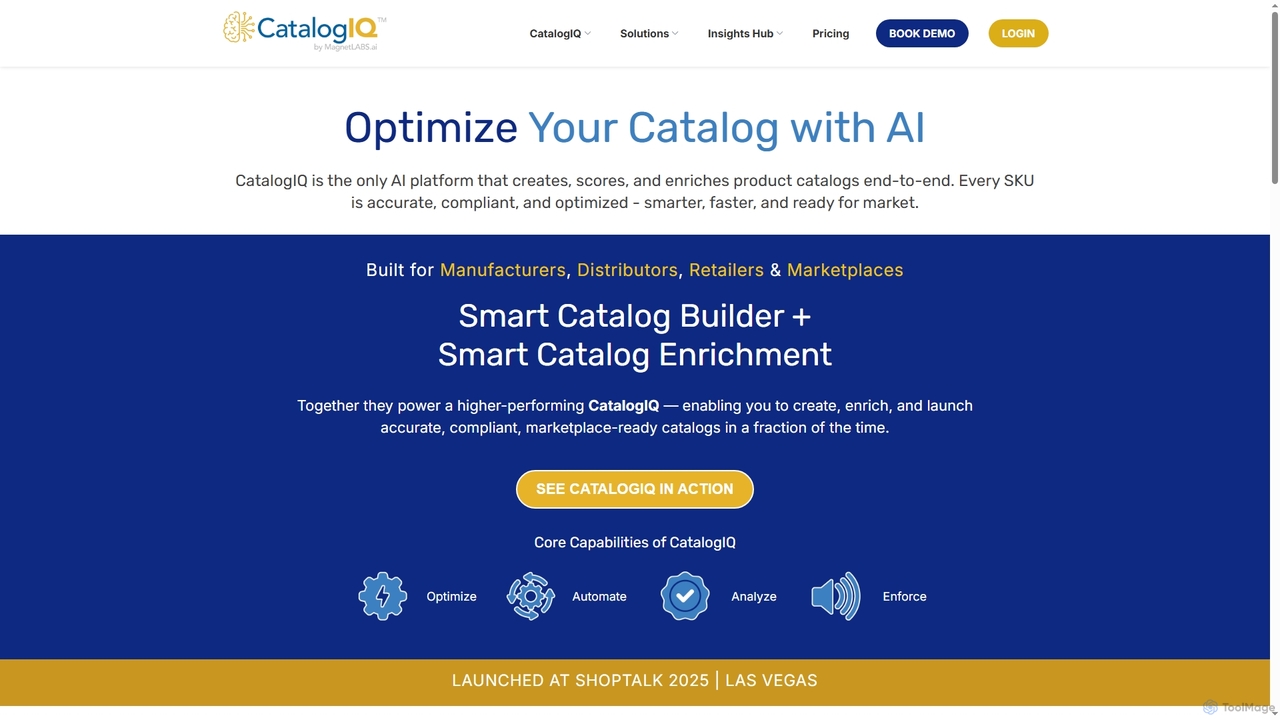
CatalogIQ is an AI-powered platform that optimizes e-commerce product catalogs by creating, scoring, and enriching product data end-to-end. …

4.4K

About Product Data Management

Product Data Management (PDM) tools are AI-powered solutions designed to centralize, standardize, and enrich product information across all sales channels. Leveraging artificial intelligence, these tools automate the extraction, classification, and maintenance of vast product catalogs, significantly improving data accuracy and consistency. They are crucial for e-commerce businesses aiming to streamline operations, accelerate product launches, and enhance the customer experience with reliable, up-to-date product details.

Core Features

  • Automated Data Extraction & Ingestion: AI automatically pulls product data from various sources like supplier feeds, ERPs, and legacy systems, reducing manual entry.
  • Intelligent Product Classification: Uses machine learning to categorize products accurately, even with inconsistent input, ensuring proper organization.
  • AI-Powered Data Enrichment: Automatically generates or suggests missing product attributes, descriptions, and metadata, enhancing product completeness and SEO.
  • Duplicate Detection & Resolution: Identifies and merges redundant product entries, maintaining a clean and consistent product catalog.
  • Multi-channel Syndication: Ensures consistent and accurate product information is automatically distributed to e-commerce platforms, marketplaces, and other sales channels.

Applicable Scenarios

Product Data Management tools are essential for e-commerce businesses, manufacturers, and retailers managing extensive and complex product catalogs. They are particularly valuable for organizations operating across multiple sales channels or international markets, where consistent and localized product information is critical. These tools streamline the process of onboarding new products, updating existing data, and ensuring compliance with various platform requirements.

How to Choose

When selecting an AI Product Data Management tool, consider its integration capabilities with your existing e-commerce platforms, ERP, and PIM systems. Evaluate the breadth and depth of its AI features, such as natural language processing for descriptions and computer vision for image tagging. Scalability, data governance features, and the ability to handle multi-language and multi-currency data are also crucial for long-term success.

Product Data ManagementUse Cases

1

Automating Product Description Generation for E-commerce

E-commerce content teams often spend significant time writing unique descriptions for thousands of products. AI PDM tools can automatically generate compelling, SEO-optimized product descriptions based on extracted attributes and predefined templates. This allows content creators to focus on refining and personalizing, drastically reducing time-to-market for new products and ensuring consistent brand voice across the catalog.

2

Standardizing Product Attributes from Diverse Suppliers

Retailers sourcing products from numerous suppliers face the challenge of inconsistent data formats and attribute naming conventions. An AI PDM system can ingest raw supplier data, intelligently extract key attributes (e.g., color, size, material), and normalize them into a standardized format. This ensures data consistency across the entire product catalog, simplifying search, filtering, and comparison for customers.

3

Synchronizing Product Information Across Multi-channel Sales

Brands selling on their own website, Amazon, eBay, and social media platforms struggle to keep product information consistent and up-to-date everywhere. AI PDM tools act as a central hub, allowing businesses to manage all product data in one place and automatically syndicate it to various channels. This prevents discrepancies, reduces manual updates, and ensures customers always see accurate information, regardless of where they shop.

4

Enhancing Product Image Metadata and Tagging with AI

For large product catalogs, manually tagging and categorizing images for search and discoverability is time-consuming. AI PDM solutions can use computer vision to automatically analyze product images, identify key features, and generate relevant tags and metadata. This improves internal organization, enhances site search capabilities, and supports visual merchandising efforts, making products easier for customers to find.

5

Expediting New Product Onboarding and Launch

Bringing new products to market quickly is vital for competitive e-commerce. AI PDM tools accelerate this process by automating data collection, enrichment, and validation. From ingesting initial supplier data to generating marketing-ready content and syndicating to sales channels, the entire workflow is streamlined, enabling businesses to launch new products faster and capitalize on market trends.

6

Detecting and Resolving Product Data Duplicates

Over time, large product catalogs can accumulate duplicate entries due to various data sources or manual errors, leading to confusion and inefficiencies. AI PDM systems employ advanced algorithms to identify and flag potential duplicate products, even with slight variations in naming or attributes. This allows data managers to review and merge duplicates, ensuring a clean, accurate, and efficient product database.

Product Data ManagementFrequently Asked Questions