Tire Robot
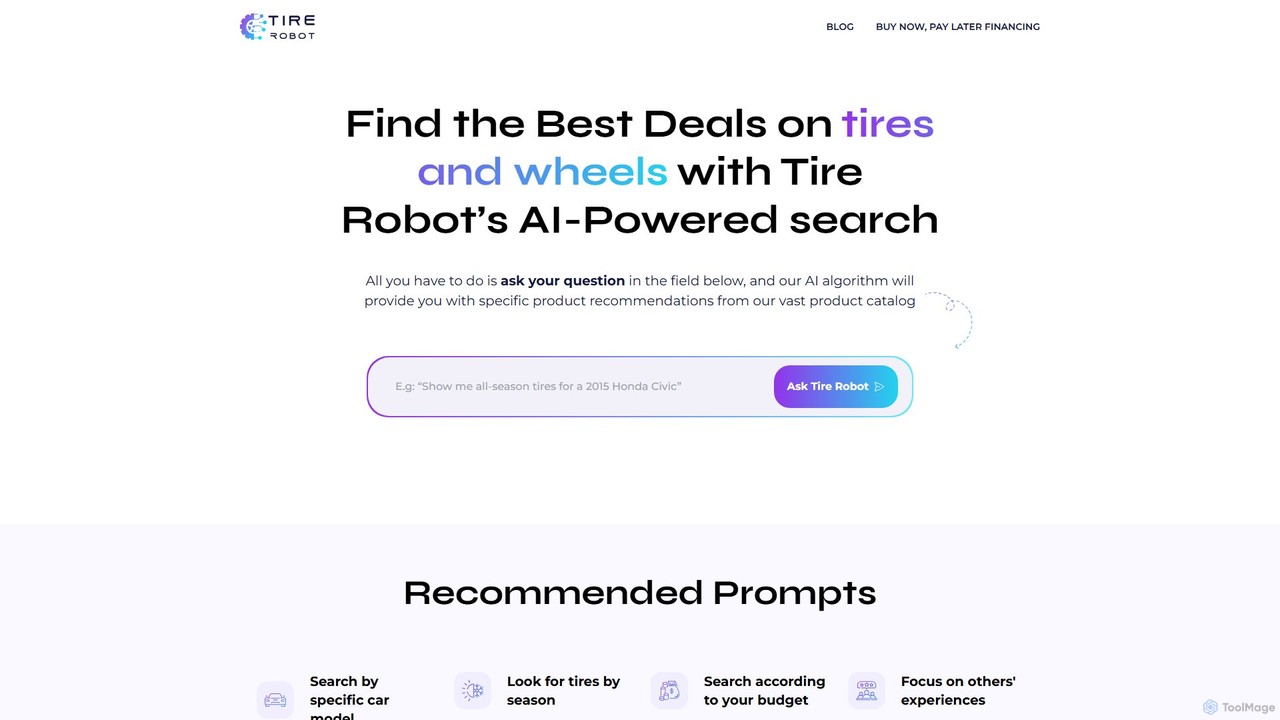
Tire Robot is a specialized AI-powered search engine designed to simplify the process of finding the best deals …
Tire Robot is a specialized AI-powered search engine designed to simplify the process of finding the best deals on tires and wheels. By using natural language queries, users can ask for recommendations based on their specific vehicle, budget, or performance needs, and receive personalized, data-driven suggestions from a vast product catalog.
About Search Engine
AI-powered Search Engines are advanced tools that leverage artificial intelligence to enhance information retrieval and discovery, particularly within the E-commerce domain. They utilize machine learning, natural language processing, and computer vision to understand user intent and deliver highly relevant, personalized results. These engines significantly improve user experience and conversion rates by making product discovery more intuitive and efficient for online shoppers.
Core Features
- Semantic Search: Understands the meaning and context of queries, not just keywords, to return more accurate results.
- Personalized Results: Tailors search outcomes based on individual user behavior, preferences, and past interactions.
- Visual Search: Allows users to search for products or information using images, identifying similar items or categories.
- Voice Search Optimization: Processes spoken queries, adapting to natural language patterns for hands-free searching.
- Predictive Search & Autocomplete: Offers intelligent suggestions and completes queries in real-time, improving search speed and accuracy.
Applicable Scenarios
AI search engines are crucial for online retailers, content platforms, and internal knowledge bases. They empower e-commerce sites to offer a superior product discovery experience, helping customers find exactly what they need even with vague descriptions. For content publishers, these tools enhance content discoverability, guiding users to relevant articles or videos.
How to Choose
When selecting an AI search engine, consider its relevance algorithm's accuracy, integration capabilities with existing platforms (like Shopify or Magento), scalability to handle growing data volumes, and customization options for specific business needs. Evaluate its support for various data types (text, image, voice) and its ability to provide actionable analytics on search performance.
Search EngineUse Cases
Enhancing E-commerce Product Discovery
Online retailers can leverage AI search engines to help customers find products more easily, even with vague or natural language queries. For instance, a shopper searching for 'comfortable shoes for long walks in summer' can receive tailored suggestions based on product attributes, customer reviews, and visual styles, significantly reducing bounce rates and increasing sales conversions by guiding them directly to relevant items.
Optimizing Internal Knowledge Base Search
Large organizations often struggle with employees finding relevant information within vast internal knowledge bases. An AI search engine can process complex technical documents, FAQs, and company policies, allowing employees to quickly retrieve precise answers using natural language queries. This reduces time spent searching, improves productivity, and ensures consistent access to accurate information across departments.
Personalizing Content Recommendations
Media companies and content platforms can utilize AI search engines to offer highly personalized content recommendations. By analyzing user viewing history, interactions, and preferences, the engine can suggest articles, videos, or music that align with individual tastes, leading to increased engagement, longer session durations, and improved user satisfaction across the platform.
Improving Customer Support with AI Search
Customer service departments can deploy AI search engines within their support portals or chatbots to provide instant, accurate answers to customer queries. By indexing FAQs, troubleshooting guides, and product manuals, the AI can quickly retrieve relevant information, reducing agent workload and improving customer satisfaction by offering self-service options and faster resolution times for common issues.
Analyzing Search Trends and User Behavior
Marketing and product teams can utilize AI search engines' analytical capabilities to gain insights into user search patterns, popular queries, and content gaps. By understanding what users are searching for and how they interact with results, businesses can identify emerging trends, optimize content strategies, and make data-driven decisions for product development and marketing campaigns, leading to better market fit and higher ROI.
Facilitating Research and Data Discovery
Researchers, analysts, and students can use AI search engines to efficiently sift through vast amounts of academic papers, reports, and datasets. These tools can identify key concepts, summarize findings, and connect disparate pieces of information across various sources, significantly accelerating the research process and enabling deeper insights that would be challenging to uncover with traditional search methods.