Howheavy
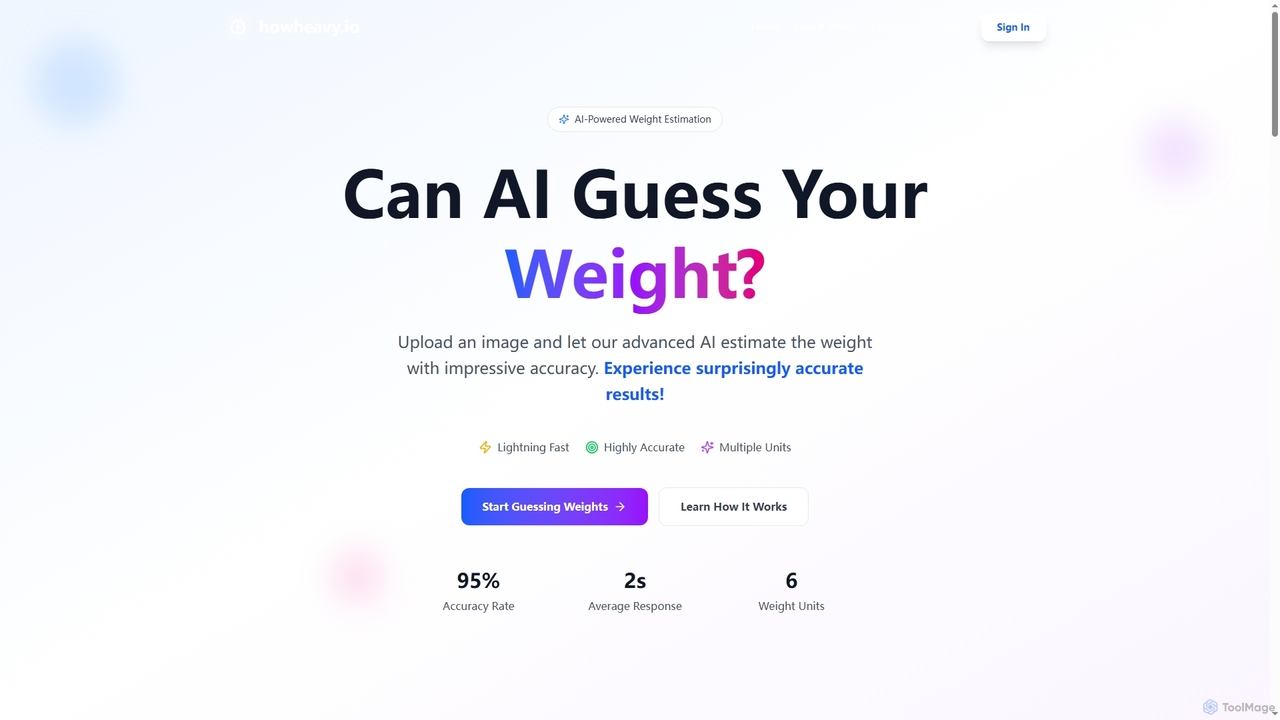
Howheavy is an AI-powered tool that accurately estimates the weight of objects, people, animals, and vehicles from a …
Howheavy is an AI-powered tool that accurately estimates the weight of objects, people, animals, and vehicles from a single image. It leverages advanced computer vision to deliver instant results with a 95% accuracy rate, supporting multiple units and ensuring user privacy.
About Shipping
AI Shipping tools are a specialized category of e-commerce software that uses artificial intelligence to optimize and automate the entire logistics process. These tools leverage machine learning algorithms to analyze historical data, predict delivery times, and select the most efficient shipping routes and carriers in real-time. Their primary value lies in reducing shipping costs, improving delivery speed and accuracy, and enhancing the post-purchase customer experience. By moving beyond simple rule-based automation, AI Shipping solutions provide dynamic, data-driven decision-making for complex logistical challenges.
Core Features
- Predictive Delivery Estimation: Utilizes AI to provide customers with more accurate and reliable delivery date estimates before and after purchase.
- Intelligent Carrier Selection: Automatically compares carrier rates, performance, and service levels in real-time to select the optimal option for each specific order.
- Dynamic Route Optimization: Calculates the most efficient delivery routes by analyzing traffic patterns, weather conditions, and delivery density.
- Automated Exception Handling: Proactively identifies potential shipping delays or issues and automates customer notifications or rerouting actions.
- Shipping Cost Analytics: Employs AI to analyze shipping expenditures, identify cost-saving opportunities, and forecast future logistics expenses.
Use Cases
These tools are essential for e-commerce businesses of all sizes, from direct-to-consumer brands to large online marketplaces. Logistics managers and fulfillment center operators use them to streamline daily operations, manage high order volumes during peak seasons, and reduce manual errors. They are particularly valuable for companies engaged in international shipping, where AI can simplify customs documentation and navigate complex carrier networks.
How to Choose
When selecting an AI Shipping tool, consider its integration capabilities with your existing e-commerce platform (like Shopify or Magento) and ERP systems. Evaluate the breadth of its carrier network and whether it supports the regions you ship to. Assess the sophistication of its AI features—does it offer true predictive analytics or just basic automation? Finally, examine the pricing model, whether it's based on shipment volume, a monthly subscription, or a percentage of cost savings.

ShippingUse Cases
Automate Multi-Carrier Rate Shopping
An e-commerce manager for a growing online brand needs to minimize shipping costs without sacrificing delivery speed. Instead of manually comparing rates on different carrier websites for each order, they use an AI shipping platform. The tool automatically analyzes each order's destination, package weight, and dimensions, then instantly selects the optimal carrier (e.g., USPS, FedEx, DHL) based on the best balance of price and delivery time. This process reduces shipping expenditure by 15-20% and saves hours of manual work each day.
Automating International Shipping and Customs
For an e-commerce store expanding globally, an AI Shipping tool automates the complex process of international logistics. When an order is placed from another country, the tool instantly calculates duties and taxes, selects the most reliable and cost-effective international carrier, and auto-generates the necessary customs forms (like commercial invoices). This eliminates manual data entry, reduces the risk of customs delays due to incorrect paperwork, and provides transparent shipping costs to the international customer, significantly improving their checkout experience.
Optimize Last-Mile Delivery Routes
A local courier service or a business with its own delivery fleet faces the challenge of planning efficient daily routes. Using an AI route optimization tool, a dispatcher can input all of the day's delivery addresses. The system then calculates the most efficient sequence and path for each driver, considering real-time traffic, vehicle capacity, and promised delivery windows. This leads to significant reductions in fuel consumption, lower vehicle wear and tear, and an increase in the number of successful on-time deliveries per day.
Optimizing Last-Mile Delivery Routes
A local business with its own delivery fleet uses an AI Shipping tool to plan daily routes. The logistics manager inputs all of the day's delivery addresses into the system. The AI algorithm then analyzes real-time traffic data, delivery time windows, and vehicle capacity to generate the most efficient route for each driver. This process, which used to take hours of manual planning, is now completed in minutes. The result is a significant reduction in fuel costs, shorter delivery times, and the ability to handle more deliveries per day with the same number of drivers.
Proactively Manage Delivery Exceptions
A customer service team at a large online retailer is overwhelmed with "Where Is My Order?" (WISMO) inquiries, especially during peak season. By implementing an AI shipping intelligence tool, the system monitors all outbound shipments in real-time. It automatically detects anomalies like a package stuck in transit or a potential customs delay. The system can then trigger an automated, personalized notification to the customer, informing them of the delay and providing a new ETA. This proactive communication reduces customer anxiety and lowers support ticket volume by over 30%.
Proactively Managing Delivery Exceptions
A customer service team at a large online retailer uses an AI Shipping tool to monitor all outbound shipments. The AI flags a shipment that is likely to be delayed due to a severe weather event along its transit route. Instead of waiting for the customer to complain, the system automatically sends a proactive notification to the customer, informing them of the potential delay and providing a new estimated delivery date. This transparency turns a potentially negative experience into a positive customer service interaction, building trust and reducing the volume of inbound support tickets.
Streamline International Shipping and Customs
A business expanding into global markets struggles with the complexity of international customs documentation. An AI shipping tool automates this process by correctly classifying products with HS codes, generating commercial invoices, and electronically submitting customs forms. The AI helps ensure all information is accurate and compliant with the destination country's regulations. This minimizes the risk of packages being held at customs, speeds up cross-border transit, and provides a smoother experience for international customers.
Dynamic Carrier Selection for Cost Savings
An operations manager for a mid-sized e-commerce brand needs to minimize shipping costs without sacrificing speed. Their AI Shipping tool analyzes each order in real-time based on package dimensions, weight, destination, and the customer's chosen delivery speed. The AI then queries multiple carriers (like FedEx, UPS, DHL, and regional couriers) to find the best rate that meets the delivery promise. This 'rate shopping' happens automatically for every single order, ensuring the company consistently uses the most cost-effective shipping label, saving thousands of dollars per month compared to using a single carrier or fixed shipping rules.
Enhance Customer Post-Purchase Experience
An e-commerce brand wants to improve customer loyalty after a sale is made. They integrate an AI-powered tracking and communications tool. Instead of sending customers a simple tracking number, the tool provides a branded tracking page with a visual map, real-time updates, and highly accurate, AI-predicted delivery dates. It also allows for sending personalized updates via email or SMS at key milestones (shipped, out for delivery, delivered). This creates a premium, transparent experience that encourages repeat purchases.
Improving Delivery Date Accuracy on Product Pages
A marketing team wants to increase conversion rates by displaying reliable delivery dates on product pages. They integrate an AI Shipping tool with their e-commerce site. The tool's AI analyzes the customer's location, product availability in different warehouses, and historical carrier performance to that specific zip code. It then generates a dynamic and accurate estimated delivery date (e.g., 'Get it by Friday, Oct 26'). This replaces vague promises like 'Ships in 3-5 days,' building customer confidence and measurably increasing the add-to-cart and conversion rates.
Reduce Costs from Incorrect Addresses
A fulfillment center frequently incurs extra charges from carriers due to incorrect or incomplete delivery addresses entered by customers. An AI shipping tool with address validation capabilities automatically checks and corrects addresses at the point of order entry or before a label is printed. It standardizes addresses to the postal service's format, identifies residential vs. commercial addresses to avoid surcharges, and flags potentially undeliverable addresses. This simple step prevents costly returns, re-shipping fees, and customer frustration.
Analyzing Shipping Performance and Costs
A finance analyst for an e-commerce company uses an AI Shipping tool's dashboard to gain insights into logistics operations. The tool provides detailed reports on key metrics, such as average cost per shipment, on-time delivery rates by carrier, and shipping costs as a percentage of revenue. The AI can identify trends, such as a specific carrier consistently underperforming in a certain region or a sudden increase in surcharges. These data-driven insights allow the company to negotiate better rates with carriers, optimize warehouse locations, and make strategic decisions to improve profitability.