
ToolMage
Sign in

Best 2 Admissions AI tools for Education

Popular Admissions AI tools in Education include Edupharma and IvyEdgeSOP, helping you work more efficiently.

IvyEdgeSOP
Free

IvyEdgeSOP

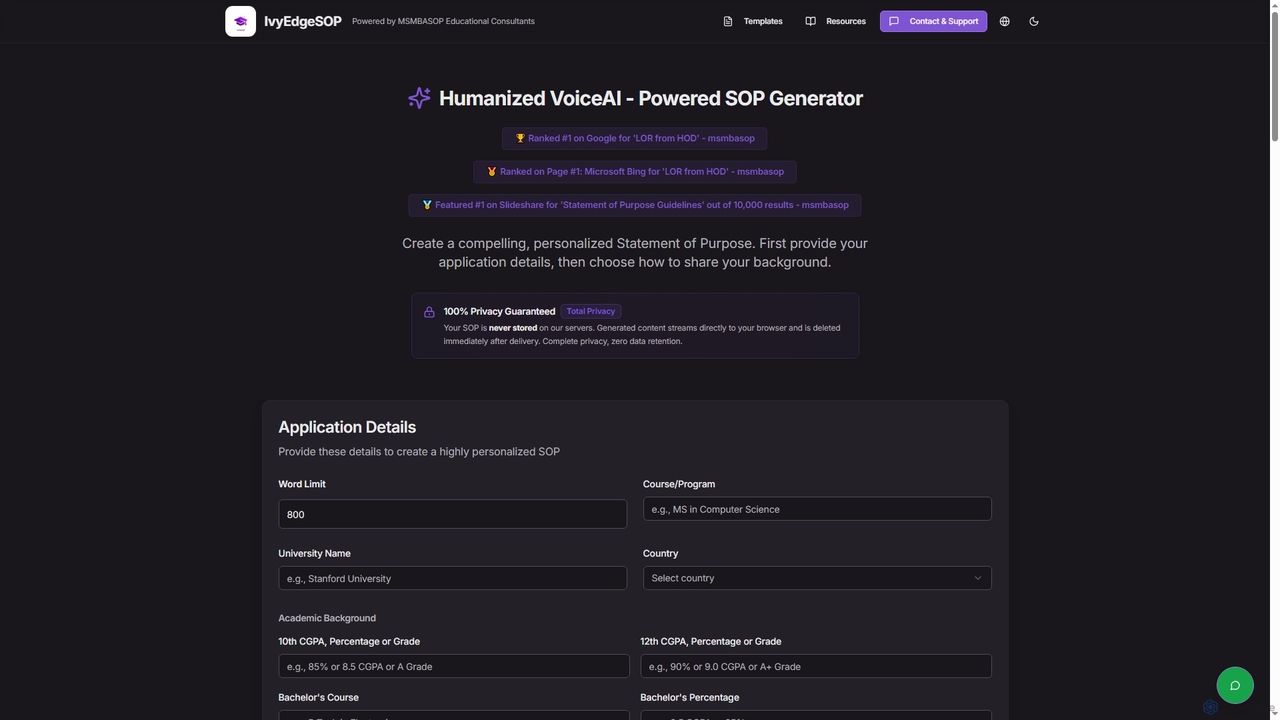
IvyEdgeSOP is a free, AI-powered platform designed to help students create personalized and compelling Statements of Purpose (SOPs) for graduate school applications. It ensures 100% privacy by not storing generated content and offers features like resume analysis, text input, and voice recording to craft unique application documents.

Application Tools
Visits 5.7KFavorites 120Likes 143
Edupharma
Freemium

Edupharma

Edupharma is an AI-powered educational consultancy dedicated to helping Indian pharmacy students pursue Master's degrees at prestigious universities worldwide. It provides guidance on admissions, university selection, scholarships, and application processes.

Guidance
Visits 5.8KFavorites 131Likes 129

About Admissions

Admissions AI tools are specialized artificial intelligence applications designed to streamline and enhance the student recruitment and enrollment processes within educational institutions. Leveraging machine learning and natural language processing, these tools automate tasks from applicant screening to personalized communication, significantly improving efficiency and decision-making in the broader education sector. They provide data-driven insights to identify best-fit candidates and optimize outreach strategies.

Core Features

  • Automated Application Screening: Efficiently review and filter large volumes of applications based on predefined criteria.
  • Predictive Enrollment Analytics: Forecast enrollment numbers and identify at-risk applicants using historical data.
  • Personalized Applicant Communication: Deliver tailored information and support to prospective students via chatbots or AI-driven email.
  • Virtual Admissions Assistants: Provide 24/7 support for common applicant queries, freeing up human staff.
  • Document Verification: Utilize AI to quickly and accurately verify submitted documents and credentials.

Applicable Scenarios

Admissions AI tools are invaluable for university admissions offices, college recruitment teams, and vocational training centers. They are used to manage high volumes of applications during peak seasons, personalize outreach to diverse student populations, and ensure equitable and efficient review processes. For example, a university can use these tools to identify promising international students or streamline the scholarship application process.

How to Choose

When selecting Admissions AI tools, consider the scope of automation needed, from initial inquiry to final enrollment. Evaluate the tool's integration capabilities with existing CRM and student information systems, its ability to handle diverse data types, and the level of customization offered for screening criteria and communication flows. Data security and compliance with educational privacy regulations are also crucial factors.

Admissions use cases

1

Automated Initial Applicant Screening

University admissions officers face thousands of applications annually. AI tools can automatically review submitted documents, transcripts, and essays against predefined criteria (e.g., GPA, test scores, specific keywords in essays). This process quickly identifies qualified candidates for further human review, reducing the manual workload by up to 70% and ensuring consistent evaluation standards across all applications.

2

Personalized Prospective Student Engagement

Recruitment teams aim to attract and retain student interest. Admissions AI-powered chatbots or virtual assistants can provide instant, personalized responses to inquiries about programs, campus life, or application deadlines 24/7. This proactive engagement keeps potential students informed and interested, leading to higher inquiry-to-application conversion rates by offering tailored information based on their expressed interests.

3

Predictive Enrollment Forecasting

Enrollment managers need accurate predictions to plan resources. AI tools analyze historical admissions data, demographic trends, and applicant behavior to forecast future enrollment numbers and identify factors influencing student matriculation. This allows institutions to adjust recruitment strategies, allocate scholarships effectively, and optimize class sizes, improving enrollment accuracy by 15-20%.

4

Streamlining Scholarship Application Review

Scholarship committees often review hundreds of applications with varying eligibility criteria. AI tools can rapidly process these applications, matching candidates to suitable scholarships based on academic merit, financial need, and specific essay content. This automation ensures that deserving students are identified more efficiently and equitably, significantly speeding up the award notification process.

5

Optimizing International Student Recruitment

International admissions departments navigate complex requirements and diverse cultural contexts. AI tools can help identify high-potential international markets, personalize outreach messages based on regional educational systems, and provide instant support for visa and documentation queries. This targeted approach enhances the institution's global reach and improves the conversion of international applicants.

6

Enhancing Admissions Interview Scheduling

Coordinating interviews for numerous applicants can be logistically challenging for admissions staff. AI-powered scheduling tools integrate with calendars, send automated reminders, and manage rescheduling requests efficiently. This reduces administrative overhead, minimizes no-shows, and provides a seamless experience for applicants, allowing staff to focus on qualitative assessments during interviews.

Admissions FAQ

What are Admissions AI tools?

Admissions AI tools are specialized artificial intelligence applications designed to automate, optimize, and personalize various stages of the student recruitment and enrollment process. They leverage technologies like machine learning, natural language processing, and predictive analytics to handle tasks such as application screening, personalized communication with prospective students, and enrollment forecasting, making the admissions journey more efficient and data-driven for educational institutions.

How do Admissions AI tools benefit educational institutions?

These tools offer significant benefits by reducing manual workload, improving the accuracy and consistency of application reviews, and enhancing the overall applicant experience. They enable institutions to process larger volumes of applications more quickly, identify best-fit candidates through data-driven insights, and engage prospective students with personalized, timely communication, ultimately leading to higher enrollment rates and better student retention.

What are the key features to look for in Admissions AI software?

When evaluating Admissions AI software, look for robust features such as automated application screening with customizable criteria, predictive analytics for enrollment forecasting, AI-powered chatbots or virtual assistants for 24/7 applicant support, and seamless integration with existing CRM and student information systems. Additionally, consider capabilities for personalized communication, document verification, and comprehensive reporting to track key metrics.

How do Admissions AI tools differ from traditional admissions software?

Traditional admissions software primarily digitizes existing manual processes, focusing on data storage and basic workflow management. Admissions AI tools, however, go beyond digitization by applying intelligence to data. They can learn from historical patterns, make predictions, automate complex decision-making processes (like initial screening), and personalize interactions, offering proactive insights and adaptive capabilities that traditional systems lack.

Can Admissions AI tools help with diversity and inclusion goals?

Yes, when properly designed and implemented, Admissions AI tools can support diversity and inclusion goals. By standardizing the initial screening process and reducing unconscious human bias, they can ensure all applicants are evaluated fairly based on objective criteria. Furthermore, AI can help identify underrepresented groups and tailor outreach efforts to encourage a more diverse applicant pool, provided the algorithms are trained on diverse and unbiased datasets.