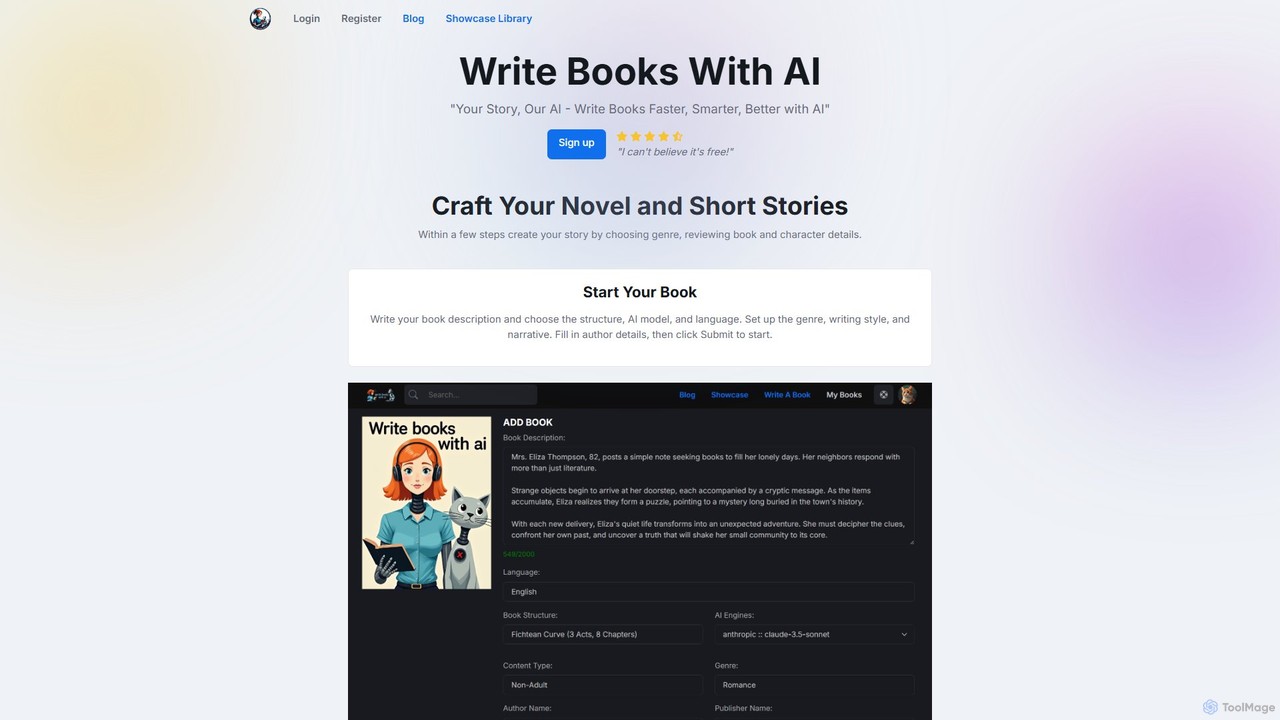
Write Books With AI
An AI-powered platform designed to help authors write novels and short stories faster and more efficiently. It provides …
An AI-powered platform designed to help authors write novels and short stories faster and more efficiently. It provides a structured, step-by-step process from initial idea and character creation to outlining, collaborative writing, and final export, helping to overcome writer's block and streamline the creative process.
About Authorship
AI Authorship tools are specialized applications designed to verify the originality, credibility, and proper attribution of written content. As a key component of educational technology, these tools utilize advanced algorithms to compare text against vast databases and detect similarities, potential plagiarism, and even AI-generated text. Their primary value lies in upholding academic integrity, streamlining the research process, and teaching proper citation practices. Many tools also offer features for citation management and source evaluation, making them essential for students, educators, and researchers.
Core Features
- Plagiarism Detection: Scans documents and compares them against billions of web pages, academic journals, and publications to identify non-original content.
- AI Content Detection: Employs sophisticated models to identify patterns and characteristics typical of text generated by large language models (LLMs).
- Citation Generation & Management: Automatically creates and formats citations in various styles (e.g., APA, MLA, Chicago) and helps organize research sources.
- Source Credibility Analysis: Evaluates the reliability and academic suitability of cited websites and sources.
Use Cases
These tools are indispensable in academic settings, from high schools to universities, for both students and instructors. Researchers and professional writers use them to ensure their manuscripts are original before submission to journals or publishers. Educational institutions also integrate them into Learning Management Systems (LMS) to automate originality checks for assignments.
How to Choose
When selecting an AI Authorship tool, consider the comprehensiveness of its database for plagiarism checking and the accuracy of its AI detection model. Evaluate the range of supported citation styles, integration capabilities with platforms like Google Docs or LMS, and the clarity of its originality reports. Finally, consider the pricing model—whether it's subscription-based, per-document, or part of a larger institutional package.

AuthorshipUse Cases
Verifying Originality of Student Essays
An educator at a university uses an AI Authorship tool integrated into their Learning Management System (LMS). When students submit their essays, the tool automatically scans each document for plagiarism against a vast academic database and the open web. It also flags sections that are likely generated by AI. The educator receives a detailed report highlighting problematic areas, similarity scores, and links to original sources, enabling them to uphold academic integrity standards efficiently and provide targeted feedback to students on proper citation.
Preparing a Research Paper for Publication
A postgraduate researcher is finalizing a manuscript for submission to a scientific journal. Before submitting, they use an AI Authorship tool to perform a final check. The tool helps them identify any instances of unintentional self-plagiarism from their previous works, ensures all sources are cited correctly in APA 7th edition format, and generates a comprehensive bibliography. It also analyzes the credibility of their online sources, suggesting replacements for any non-academic references. This process significantly reduces the risk of desk rejection due to formatting or originality issues.
Screening Manuscripts at an Academic Journal
An editorial assistant at an academic publishing house is responsible for the initial screening of submitted manuscripts. They use a professional-grade AI Authorship tool to process dozens of submissions daily. The tool provides a quick, reliable originality score for each paper, flagging those with high similarity for further review. This first-pass filter allows the editorial team to focus their time and expertise on scientifically sound and original research, streamlining the peer-review pipeline and maintaining the journal's reputation for quality and integrity.
Developing Citation Skills as a Student
A high school student learning to write research papers uses an AI Authorship tool as a learning aid. After writing a draft, they run it through the tool. The report shows them where they have forgotten to cite a source or have paraphrased too closely to the original text. The citation generator helps them correctly format their bibliography in MLA style. By reviewing the feedback and making corrections, the student actively learns the principles of academic honesty and proper attribution, building foundational skills for higher education.
Auditing Corporate and Legal Documents
A legal team at a corporation uses an AI Authorship tool to audit important internal and external documents, such as white papers, policy documents, and patent applications. The tool helps ensure that all information is properly attributed to its source, reducing the risk of copyright infringement. It also verifies that sensitive internal documents do not contain unattributed text copied from external, publicly available sources, which could pose a security or compliance risk. This provides an extra layer of due diligence for critical corporate communications.
Final Thesis and Dissertation Review
A PhD candidate is conducting a final review of their dissertation before submitting it to their committee. They use a comprehensive AI Authorship tool to perform a deep scan of the entire document, which can be hundreds of pages long. The tool checks for consistency in citations across all chapters, identifies any overlooked sources that need to be added to the bibliography, and provides a final originality report. This gives the candidate and their advisor confidence that the work meets the highest standards of academic integrity required for a doctoral degree.