
ToolMage
Sign in

Best 1 College Application for Education

Popular College Application in Education include Extracurrify, helping you work more efficiently.

Extracurrify
Freemium

Extracurrify

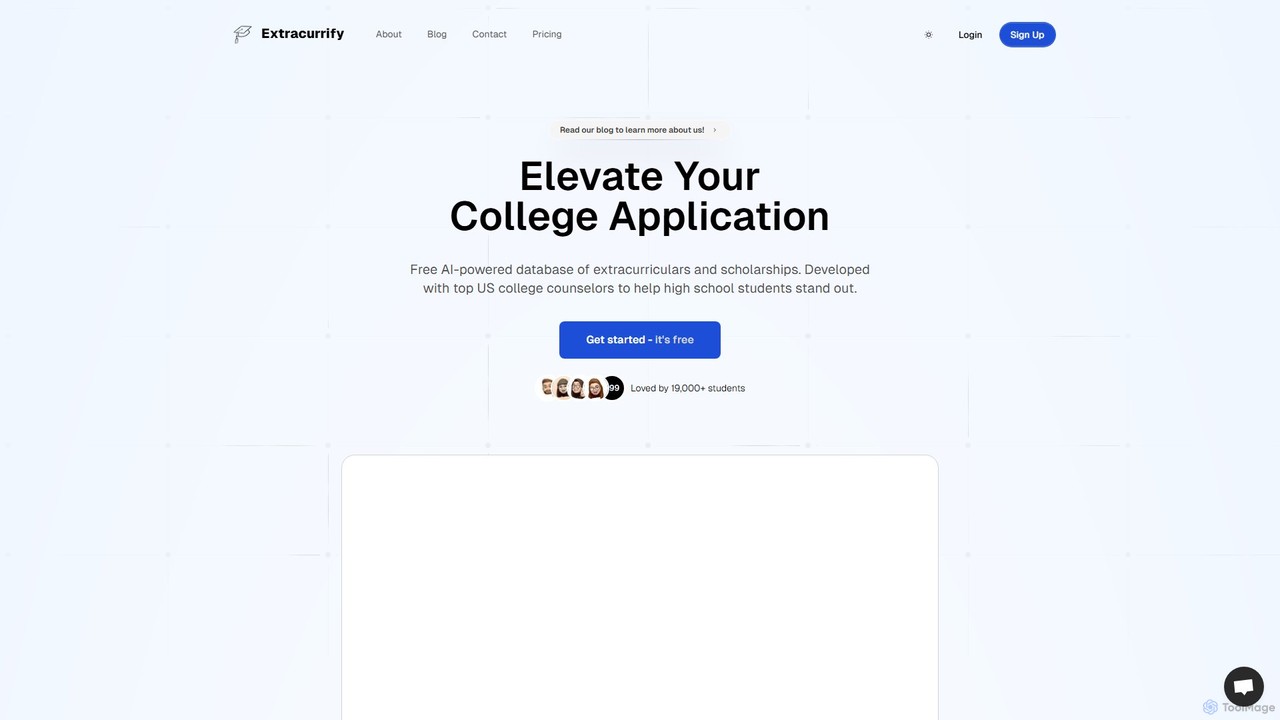
Extracurrify is an AI-powered platform designed for high school students to enhance their college applications. It offers a comprehensive, free database of extracurricular activities and scholarships, tailored to students' majors and interests. With an AI counselor, university generator, and personalized feedback, it helps students from all backgrounds build a standout profile for top universities.

Personal Assistant
Visits 8.9KFavorites 141Likes 147

About College Application

AI College Application tools are specialized platforms that leverage artificial intelligence to streamline and enhance the university admissions process. These tools utilize natural language processing (NLP) to analyze essays, machine learning to match students with suitable universities, and data automation to manage deadlines. They provide structured guidance, helping applicants craft compelling personal statements, track requirements, and prepare for interviews. This focused support aims to demystify the application journey and improve a student's chances of acceptance.

Core Features

  • Essay Analysis & Feedback: Provides instant suggestions on grammar, style, clarity, and structure for personal statements and supplemental essays.
  • Application Management: Organizes deadlines, checklists, and required documents for multiple universities in a centralized dashboard.
  • Interview Simulation: Offers a practice environment with common admission interview questions and provides feedback on responses and delivery.
  • University & Scholarship Matching: Recommends institutions and financial aid opportunities based on a student's academic profile, interests, and preferences.
  • Activity List Optimization: Helps students articulate their extracurricular experiences effectively to highlight impact and leadership.

Use Cases

These tools are primarily used by high school students preparing for undergraduate admissions, as well as transfer students and prospective graduate students. High school counselors and independent educational consultants also use these platforms to manage their caseloads, providing data-driven advice to multiple students efficiently. They are particularly valuable for navigating the complexities of applications to different countries or highly selective programs.

How to Choose

When selecting an AI College Application tool, consider the depth and quality of its essay feedback; some offer basic grammar checks while others provide sophisticated content analysis. Evaluate the comprehensiveness of its university database and deadline tracking features. Assess the quality of the interview preparation module. Finally, review the tool's data privacy policy to ensure personal information is handled securely.

College Application use cases

1

Refining Personal Statements with AI Feedback

A high school senior is struggling to articulate their personal story for the Common App essay. They upload their draft to an AI College Application tool. The AI provides immediate feedback, highlighting run-on sentences, suggesting stronger vocabulary, and analyzing the essay's tone for sincerity. It also checks if the narrative effectively answers the prompt. The student uses this iterative feedback to revise their essay multiple times, transforming a rough draft into a polished, compelling personal statement that clearly reflects their character and aspirations, significantly strengthening their application.

2

Managing Multiple Application Deadlines

A student is applying to ten different universities, each with unique deadlines for early action, regular decision, scholarships, and financial aid. Manually tracking this is overwhelming. They use an AI application management tool to input all their target schools. The platform automatically populates a calendar with every critical date and sends personalized reminders. It creates a master checklist of required documents for each application, such as transcripts and recommendation letters. This centralized system prevents missed deadlines and reduces stress, allowing the student to focus on the quality of their applications rather than logistics.

3

Practicing for Admission Interviews

An international student is preparing for a video interview with a highly selective university. They are nervous about their English fluency and ability to answer behavioral questions. Using an AI interview simulator, they practice answering common questions like "Tell me about a time you faced a challenge." The tool records their responses and provides feedback on their pacing, use of filler words (e.g., "um," "like"), and the clarity of their answers. After several practice sessions, the student gains confidence, refines their talking points, and feels much more prepared to present their best self during the actual interview.

4

Discovering Best-Fit Scholarships

A family is concerned about the high cost of tuition and needs to find financial aid opportunities. Instead of manually searching through countless scholarship websites, they use an AI tool's scholarship matching feature. They input the student's GPA, test scores, intended major, extracurricular activities, and demographic information. The AI algorithm scans a vast database and generates a curated list of scholarships for which the student is a strong candidate. This saves dozens of hours of research and uncovers niche scholarships they might have otherwise missed, increasing their chances of securing funding.

5

Building a Cohesive Extracurricular List

A student has participated in many activities but struggles to describe them concisely and powerfully for their application's activity section. They use an AI tool that suggests strong action verbs and helps frame each activity to highlight leadership, initiative, and impact. For example, instead of "Member of the debate club," the tool suggests, "Collaborated with a team of 10 to research and formulate arguments, achieving a 3rd place finish in the regional tournament." This transforms a simple list into a compelling narrative of their skills and accomplishments, providing admissions officers with a clearer picture of their potential.

6

Comparing University Admission Requirements

A guidance counselor is advising 50 students, each with a different list of target universities. Keeping track of the specific GPA, test score ranges, and essay prompts for each school is a logistical challenge. The counselor uses an AI-powered platform to create a dashboard for each student. This dashboard aggregates and compares the admission requirements from all their chosen schools side-by-side. It visualizes how a student's profile stacks up against the average admitted student for each university, helping to categorize schools as 'reach,' 'target,' or 'safety.' This data-driven approach allows the counselor to provide more accurate and personalized advice efficiently.

College Application FAQ

What are AI College Application tools?

AI College Application tools are software platforms designed to assist students with the university admissions process. They use artificial intelligence to provide services like essay analysis, deadline management, interview practice, and matching students with suitable universities and scholarships. Their primary goal is to organize the complex application process and help students present their qualifications more effectively, rather than creating content for them.

Can AI write my college application essay for me?

No, and using AI to write your essay is considered academic dishonesty and plagiarism by universities. AI College Application tools are designed to be writing assistants, not ghostwriters. They help you improve your own work by providing feedback on grammar, style, structure, and clarity. The personal statement must be your own authentic story and voice. Using AI to generate the essay undermines the purpose of the application and can lead to severe consequences, including rejection or expulsion.

How do I choose the right AI College Application tool?

Choosing the right tool depends on your specific needs. Consider the following factors:

  • Essay Feedback Quality: Does it offer basic grammar checks or in-depth analysis of content, tone, and structure? Look for tools that provide actionable suggestions.
  • Feature Set: Do you need only an essay editor, or also a deadline tracker, interview simulator, and scholarship finder? Choose a tool with the features you will actually use.
  • User Interface: Is the platform intuitive and easy to navigate? A complicated interface can add stress to the process.
  • Cost: Compare pricing models. Some offer one-time fees, while others are subscription-based. Determine your budget beforehand.
  • Data Privacy: Ensure the tool has a clear privacy policy regarding how your personal and academic data is stored and used.
What's the difference between an AI application tool and a general grammar checker?

A general grammar checker, like Grammarly or the one built into word processors, primarily focuses on correcting syntax, spelling, and punctuation errors. An AI College Application tool goes much further. It is specifically trained on successful application essays and understands the context of admissions. It can provide feedback on higher-level aspects like the essay's narrative structure, clarity of argument, tone, and relevance to a specific prompt. Many also include application management features that grammar checkers lack.

Are AI College Application tools secure to use?

Security is a critical consideration. Reputable AI College Application tools use encryption and secure servers to protect your data. However, you are sharing sensitive personal and academic information. Before using any tool, it is essential to read its privacy policy and terms of service. Understand how your data will be stored, used, and whether it will be shared with third parties. Choose platforms that are transparent about their security measures and have a strong reputation for protecting user privacy.