Review My eLearning
An AI-powered platform designed to streamline the review and collaboration process for eLearning courses. It offers centralized feedback, …
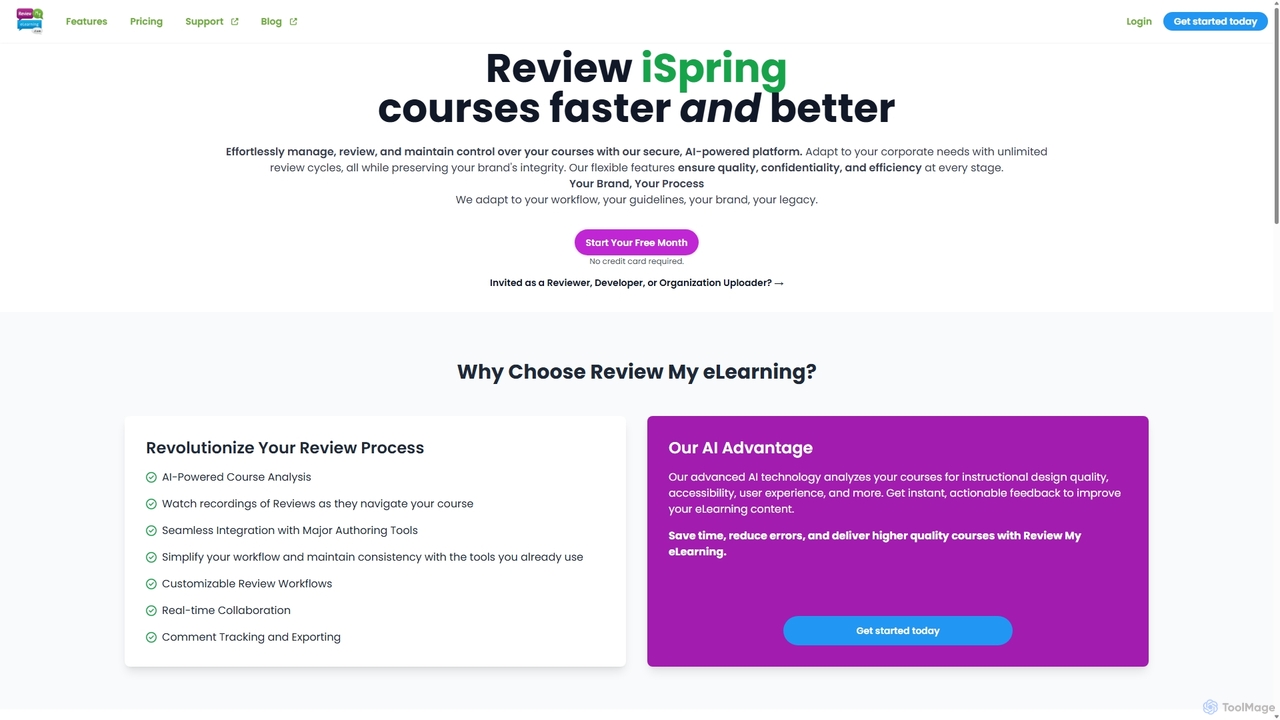
An AI-powered platform designed to streamline the review and collaboration process for eLearning courses. It offers centralized feedback, real-time collaboration, AI-driven course analysis, and user interaction replays to help instructional designers and developers create higher-quality content faster. It supports courses from all major authoring tools.
About Course Development
AI Course Development tools are a class of software designed to automate and accelerate the creation of educational content. They leverage generative AI models to produce course outlines, lesson text, quiz questions, and multimedia scripts from simple prompts. This enables educators, corporate trainers, and content creators to build engaging and structured learning experiences more efficiently. These tools often integrate with Learning Management Systems (LMS) and support various instructional design models, significantly reducing development time.
Core Features
- Curriculum & Outline Generation: Automatically creates structured course outlines, modules, and learning paths based on a topic.
- Automated Content Creation: Generates lesson text, explanations, summaries, and examples for each section of the course.
- Assessment & Quiz Production: Designs multiple-choice questions, true/false statements, and open-ended prompts to evaluate learner understanding.
- Multimedia Scripting: Writes scripts for video lessons or generates content for presentation slides.
- Learning Objective Formulation: Helps define clear, measurable learning goals and outcomes for the course.
Use Cases
These tools are primarily used by corporate learning and development (L&D) departments, instructional designers, online course creators, and academic institutions. They are ideal for rapidly developing employee onboarding programs, creating certification courses, converting existing documentation into training modules, and designing curricula for online learning platforms.
How to Choose
When selecting an AI Course Development tool, consider the quality and accuracy of the generated content, its ability to customize tone and style, and integration capabilities with your existing LMS (e.g., Moodle, Canvas). Also evaluate the range of supported output formats (like SCORM, xAPI, PDF), the user interface's ease of use, and the pricing model's scalability for your needs.
Course DevelopmentUse Cases
Rapid Corporate Training Program Development
An L&D specialist in a large corporation needs to create a mandatory compliance training module for 500 employees within two weeks. Using an AI Course Development tool, they input the company's policy documents and key learning objectives. The AI generates a complete course structure, drafts all lesson content, and creates a 20-question assessment quiz. The specialist then spends a few hours reviewing and refining the content, launching the course in just three days instead of the typical three weeks, ensuring timely compliance.
Creating an Online Course for Monetization
A subject matter expert in digital marketing wants to create and sell an online course. Lacking formal instructional design experience, they use an AI tool to structure their expertise. They provide a list of core topics, and the AI generates a comprehensive curriculum, including engaging module titles, learning objectives, and video scripts for each lesson. It also suggests interactive activities and quiz questions. This allows the expert to focus on recording high-quality content, launching their course on a platform like Udemy in weeks instead of months.
Converting Existing Documentation into Training Modules
A software company has extensive technical documentation but lacks a structured onboarding program for new developers. An instructional designer uses an AI course development tool to process the documentation library. The tool analyzes the content, identifies key concepts, and automatically organizes it into a logical learning path with modules like 'Getting Started', 'Core Features', and 'Advanced APIs'. It also generates summaries and short quizzes for each module, transforming static documentation into an interactive and effective training resource with minimal manual effort.
Generating Diverse Assessment Questions
An educator preparing for final exams needs to create a large bank of unique questions to prevent cheating and test a wide range of knowledge. They provide the AI tool with lecture notes and key textbook chapters. The AI generates hundreds of varied questions, including multiple-choice, true/false, and short-answer formats, all mapped to specific learning objectives. This saves the educator dozens of hours of tedious work and provides a robust set of assessments to ensure fair and comprehensive evaluation of student performance.
Creating Microlearning Content for Mobile
A company wants to provide on-the-go training for its sales team. A training manager uses an AI course developer to repurpose a lengthy sales manual into a series of microlearning modules. The AI breaks down complex topics into bite-sized lessons, generates short explainer video scripts, and creates quick knowledge-check quizzes. The output is optimized for mobile viewing, allowing salespeople to complete a 5-minute lesson while waiting for a client, boosting knowledge retention and application in the field.
Localizing Training Content for Global Teams
A multinational corporation needs to deploy a new software training program to its offices worldwide. The initial course is created in English using an AI development tool. Subsequently, the same tool is used to translate and localize the content into Spanish, German, and Japanese. The AI not only translates the text but also suggests culturally relevant examples and adjusts the tone where necessary. This ensures a consistent yet locally-adapted learning experience for all employees, accomplished in a fraction of the time and cost of traditional translation services.