
MakerBox
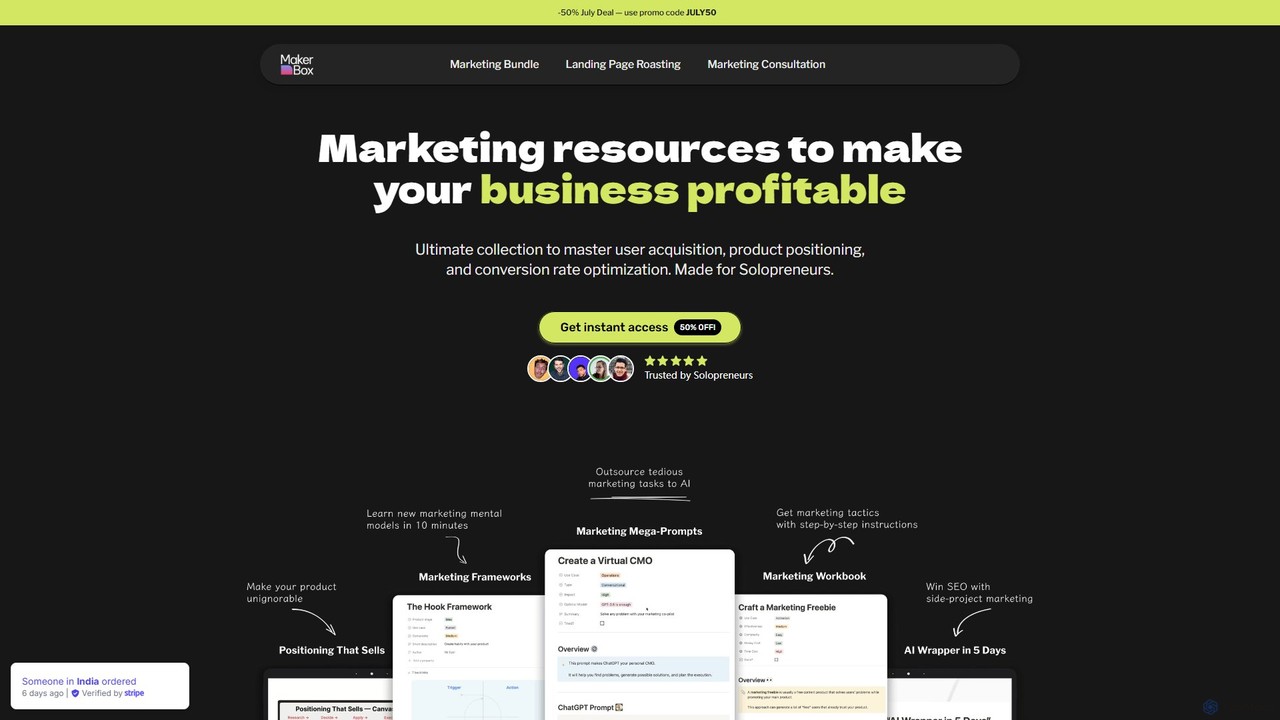
MakerBox is a comprehensive suite of marketing resources, AI-powered tools, and expert services designed for solopreneurs and bootstrapped …
MakerBox is a comprehensive suite of marketing resources, AI-powered tools, and expert services designed for solopreneurs and bootstrapped founders. It provides ChatGPT mega-prompts, actionable workbooks, proven frameworks, video courses, and personalized services like landing page reviews and strategy calls to simplify marketing and accelerate growth.
About Courses
AI Courses are educational platforms that use artificial intelligence to deliver personalized and adaptive learning experiences. These tools analyze a learner's performance in real-time to customize curriculum, provide instant feedback, and adjust difficulty levels. This creates a highly efficient and engaging educational journey tailored to individual needs and learning paces, moving beyond the one-size-fits-all model of traditional online learning. They are a key component of the modern Education technology stack.
Core Features
- Personalized Learning Paths: The AI dynamically creates and adjusts the curriculum based on the user's knowledge gaps and learning speed.
- AI-Powered Tutoring: Provides instant, 24/7 assistance, answers questions, and offers hints on exercises and problems.
- Automated Assessment & Feedback: Automatically grades quizzes and assignments, providing detailed, immediate feedback to help learners improve.
- Adaptive Quizzing: Questions become easier or harder based on the user's previous answers to accurately gauge their mastery level.
- Interactive Simulations: Offers realistic, AI-driven environments for hands-on practice in subjects like coding, business, or languages.
Applicable Scenarios
AI Courses are widely used in corporate training for employee upskilling and onboarding, where personalization can accelerate competency. They are also ideal for individual learners preparing for professional certifications or learning complex skills like programming, as the AI provides tailored practice. Educational institutions use them to offer scalable, high-quality instruction to a large number of students.
Selection Criteria
When choosing an AI Course platform, evaluate the depth of its subject matter catalog and the sophistication of its AI adaptivity. Consider its feedback mechanisms—how detailed and helpful are they? Also, assess its integration capabilities with existing Learning Management Systems (LMS) and review the pricing model, whether it's per-user subscription or an enterprise license.
CoursesUse Cases
Corporate Skill Development at Scale
A human resources manager at a large tech company needs to upskill 500 employees on new data privacy regulations. Instead of generic webinars, they use an AI Course platform. The platform first assesses each employee's existing knowledge. Based on the results, it generates a unique learning path for everyone, focusing only on the topics they don't know. The AI tutor answers specific policy questions, and interactive scenarios test their ability to apply the rules. This approach reduces training time by an average of 40% and ensures verifiable comprehension across the organization.
Personalized Coding Education for Beginners
A student wants to learn Python programming but finds traditional video tutorials either too fast or too slow. They enroll in an AI-powered coding course. The platform provides bite-sized lessons and interactive coding challenges. When the student makes a mistake in their code, the AI tutor doesn't just show the correct answer; it provides contextual hints and explains the underlying concept. It also generates personalized practice problems focusing on areas where the student struggles, such as loops or data structures, ensuring a solid, foundational understanding of the language.
Adaptive Language Learning with AI Conversation
A user is learning French for an upcoming trip. They use an AI language course that goes beyond vocabulary flashcards. The platform features an AI conversation partner that can discuss various topics, from ordering food to asking for directions. The AI analyzes the user's pronunciation, grammar, and vocabulary usage in real-time, providing gentle corrections and suggestions. The difficulty of the conversation adapts as the user's proficiency grows, ensuring they are always challenged but not overwhelmed. This practical application accelerates conversational fluency much faster than textbook exercises.
Efficient Preparation for Professional Certifications
An IT professional is studying for a cloud computing certification. The exam covers a vast amount of material. They use an AI course designed for certification prep. The platform's adaptive assessment engine quickly identifies their strong and weak areas. Instead of reviewing the entire syllabus, the AI curates a study plan that focuses heavily on their knowledge gaps. It provides mock exams that simulate the real test environment and offers detailed analytics on performance, highlighting specific topics that need more attention. This targeted approach maximizes study efficiency and increases the likelihood of passing on the first attempt.
Scalable Onboarding for University Students
A university needs to onboard 10,000 new students each year, teaching them about campus services, academic integrity policies, and library resources. Managing this through in-person sessions is a logistical challenge. The university implements an AI-powered onboarding course. Each student completes the modules at their own pace. The course includes interactive campus maps and an AI chatbot that answers common questions 24/7. The system tracks completion rates and flags students who may need additional support, allowing staff to intervene proactively and ensuring every new student receives consistent, accurate information.
Safe Practice through Medical Training Simulations
Medical students need to practice diagnostic skills without risking patient safety. They use an AI course featuring advanced patient simulations. Students interact with an AI-powered virtual patient, asking questions about symptoms and medical history. The AI patient responds dynamically and realistically based on a vast medical database. Students can order virtual tests and propose treatment plans. The AI provides immediate feedback on their diagnostic process, decision-making, and potential errors. This allows for unlimited, risk-free practice to build clinical reasoning and confidence before interacting with real patients.