neus.ai
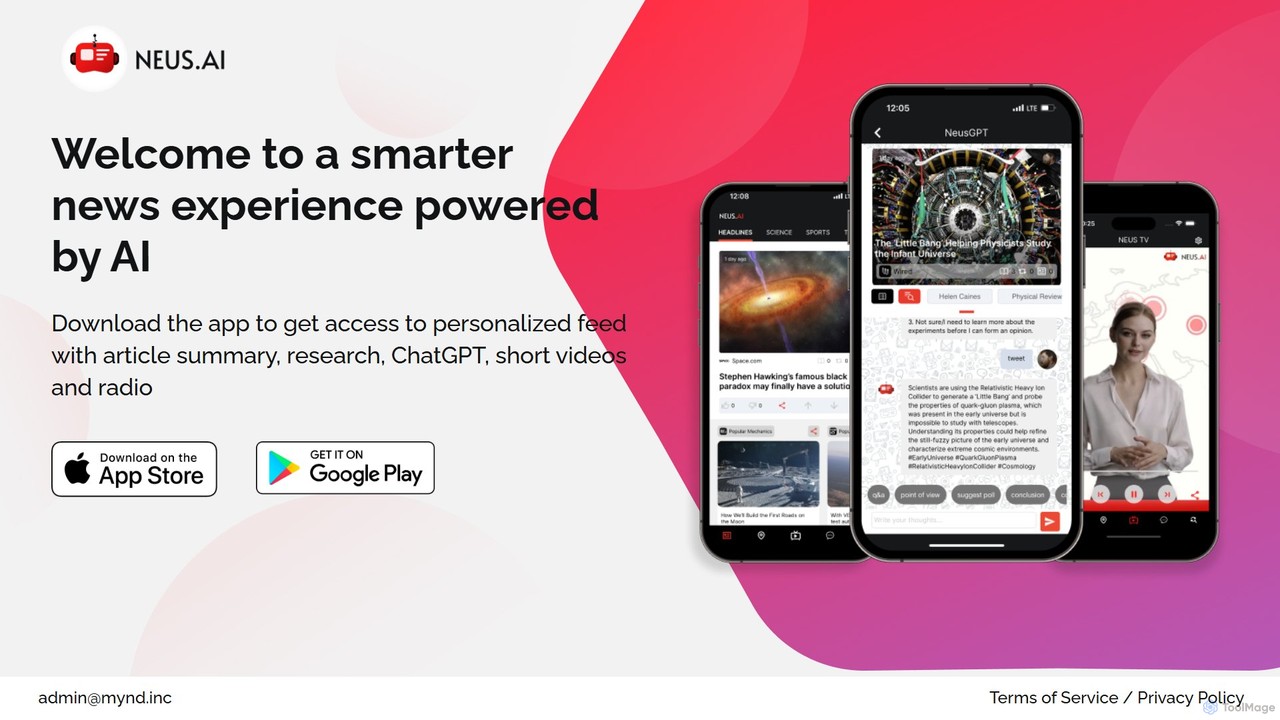
neus.ai is an AI-powered news application that delivers a personalized news experience. It provides article summaries, an integrated …
neus.ai is an AI-powered news application that delivers a personalized news experience. It provides article summaries, an integrated research assistant, short news videos, and audio radio, helping you stay informed efficiently and cut through the noise.
About Research Assistant
Research Assistant tools are AI-powered platforms designed to streamline and enhance various stages of the research process, making them a vital component within the broader education and professional development landscape. Leveraging advanced natural language processing (NLP) and machine learning algorithms, these tools can efficiently gather, analyze, synthesize, and summarize vast amounts of information from diverse sources. They empower academics, professionals, and students to conduct more thorough, accurate, and efficient research, significantly reducing manual effort, accelerating discovery, and helping to overcome information overload.
Core Features
- Automated Literature Review: Quickly scans and summarizes academic papers, articles, and reports, identifying key findings, methodologies, and gaps in existing knowledge.
- Data Synthesis & Analysis: Processes large, unstructured datasets, extracts relevant information, identifies patterns, correlations, and anomalies for deeper insights.
- Citation & Reference Management: Helps organize research sources, automatically generates citations in various academic styles (e.g., APA, MLA, Chicago), and manages bibliographies.
- Hypothesis Generation: Analyzes existing data and literature to suggest potential research questions, hypotheses, or avenues for further investigation.
- Report Drafting & Summarization: Assists in structuring research reports, generating concise summaries of complex texts, and extracting key arguments or conclusions.
Use Cases
These tools are invaluable for anyone engaged in systematic inquiry across various disciplines. Academic researchers utilize them to accelerate literature reviews, identify gaps in existing knowledge, and prepare for thesis writing. Market analysts leverage them to synthesize industry reports, consumer data, and competitive intelligence for strategic insights and business planning. Legal professionals employ them to quickly sift through vast amounts of case law, statutes, and legal documents to find precedents and relevant clauses. Scientific researchers use them to process experimental data, identify patterns, and generate new hypotheses, making the research process more robust, efficient, and comprehensive.
How to Choose
When selecting an AI Research Assistant, prioritize tools based on their accuracy in information retrieval, summarization, and the reliability of their source verification mechanisms. Consider their integration capabilities with existing academic or professional workflows, such as popular reference managers (e.g., Zotero, Mendeley) or data analysis software. Evaluate the range of supported document types (e.g., PDFs, web pages, databases) and research methodologies. Crucially, assess data privacy and security features, especially when handling sensitive information. Finally, examine the tool's customization options and user interface to ensure it aligns with your specific research needs and disciplinary requirements.
Research AssistantUse Cases
Academic Literature Review Acceleration
For university students and academic researchers, AI Research Assistants significantly speed up the literature review process. Users can upload numerous research papers or provide topics, and the AI will quickly summarize key findings, identify methodologies, highlight relevant citations, and pinpoint gaps in existing knowledge, enabling more focused and efficient thesis or dissertation writing.
Market Trend & Competitive Analysis
Business analysts and strategists leverage these tools to rapidly synthesize vast amounts of market data, industry reports, and competitor intelligence. The AI can identify emerging trends, analyze competitive landscapes, and extract critical insights from unstructured text, providing a comprehensive overview for strategic decision-making and product development.
Scientific Data Synthesis & Hypothesis Generation
Scientists and R&D teams use AI Research Assistants to process complex experimental data, scientific articles, and clinical trials. The tools can identify subtle patterns, correlations, and anomalies across diverse datasets, helping researchers generate novel hypotheses, validate findings, and accelerate the discovery process in fields like medicine or material science.
Legal Document Review & Case Preparation
Legal professionals, including lawyers and paralegals, employ these AI tools to efficiently review extensive legal documents, case law, statutes, and contracts. The AI can quickly identify relevant precedents, extract key clauses, and summarize complex legal arguments, drastically reducing the time spent on manual document review and enhancing accuracy in case preparation.
Fact-Checking & Source Verification for Content Creation
Content creators, journalists, and editors utilize AI Research Assistants to ensure the accuracy and credibility of their work. The tools can cross-reference facts, statistics, and claims against multiple reputable sources, verify information, and highlight potential inaccuracies or biases, thereby enhancing the trustworthiness and authority of published content.
Grant Proposal & Funding Application Support
Researchers and non-profit organizations use AI Research Assistants to compile comprehensive background information and supporting evidence for grant proposals and funding applications. The AI can quickly gather relevant statistics, previous research findings, and impact data, helping to build a stronger, evidence-based case for funding and increasing success rates.