
ToolMage
Sign in

Best 1 Resources AI tools for Education

Popular Resources AI tools in Education include AI for Work, helping you work more efficiently.

AI for Work
Freemium

AI for Work

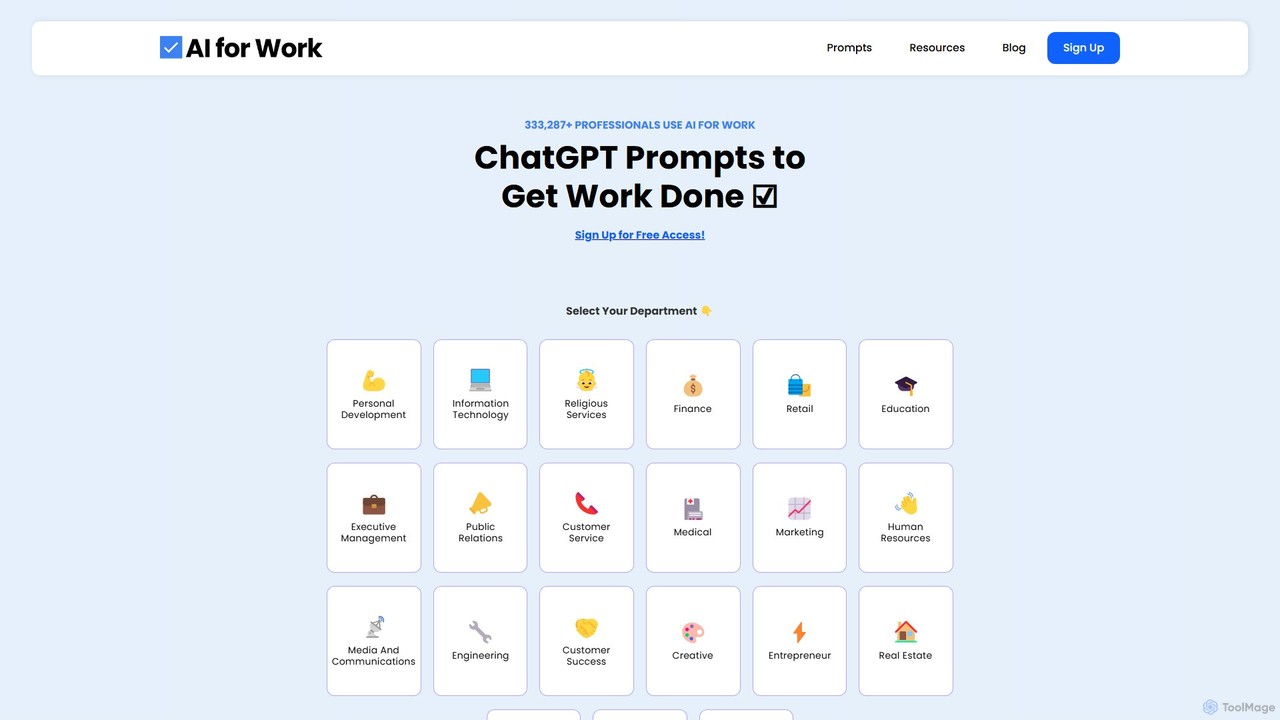
AI for Work is a comprehensive library of over 2,000 advanced ChatGPT prompts tailored for professionals across various industries. It helps users save time, enhance productivity, and generate high-quality, role-specific content by providing expertly crafted prompts for marketing, finance, legal, HR, and more.

Management
Visits 121.8KFavorites 100Likes 99

About Resources

AI Resources are tools that leverage artificial intelligence to discover, curate, and synthesize information from vast datasets. They use natural language processing (NLP) and machine learning models to transform scattered data into structured knowledge. These platforms, a key part of the Education category, are designed to accelerate research, facilitate personalized learning, and provide concise summaries of complex topics. By organizing information contextually, they help users grasp key concepts and identify relevant materials more efficiently than traditional search methods.

Core Features

  • Knowledge Curation: Automatically gathers and organizes relevant articles, research papers, and multimedia content from diverse sources.
  • AI-Powered Summarization: Generates concise and coherent summaries of long documents, saving significant reading time.
  • Personalized Learning Paths: Recommends a sequence of learning materials tailored to a user's goals and existing knowledge.
  • Semantic Search: Enables users to ask complex questions and find information based on meaning and context, not just keywords.
  • Information Synthesis: Connects ideas from multiple sources to highlight patterns, relationships, and insights.

Use Cases

These tools are widely used by students, academic researchers, business analysts, and lifelong learners. In academia, they streamline literature reviews and study preparation. In business, they support market research and competitive analysis by distilling industry reports and news.

How to Choose

When selecting an AI Resource tool, consider the breadth and depth of its content sources. Evaluate the accuracy of its summarization and the relevance of its curated content. Also, assess the quality of its personalization features and whether its interface supports an intuitive research and learning workflow.

Featured tool rankings

Resources use cases

1

Accelerate Academic Literature Reviews

A graduate student uses an AI resource platform to analyze hundreds of research papers for their thesis. Instead of manually reading each one, they use the tool to generate summaries, identify key themes, and map out the connections between different studies. This reduces the initial research phase from months to weeks, allowing more time for analysis and writing.

2

Create Personalized Skill Development Plans

A marketing professional aiming to learn data analytics uses an AI resource tool to build a custom learning path. The tool assesses their current knowledge and career goals, then curates a sequence of articles, online courses, and practical projects. It tracks their progress and adjusts the path in real-time, ensuring an efficient and targeted learning experience.

3

Streamline Corporate Knowledge Management

A large enterprise implements an AI resource tool to create a centralized knowledge hub. Employees can ask natural language questions about internal policies, project histories, or technical documentation. The AI synthesizes information from various internal documents to provide direct, accurate answers, reducing the time spent searching for information and asking colleagues.

4

Simplify Complex Subject Comprehension

A high school student preparing for an exam on a difficult topic like cellular biology uses an AI resource tool for clarification. They input concepts they find confusing, and the tool provides simplified explanations, analogies, and visual aids sourced from reputable educational materials. This helps them build a foundational understanding more effectively than reading dense textbooks alone.

5

Conduct Rapid Market and Competitor Analysis

A business strategist uses an AI resource tool to stay informed about industry trends. The platform continuously scans news articles, financial reports, and social media, summarizing key developments and competitor activities. This provides a real-time intelligence dashboard, enabling faster and more informed strategic decision-making without manual data gathering.

6

Explore New Hobbies and Interests

An individual curious about astronomy uses an AI resource tool to dive into the subject. They start with a simple question like "How are stars formed?" and the tool provides a curated journey, from introductory articles and videos to more advanced academic papers and links to relevant online communities. This fosters a structured yet flexible exploration of their new interest.

Resources FAQ

What are AI Educational Resources?

AI Educational Resources are digital tools that use artificial intelligence to find, organize, and present information for learning and research. Unlike simple databases, they actively summarize content, create personalized learning plans, and answer complex questions by synthesizing knowledge from multiple sources. They are designed to make learning more efficient and effective.

How do I choose the right AI Resource tool?

To choose the right tool, consider these four factors:

  • Content Sources: Ensure the tool draws from reputable and relevant databases for your field (e.g., academic journals, news sites, textbooks).
  • Feature Set: Decide if you need summarization, personalization, semantic search, or data visualization.
  • Accuracy and Reliability: Check if the tool provides citations and how it verifies information to ensure trustworthiness.
  • User Interface: Select a tool with an intuitive interface that simplifies your research or learning workflow.
What is the difference between an AI Resource tool and a search engine like Google?

A search engine provides a list of links to web pages based on keyword matching, leaving the user to sift through and synthesize the information. An AI Resource tool goes a step further by processing the information from those sources to provide direct answers, concise summaries, and curated collections of content, effectively acting as a research assistant.

Who are the primary users of AI Resource tools?

These tools are valuable for a wide range of users. Students and researchers use them to accelerate literature reviews and study. Professionals use them for market analysis, continuous learning, and staying updated on industry trends. Lifelong learners also use them to explore new topics of interest in a structured way.

How do AI Resource tools handle information accuracy and bias?

Reputable AI Resource tools address accuracy by primarily drawing from vetted academic and professional sources and providing clear citations for all information presented. However, like any AI, they can reflect biases present in their training data. Users should maintain a critical perspective, cross-reference key findings, and use the tools as a powerful starting point for research rather than an absolute final authority.