
ToolMage
Sign in

Best 1 Student Assessment AI tools for Education

Popular Student Assessment AI tools in Education include Edmentum, helping you work more efficiently.

Edmentum
Paid

Edmentum

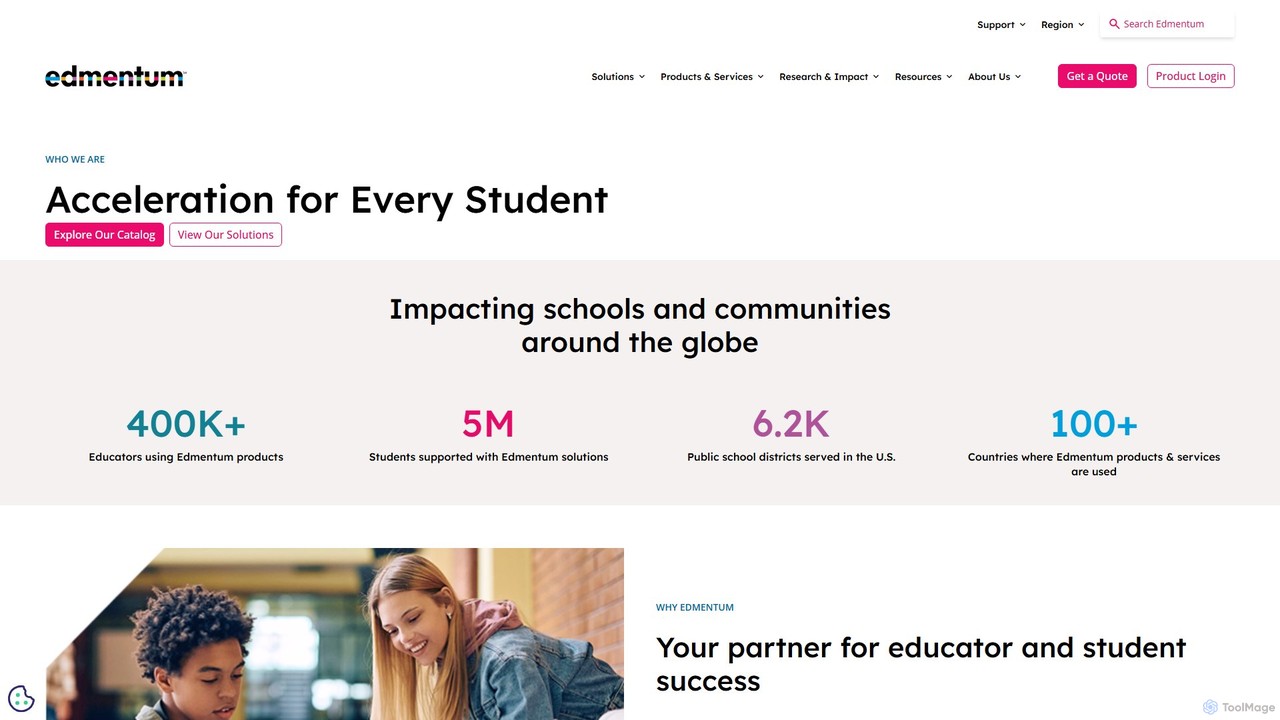
Edmentum is a comprehensive K-12 learning acceleration platform, providing personalized digital curriculum, assessments, and educational services. It empowers educators with data-driven insights and tools to support individual student needs, from intervention and credit recovery to career and technical education, fostering academic growth and future readiness.

Learning Platform
Visits 3.5MFavorites 101Likes 113

About Student Assessment

AI Student Assessment tools are a specialized category of educational software that uses artificial intelligence to create, administer, grade, and analyze academic evaluations. These platforms leverage Natural Language Processing (NLP) and machine learning to assess not just multiple-choice questions, but also complex open-ended responses, essays, and even code. Their primary value lies in automating time-consuming grading tasks, providing instant, objective feedback to students, and offering educators deep analytical insights into learning gaps and class performance. This allows for more personalized and data-driven instructional strategies.

Core Features

  • Automated Grading: Instantly evaluates a wide range of answer types, from simple multiple-choice to complex short answers and essays, based on predefined rubrics.
  • Question Generation: Automatically creates diverse and relevant questions (e.g., MCQs, fill-in-the-blanks, conceptual queries) from uploaded course materials like textbooks or lecture notes.
  • Performance Analytics: Delivers detailed dashboards and reports on individual student and cohort performance, highlighting areas of strength and weakness.
  • Plagiarism Detection: Scans student submissions against a vast database of academic and online sources to ensure originality and academic integrity.
  • Personalized Feedback: Generates targeted, constructive feedback for students, explaining incorrect answers and suggesting areas for improvement.

Applicable Scenarios

These tools are widely used across the educational spectrum. In higher education, professors use them to manage large classes and provide consistent feedback. For K-12 schools, they help teachers track student progress against curriculum standards. Online learning platforms and MOOCs rely on them for scalable assessment, while corporate training departments use them to measure employee competency and training effectiveness.

Selection Criteria

When choosing an AI Student Assessment tool, consider its subject matter compatibility—some excel at STEM subjects while others are better for humanities. Evaluate its integration capabilities with your existing Learning Management System (LMS) like Canvas or Moodle. Also, assess the range of question types it supports and review its data privacy and security policies to ensure student information is protected.

Student Assessment use cases

1

Automating Weekly Quiz Grading for a History Class

A high school history teacher responsible for three classes of 30 students each faces the challenge of grading nearly 100 short-answer quizzes every week. By using an AI Student Assessment tool, the teacher uploads the quiz and a detailed answer key or rubric. The AI grades all submissions within minutes, identifying common misconceptions across all classes. This process not only saves the teacher 4-5 hours of manual grading per week but also provides an immediate performance dashboard, allowing them to adjust the next lesson plan to address areas where students struggled most.

2

Generating a Diverse Question Bank for a Final Exam

A university professor preparing for a final exam in a biology course wants to create a comprehensive test that covers the entire semester's material without reusing old questions. They upload lecture slides, textbook chapters, and research articles into an AI question generation tool. The AI analyzes the content and produces hundreds of questions in various formats: multiple-choice, true/false, and conceptual short-answer. The professor can then review, edit, and select the best questions to build multiple versions of the exam, ensuring academic integrity and a fair assessment of student knowledge.

3

Providing Instant Feedback on Coding Assignments

A computer science instructor at a coding bootcamp needs to provide timely and specific feedback on dozens of programming assignments daily. They use a specialized AI assessment platform that can compile and run student code against a series of predefined test cases. The tool automatically grades the assignments based on correctness, efficiency, and code style. More importantly, it provides students with instant, line-by-line feedback, highlighting errors and suggesting improvements. This immediate feedback loop accelerates the learning process and frees up the instructor to focus on teaching more complex concepts.

4

Ensuring Academic Integrity in Online University Exams

An online university needs to maintain high standards of academic integrity for its remotely proctored final exams. They integrate an AI assessment tool that includes plagiarism detection and identity verification. Before the exam, the system verifies the student's identity using their webcam. During the exam, it monitors for suspicious behavior. After submission, the AI scans all essay answers against billions of web pages and academic papers. This comprehensive approach helps the university prevent cheating, ensures fair evaluation for all students, and upholds the credibility of its online degrees.

5

Analyzing Student Essay Writing Skills for Formative Feedback

An English department wants to provide more detailed formative feedback on undergraduate essays before final submission. They use an AI assessment tool that analyzes writing for multiple dimensions: argument structure, clarity, evidence usage, grammar, and style. The tool generates a detailed report for each student, highlighting strengths and providing specific, actionable suggestions for improvement, such as 'Consider adding a stronger counter-argument in paragraph 3.' This allows students to revise their work effectively and helps instructors focus their in-person feedback on higher-level conceptual issues.

6

Identifying Learning Gaps in a Corporate Training Program

A large corporation rolls out a new compliance training module to all employees. To measure its effectiveness, the training department uses an AI assessment platform to administer a post-training test. The platform's analytics dashboard quickly reveals that while 90% of employees understood the core policies, 40% struggled with questions related to a specific new regulation. This data-driven insight allows the training team to immediately create and deploy a targeted micro-learning module focused solely on that regulation, ensuring full comprehension and reducing corporate risk without requiring a full-scale retraining.

Student Assessment FAQ

What are AI Student Assessment tools?

AI Student Assessment tools are software applications that use artificial intelligence to automate and enhance the process of evaluating student learning. Unlike simple quiz makers, they employ technologies like Natural Language Processing (NLP) to grade complex answers such as essays and short responses. Key features often include automated grading, question generation from course materials, plagiarism detection, and detailed performance analytics. Their main purpose is to save educators time, provide students with immediate and consistent feedback, and offer data-driven insights to improve teaching and learning outcomes.

How to choose the right AI Student Assessment tool?

Choosing the right tool depends on your specific educational context. Consider these key factors:

  • Subject Matter: Ensure the tool is optimized for your subject. Tools for STEM fields may need to evaluate code or mathematical equations, while humanities tools should excel at analyzing text.
  • LMS Integration: Check for seamless integration with your existing Learning Management System (e.g., Canvas, Moodle, Blackboard) to streamline workflows and sync grades.
  • Question & Answer Types: Verify that the tool supports the assessment formats you use, from multiple-choice and fill-in-the-blank to essays and file uploads.
  • Data Security & Privacy: Confirm that the platform complies with educational privacy regulations (like FERPA in the U.S.) and has robust security measures to protect student data.
  • Analytics & Reporting: Evaluate the depth of the analytics provided. A good tool should offer insights into both individual student performance and class-wide trends.
What's the difference between AI assessment and a standard online quiz maker?

The primary difference lies in intelligence and capability. A standard online quiz maker is typically limited to auto-grading objective questions like multiple-choice or true/false. AI assessment tools go much further:

  • Subjective Grading: They use NLP to understand and grade subjective content like essays and open-ended questions based on a rubric.
  • Content Generation: Many AI tools can generate new, relevant questions from existing course materials, whereas standard tools require manual question entry.
  • Deep Analytics: AI platforms provide sophisticated analytics that can identify specific knowledge gaps, track progress over time, and offer predictive insights, far beyond the simple score reports of quiz makers.
  • Personalized Feedback: AI can generate specific, constructive feedback for students, explaining why an answer is incorrect, a feature rarely found in standard quiz tools.

In essence, a standard quiz maker digitizes testing, while an AI assessment tool transforms it by adding a layer of intelligence, analysis, and personalization.

Can AI tools reliably grade essays and open-ended questions?

Yes, modern AI tools can grade essays and open-ended questions with a high degree of reliability, but their effectiveness depends on the subject and setup. They use Natural Language Processing (NLP) to analyze text for various factors like keyword relevance, argument structure, grammar, and coherence, comparing them against a pre-trained model or a rubric provided by the educator. For subjects with clear-cut answers (like history or science), they are highly accurate. For more nuanced subjects like literature or philosophy, they are best used as a 'co-grader' or 'teaching assistant' to handle first-pass grading and identify basic errors, allowing human educators to focus on providing deeper, more subjective feedback on creativity and critical thinking.

Who can benefit from using AI Student Assessment tools?

A wide range of professionals in education and training can benefit from these tools. This includes:

  • University Professors & Lecturers: To manage large class sizes, automate grading for introductory courses, and provide consistent, scalable feedback.
  • K-12 Teachers: To save time on grading homework and quizzes, track student progress against standards, and identify learning gaps early.
  • Online Course Creators & MOOC Providers: To offer scalable, automated assessments and certifications to thousands of learners simultaneously.
  • Corporate Trainers & L&D Professionals: To measure the effectiveness of training programs, assess employee knowledge, and ensure compliance with required standards.
  • Standardized Testing Organizations: To streamline the grading process for large-scale examinations and improve scoring consistency.