Engineering Best in category 1 results Aerospace Engineering AI Tool

Popular AI tools in the Aerospace Engineering field of Engineering include Vecteur, etc., helping you quickly improve efficiency.

Vecteur

Vecteur

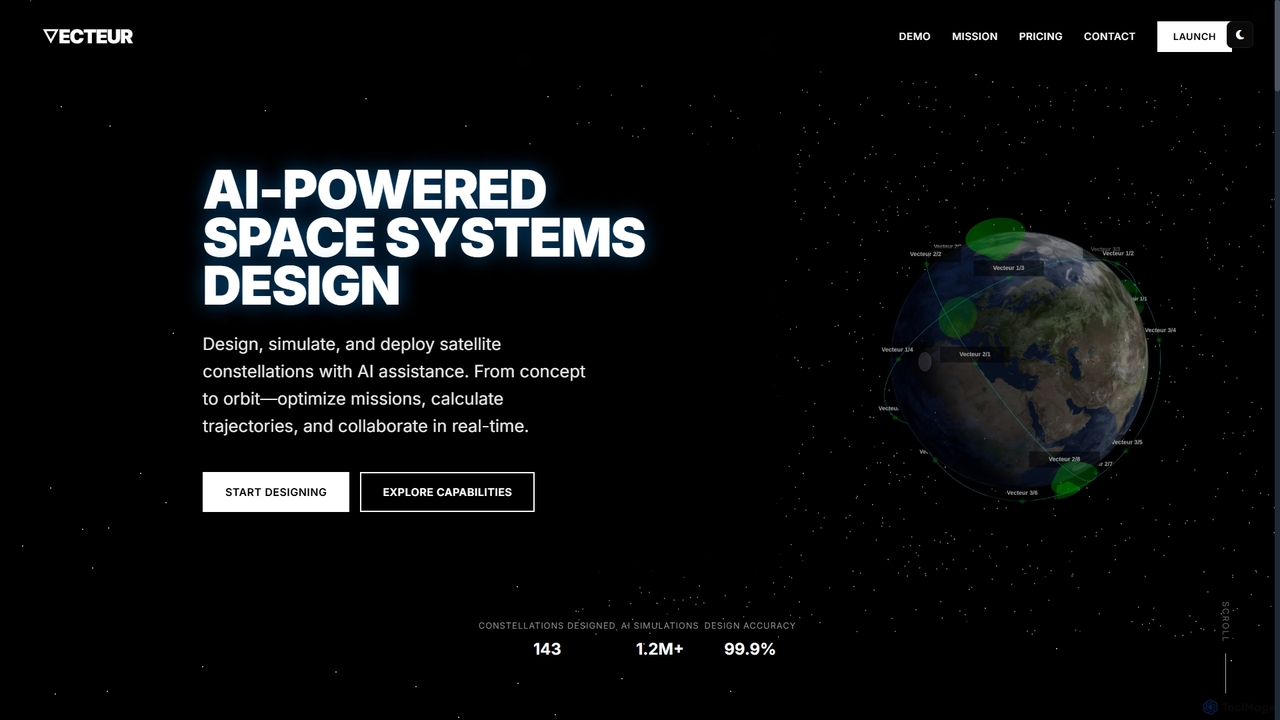
Vecteur is an AI-powered platform revolutionizing space systems engineering, enabling users to design, simulate, and deploy satellite constellations …

3.7K

About Aerospace Engineering

Aerospace Engineering AI tools are specialized software solutions that leverage artificial intelligence to enhance the design, analysis, manufacturing, and operation of aircraft, spacecraft, and related systems. These tools utilize advanced algorithms, machine learning, and data analytics to tackle complex challenges inherent in aerospace development. They provide engineers with capabilities to accelerate research and development cycles, improve system performance, ensure safety, and optimize operational efficiency across the entire aerospace lifecycle.

Core Features

  • Generative Design: Automatically creates optimized component designs based on specified performance criteria and constraints.
  • Predictive Maintenance: Analyzes sensor data from aerospace assets to forecast potential failures and schedule proactive maintenance.
  • Flight Path Optimization: Uses AI to calculate the most efficient and safe flight trajectories considering various environmental and operational factors.
  • Advanced Simulation & Modeling: Accelerates and refines complex aerodynamic, structural, and thermal simulations.
  • Data Analytics for Operations: Processes vast amounts of flight, sensor, and operational data to identify patterns and improve decision-making.

Applicable Scenarios

Aerospace Engineering AI tools are crucial for aerospace manufacturers, defense contractors, airlines, and space agencies. They are used by design engineers for rapid prototyping, by maintenance teams for proactive asset management, and by mission planners for optimizing complex operations. These tools support the entire lifecycle from conceptual design to in-service support, enhancing innovation and reliability.

How to Choose

Selecting the right Aerospace Engineering AI tool involves evaluating its integration capabilities with existing CAD/CAE software, the accuracy and reliability of its AI models, its ability to handle large and diverse datasets, and compliance with industry regulations (e.g., FAA, EASA). Consider the specific application area (e.g., design, maintenance, operations) and the level of customization or domain-specific knowledge embedded in the tool.

Aerospace EngineeringUse Cases

1

Generative Design for Lightweight Aircraft Components

Aerospace design engineers utilize AI-powered generative design tools to automatically create novel, optimized designs for aircraft parts such as brackets, spars, or engine components. By inputting performance requirements, material properties, and manufacturing constraints, the AI explores thousands of design iterations, often resulting in lighter, stronger, and more fuel-efficient structures that traditional methods might miss, significantly reducing design time and material waste.

2

Optimizing Satellite Constellation Deployment

Space mission planners employ AI algorithms to optimize the deployment and orbital maintenance of large satellite constellations. The AI analyzes factors like launch vehicle capabilities, desired coverage areas, collision avoidance risks, and fuel consumption to determine the most efficient launch windows and orbital maneuvers. This ensures maximum operational lifespan and effectiveness for communication, navigation, or earth observation satellites.

3

Predictive Maintenance for Commercial Aircraft Engines

Airlines and MRO (Maintenance, Repair, and Overhaul) providers leverage AI to analyze real-time sensor data from commercial aircraft engines. The AI identifies subtle anomalies and predicts potential component failures before they occur, allowing maintenance teams to schedule proactive repairs during planned downtime. This minimizes unscheduled maintenance, reduces flight delays, enhances safety, and extends the operational life of expensive assets.

4

Accelerating Aerodynamic Simulation (CFD)

Researchers and engineers use AI to significantly accelerate computational fluid dynamics (CFD) simulations for new aircraft and rocket designs. AI models, trained on vast datasets of previous simulations and experimental data, can quickly predict aerodynamic performance, drag, and lift characteristics. This reduces the need for lengthy, resource-intensive traditional simulations and physical wind tunnel tests, speeding up the design iteration process.

5

Automated Quality Inspection in Aerospace Manufacturing

Aerospace manufacturers deploy AI-powered vision systems for automated quality inspection of critical components, such as turbine blades, composite panels, or wiring harnesses. AI algorithms analyze high-resolution images or sensor data to detect microscopic defects, cracks, or assembly errors with greater speed and accuracy than human inspectors. This ensures the highest quality standards, reduces rework, and enhances overall product reliability.

6

Intelligent Air Traffic Flow Management

Air traffic control centers utilize AI systems to optimize air traffic flow, especially in congested airspace or during adverse weather conditions. The AI analyzes real-time data on aircraft positions, weather forecasts, airport capacities, and flight schedules to predict potential bottlenecks and suggest dynamic routing or sequencing adjustments. This reduces delays, minimizes fuel burn, and improves overall airspace efficiency and safety.

Aerospace EngineeringFrequently Asked Questions