ToolMage
Sign in

Best 1 Data Science AI tools for Engineering

Popular Data Science AI tools in Engineering include Mathify, helping you work more efficiently.

Freemium

Mathify

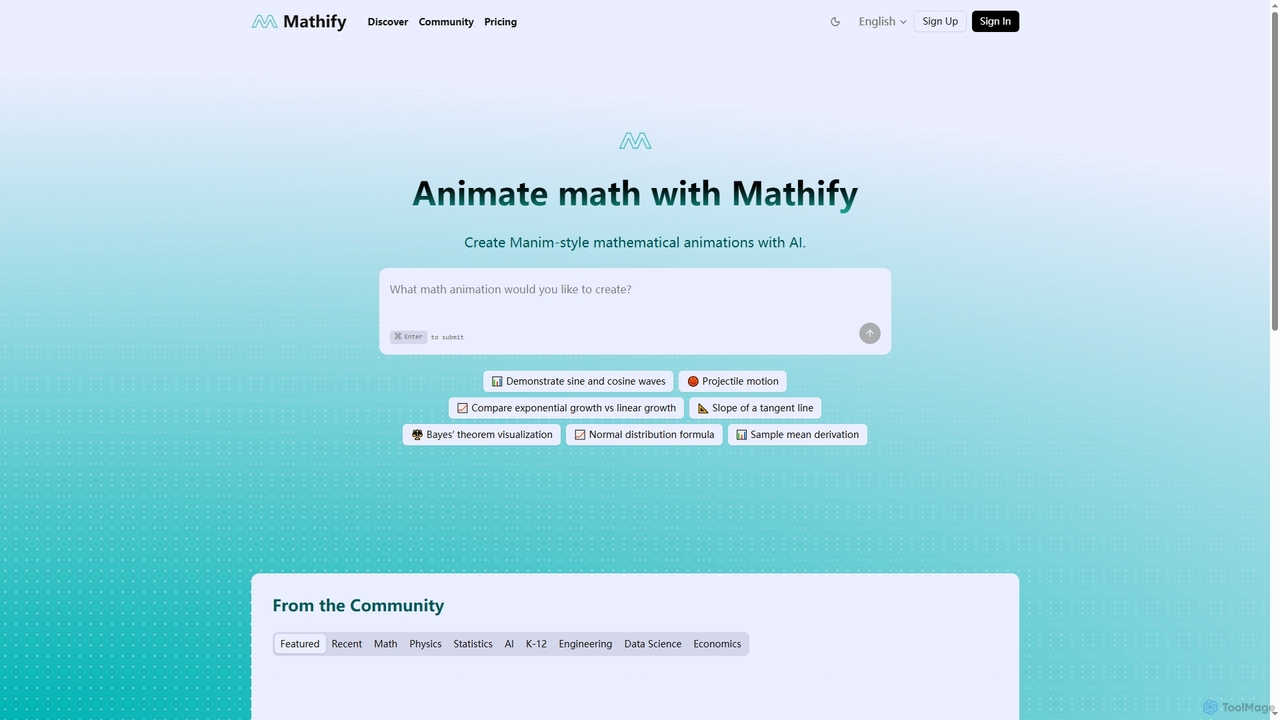
Mathify is an AI-powered tool that simplifies the creation of Manim-style mathematical animations. It enables users to visualize complex mathematical and scientific concepts, making abstract ideas more accessible for education, research, and content creation.

Ai Development Tools
Visits 5KFavorites 91Likes 87

About Data Science

Data Science tools are sophisticated AI-powered platforms engineered to extract profound insights, patterns, and actionable knowledge from complex, often vast, datasets. These advanced tools harness cutting-edge machine learning algorithms, robust statistical modeling techniques, and high-performance computational capabilities to efficiently process, meticulously analyze, and accurately interpret both structured and unstructured data. They empower data scientists, analysts, and business leaders to make truly data-driven decisions, anticipate future trends with greater accuracy, and significantly optimize operations across a multitude of industries, effectively transforming raw data into strategic intelligence.

Core Features

  • Automated Data Ingestion & Preprocessing: Streamlines the entire process of collecting, cleaning, transforming, and preparing raw data from diverse sources, ensuring data quality and readiness for analysis.
  • Advanced Exploratory Data Analysis (EDA): Offers powerful interactive visualizations, comprehensive statistical summaries, and anomaly detection features to quickly uncover initial patterns, outliers, and complex relationships within large datasets.
  • Machine Learning Model Building & Training: Provides a rich environment for developing, training, and rigorously evaluating a wide array of predictive and prescriptive models, supporting algorithms from regression and classification to clustering and deep learning.
  • Seamless Model Deployment & Monitoring: Facilitates the smooth integration of validated machine learning models into production systems, coupled with continuous monitoring of their performance, accuracy, and potential drift over time.
  • Intelligent Feature Engineering: Assists users in automatically or semi-automatically creating new, highly informative features from existing data, which significantly enhances model performance, interpretability, and robustness.
  • Scalable Computing & Big Data Integration: Designed to handle massive datasets and complex computations, often integrating with cloud platforms and big data technologies like Spark or Hadoop for distributed processing.

Use Cases

Data Science tools are indispensable for organizations striving to achieve a significant competitive advantage through sophisticated analytical capabilities. They are extensively utilized by data scientists, machine learning engineers, and advanced business analysts across critical sectors such as finance, healthcare, retail, manufacturing, and technology. These tools enable a wide range of strategic tasks, including identifying lucrative market opportunities, deeply understanding intricate customer behaviors, optimizing complex supply chains, and enhancing personalized user experiences.

How to Choose

When selecting a Data Science tool, it's crucial to consider its comprehensive data integration capabilities, ensuring compatibility with all your existing data sources and formats. Evaluate the breadth and depth of its machine learning algorithm library, alongside its features for model interpretability and explainability. Assess its scalability for efficiently handling ever-growing datasets and the ease of collaboration it offers for distributed data science teams. Furthermore, investigate its model deployment options, MLOps functionalities, and robust ongoing model monitoring features to guarantee long-term operational efficiency and model reliability.

Featured tool rankings

Data Science use cases

1

Predictive Analytics for Business Strategy

Business strategists and executives leverage Data Science tools to forecast market trends, predict sales volumes, and identify emerging opportunities or risks. By analyzing historical data, economic indicators, and consumer behavior, these tools build predictive models that inform strategic planning, resource allocation, and investment decisions, leading to more resilient and proactive business operations.

2

Customer Churn Prediction and Retention

Marketing and customer success teams utilize Data Science tools to identify customers at high risk of churning. By analyzing customer interaction data, usage patterns, and demographic information, AI models can predict churn probability. This allows businesses to proactively engage with at-risk customers through targeted offers or personalized support, significantly improving customer retention rates and lifetime value.

3

Fraud Detection in Financial Services

Financial institutions employ Data Science tools to detect and prevent fraudulent transactions in real-time. These tools analyze vast streams of transaction data, user behavior, and network patterns to identify anomalies that deviate from normal activity. Machine learning models are trained to flag suspicious transactions, minimizing financial losses and enhancing security for both the institution and its customers.

4

Personalized Recommendation Systems

E-commerce platforms and media streaming services use Data Science tools to build highly personalized recommendation engines. By analyzing user preferences, viewing history, purchase behavior, and interactions, these tools suggest relevant products, movies, or content. This enhances user experience, increases engagement, and drives sales by presenting users with items they are most likely to be interested in.

5

Healthcare Diagnostics and Treatment Optimization

Medical researchers and clinicians apply Data Science tools to analyze patient data, medical images, and genomic information for improved diagnostics and personalized treatment plans. AI models can identify subtle patterns indicative of diseases, predict patient responses to therapies, and optimize drug dosages, leading to more accurate diagnoses, better patient outcomes, and more efficient healthcare delivery.

6

Supply Chain Demand Forecasting

Logistics and operations managers use Data Science tools to accurately forecast demand for products and services. By integrating historical sales data, seasonal trends, promotional activities, and external factors like weather or economic conditions, these tools generate precise demand predictions. This optimizes inventory levels, reduces waste, and ensures timely product availability, leading to more efficient supply chain management.

Data Science FAQ

What are Data Science tools?

Data Science tools are software platforms that enable users to collect, process, analyze, and interpret large datasets to extract valuable insights and build predictive models. They leverage machine learning, statistics, and computational methods to transform raw data into actionable intelligence, supporting data-driven decision-making across various industries and applications.

How do Data Science tools differ from Business Intelligence (BI) tools?

While both deal with data, Data Science tools focus on predictive and prescriptive analytics, using advanced algorithms to forecast future outcomes and recommend actions. BI tools, conversely, primarily focus on descriptive analytics, summarizing past and present data through dashboards and reports to understand "what happened." Data Science often involves more complex modeling and experimentation, whereas BI emphasizes reporting and visualization of known data.

What are the key capabilities of AI-powered Data Science platforms?

AI-powered Data Science platforms offer capabilities like automated data preparation, intelligent feature engineering, and the ability to build, train, and deploy sophisticated machine learning models with minimal coding. They often include advanced visualization tools, MLOps features for model lifecycle management, and scalable computing resources to handle big data, making complex analytics more accessible and efficient.

Who benefits most from using Data Science tools?

Data Science tools primarily benefit data scientists, machine learning engineers, business analysts, and researchers who need to perform advanced analytics, build predictive models, and uncover deep insights from data. Industries such as finance, healthcare, retail, and technology obtain significant advantages by using these tools to optimize operations, personalize customer experiences, and drive strategic growth.

What should I consider when choosing a Data Science tool?

When choosing a Data Science tool, consider its ease of use and learning curve, especially if your team has varying technical skills. Evaluate its integration capabilities with your existing data infrastructure and other business tools. Look for comprehensive machine learning libraries, robust data visualization features, and strong MLOps support for model deployment and monitoring. Scalability, community support, and pricing models are also crucial factors.