PRIZ Guru
PRIZ Guru is an AI-powered innovation platform for engineering teams. It combines systematic problem-solving methodologies like TRIZ with …
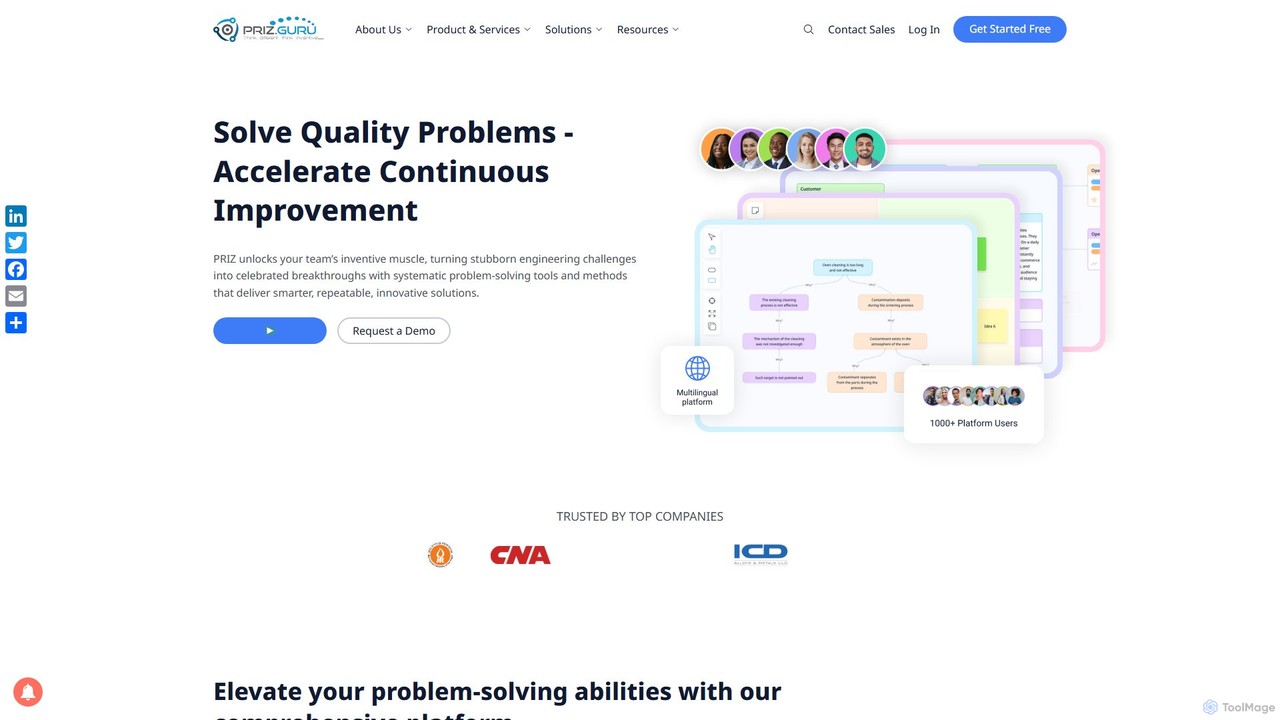
PRIZ Guru is an AI-powered innovation platform for engineering teams. It combines systematic problem-solving methodologies like TRIZ with AI-assisted facilitation, project management, and collaboration tools to turn complex engineering challenges into competitive advantages and accelerate continuous improvement.
About Innovation Management
Innovation Management tools are AI-powered platforms designed to structure and accelerate the entire innovation lifecycle, from idea generation to market launch. They leverage machine learning and natural language processing (NLP) to analyze vast datasets, including market trends, competitor patents, and internal ideas, to identify high-potential opportunities. These tools provide a centralized system for R&D departments, product managers, and strategists to make data-driven decisions, manage innovation pipelines, and reduce time-to-market. Unlike general project management software, they specialize in the 'fuzzy front-end' of innovation, offering predictive insights and collaborative frameworks for discovery and validation.
Core Features
- Idea Management & Crowdsourcing: Centralizes the collection, evaluation, and prioritization of ideas from internal and external stakeholders.
- Technology & Trend Scouting: Automatically scans patents, research papers, and market news to detect emerging technologies and shifts.
- Competitive Intelligence: Uses AI to analyze competitor activities, product launches, and strategic positioning from public data.
- Innovation Portfolio Management: Provides dashboards to visualize and balance the innovation pipeline based on risk, resources, and strategic alignment.
- Automated Workflows: Streamlines the stage-gate process for idea approval, development, and review with automated notifications and tasks.
Use Cases
These tools are essential for technology companies managing complex R&D portfolios, consumer goods firms seeking the next market trend, and financial institutions developing new fintech services. They support roles from corporate strategists and R&D managers to product teams validating new feature concepts, enabling a structured yet agile approach to innovation.
How to Choose
When selecting an Innovation Management tool, consider its integration capabilities with your existing systems (e.g., Jira, Slack). Evaluate the breadth and quality of its data sources for trend and patent analysis. Assess the sophistication of its AI-driven analytics, such as idea scoring and predictive forecasting. Finally, ensure the platform is scalable to support both small team ideation and enterprise-wide innovation programs.

Innovation ManagementUse Cases
Automating Market Trend and Technology Scouting
A corporate strategist at a manufacturing firm needs to identify disruptive technologies before they impact the market. Using an AI innovation management tool, they set up automated scouts to monitor patent databases, academic journals, and tech news for keywords like 'generative design' and 'sustainable materials'. The platform continuously analyzes this data, filters out noise, and delivers a curated weekly digest of emerging trends, key research institutions, and startup activities. This saves the strategy team over 20 hours of manual research per week and enables them to proactively initiate R&D projects in high-potential areas.
Managing an Internal Idea Crowdsourcing Campaign
An innovation manager at a large financial services company launches a company-wide challenge to find ideas for improving the mobile banking app. Using the innovation management platform, employees submit hundreds of ideas. The AI automatically groups similar suggestions, identifies duplicates, and uses NLP to analyze sentiment and key themes. It then scores each unique idea based on pre-defined criteria like strategic fit, potential impact, and estimated effort. This allows the innovation committee to bypass manual sorting and focus their review on the top 10% of AI-ranked ideas, reducing the evaluation cycle from a month to one week.
Conducting AI-Powered Competitive Intelligence
A product manager for a SaaS company is planning the next product roadmap. They use an innovation management tool to track key competitors. The tool's AI continuously scans competitor websites, press releases, social media, and customer review platforms. It automatically identifies and summarizes new feature launches, pricing changes, and shifts in marketing messaging. It also highlights recurring negative feedback on competitor products, revealing potential market gaps. The product manager receives a real-time dashboard and alerts, enabling them to make faster, more informed decisions to differentiate their product and gain a competitive edge.
Streamlining Patent Analysis for IP Strategy
An R&D team at a biotech company has developed a new compound and needs to assess its patentability. Instead of spending weeks manually searching patent databases, they input the compound's description and technical data into their innovation management tool. The AI performs a semantic search across global patent libraries, identifying prior art and mapping the existing technology landscape. It generates a visual report showing areas of dense patent activity and 'white spaces' with fewer existing patents. This accelerates the patent search from weeks to hours and provides the IP legal team with the critical data needed to draft a stronger, more defensible patent application.
Visualizing and Balancing the Innovation Portfolio
A Chief Technology Officer (CTO) needs a clear overview of all R&D projects to ensure resources are allocated effectively. The innovation management platform provides a portfolio dashboard that maps each project on a risk/reward matrix. It visualizes the balance between incremental improvements (low risk, low reward) and disruptive innovations (high risk, high reward). The AI also provides predictive analytics on project timelines and potential ROI, flagging projects that are falling behind or over budget. This data-driven overview allows the CTO to make strategic decisions, such as reallocating funds from a stalled project to a more promising one, ensuring a healthy and balanced innovation pipeline.
Fostering Cross-Functional Collaboration on New Products
A project lead for a new medical device needs to coordinate input from engineering, marketing, and regulatory affairs teams. They create a dedicated workspace for the project within the innovation management tool. Here, engineers upload design specifications, marketers add market research data, and regulatory experts comment on compliance requirements. The tool's automated stage-gate workflow ensures that the project cannot move to the next phase until all required approvals are gathered. This centralizes all communication and documentation, breaks down departmental silos, and creates a transparent, auditable trail of the entire development process.