Finance Best in category 1 results Customer Support AI Tool

Popular AI tools in the Customer Support field of Finance include Layerup, etc., helping you quickly improve efficiency.

Layerup

Layerup

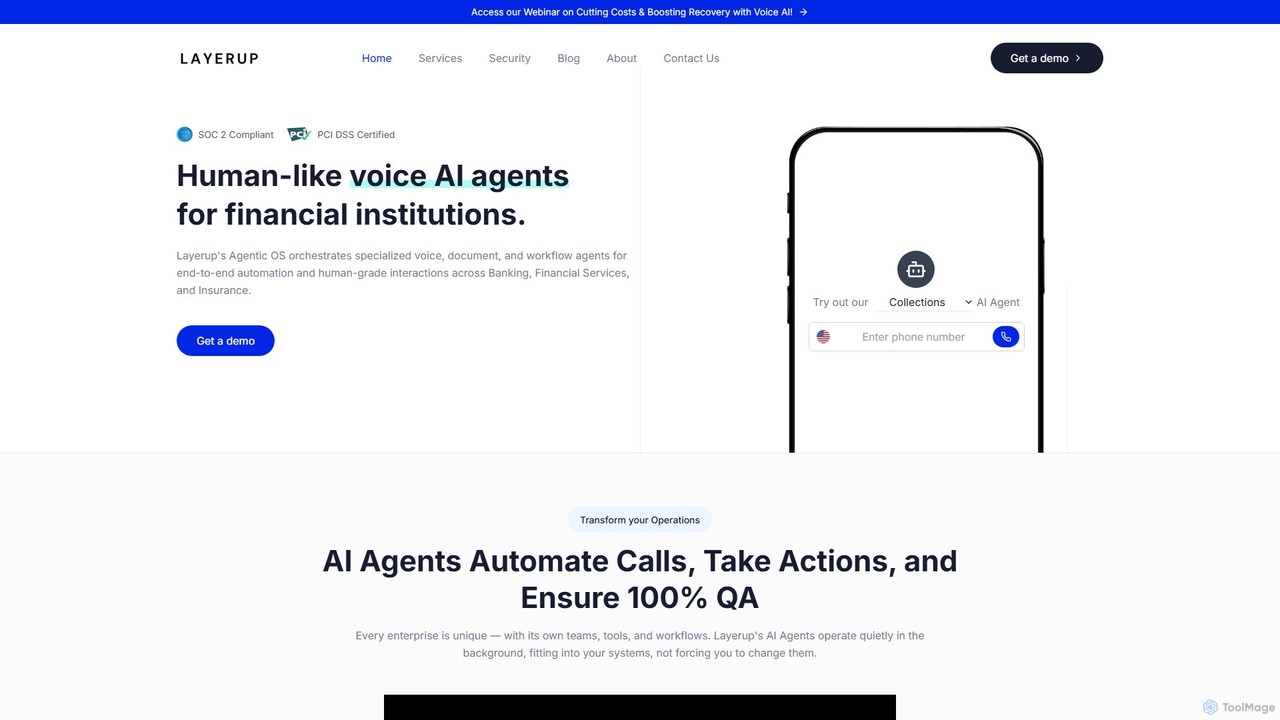
Layerup provides specialized, human-like AI agents for financial institutions. Its Agentic OS automates end-to-end workflows in collections, claims, …

11.3K

About Customer Support

AI Customer Support tools for finance are specialized platforms designed to automate and enhance customer interactions within the banking, insurance, and investment sectors. These tools leverage Natural Language Processing (NLP) and machine learning to understand and resolve financial queries with high accuracy and security. They enable financial institutions to provide instant, 24/7 support for tasks like balance inquiries, transaction disputes, and policy questions, significantly improving operational efficiency. Their key advantage lies in their ability to handle sensitive data, adhere to strict regulatory compliance, and integrate with core financial systems.

Core Features

  • Financial Jargon Understanding: Accurately interprets industry-specific terms, acronyms, and customer intent related to financial products.
  • Secure Authentication & Verification: Integrates with security protocols to safely verify customer identities before providing account-specific information.
  • Automated Ticket Triage: Intelligently categorizes incoming queries (e.g., fraud, loan application, technical issue) and routes them to the correct department.
  • Compliance Monitoring: Analyzes conversations to ensure adherence to financial regulations like KYC (Know Your Customer) and AML (Anti-Money Laundering).
  • Integration with Core Banking Systems: Connects directly with CRMs and banking platforms to fetch real-time data and execute transactions.

Applicable Scenarios

These tools are essential for retail banks, credit unions, insurance companies, brokerage firms, and fintech startups. They are used by customer service teams to manage high volumes of inquiries, by compliance officers to monitor interactions, and by operations managers to streamline support workflows for products like loans, credit cards, and investment accounts.

Selection Criteria

When choosing a tool, prioritize its security certifications (e.g., PCI DSS, SOC 2) and compliance with data privacy laws like GDPR. Evaluate its integration capabilities with your existing financial software stack. Assess the AI's accuracy in understanding complex financial queries and its ability to scale during periods of high demand, such as market volatility or tax season.

Customer SupportUse Cases

1

Automating Routine Banking Inquiries

For retail banks and credit unions, AI chatbots can handle a high volume of routine customer inquiries 24/7. A customer can ask 'What is my checking account balance?' or 'Show me my recent transactions' and receive an instant, secure response after identity verification. This frees up human agents to focus on more complex issues like loan applications or wealth management advice, reducing wait times and operational costs.

2

Streamlining Insurance Claim Initiation

Insurance companies can use AI-powered assistants to guide policyholders through the first notice of loss (FNOL) process. The AI can ask for key details of an incident (e.g., date, location, type of damage), help upload photos and documents, and automatically create a claim file. This accelerates the claims lifecycle, reduces manual data entry errors, and provides a more efficient experience for customers during a stressful time.

3

Onboarding New Investment Clients

Fintech platforms and online brokerages utilize AI support tools to create a seamless onboarding experience. The AI can guide new users through account setup, explain different investment options, and assist with the KYC (Know Your Customer) verification process. It can answer common questions about fees, fund transfers, and portfolio types, helping to convert prospects into active investors more effectively.

4

Resolving Credit Card Transaction Disputes

When a customer wants to dispute a charge on their credit card, an AI assistant can initiate the process. It can gather necessary information, such as the transaction details and the reason for the dispute, and automatically file a preliminary report. The system can then inform the customer about the next steps and timelines, providing transparency and immediate action on potential fraud or billing errors.

5

Providing Real-Time Loan Status Updates

For mortgage lenders and personal loan providers, AI tools can offer applicants on-demand status updates. Instead of calling a loan officer, an applicant can simply ask the AI assistant, 'What is the status of my mortgage application?'. The tool, integrated with the backend loan origination system, can provide real-time information on whether the application is in review, approved, or requires more documentation.

6

Enhancing Compliance in Customer Interactions

Financial institutions can deploy AI to monitor customer support conversations (both text and voice) in real-time. The system can flag non-compliant language, ensure agents provide mandatory disclosures, and identify potential instances of fraud or money laundering. This provides a crucial layer of risk management and helps the institution maintain a strong regulatory compliance posture.

Customer SupportFrequently Asked Questions