ToolMage
Sign in

Best 1 Quotation AI tools for Finance

Popular Quotation AI tools in Finance include Outlit, helping you work more efficiently.

Outlit
Paid

Outlit

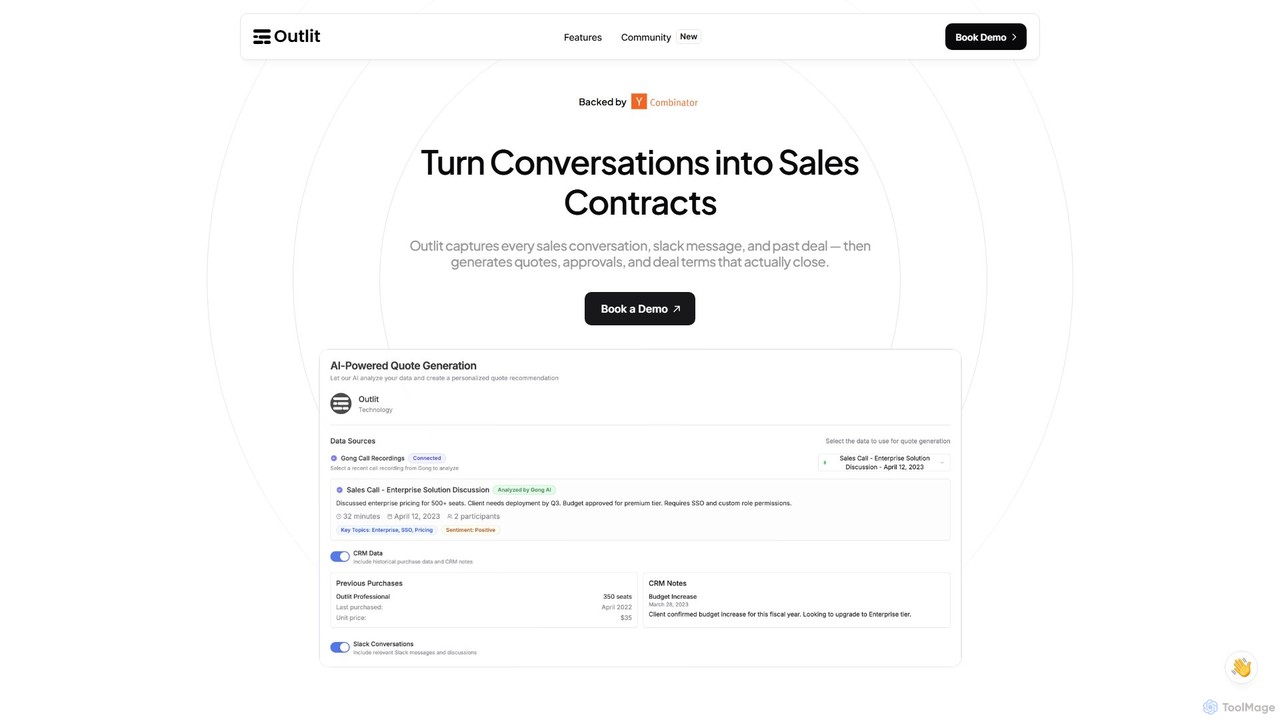
Outlit is an AI-powered deal intelligence platform that transforms sales conversations into actionable contracts. It captures data from Slack, past deals, and other communications to automatically generate accurate quotes, deal terms, and approval workflows, accelerating the entire sales cycle.

Crm
Visits 6.7KFavorites 127Likes 126

About Quotation

AI Quotation tools are specialized platforms that provide real-time and historical financial market data. These tools utilize robust APIs and AI algorithms to aggregate, process, and deliver accurate price quotes for a wide range of assets, including stocks, forex, commodities, and cryptocurrencies. They serve as a critical data infrastructure for traders, analysts, and financial applications, enabling informed decision-making, algorithmic trading, and market analysis. Many advanced tools also offer features like data normalization and technical indicator calculations directly through their APIs.

Core Features

  • Real-Time Data Feeds: Delivers low-latency, streaming price data from multiple global exchanges and liquidity providers.
  • Historical Data Access: Provides comprehensive historical price data (tick, minute, daily) for backtesting strategies and research.
  • Customizable Alerts: Allows users to set up notifications for specific price levels, volume spikes, or volatility changes.
  • Robust API Integration: Offers well-documented APIs (REST, WebSocket) for easy integration into trading bots, dashboards, and financial software.
  • Data Aggregation & Normalization: Collects data from various sources and presents it in a standardized, easy-to-use format.

Use Cases

These tools are essential for quantitative analysts developing trading algorithms, FinTech companies building financial applications, portfolio managers monitoring assets, and individual traders requiring data beyond standard brokerage platforms. They are widely used in algorithmic trading, risk management systems, and financial research.

How to Choose

When selecting an AI Quotation tool, consider the following: data coverage (which markets and assets are available?), data latency (how fast is the real-time feed?), API quality and rate limits (how reliable and scalable is the integration?), and the pricing model (per-call, subscription-based, or tiered plans). Also, evaluate the quality of historical data for backtesting purposes.

Quotation use cases

1

Developing an Automated Trading Bot

A quantitative developer aims to build a trading bot that executes trades based on specific technical indicators, such as moving average crossovers. They use the quotation tool's real-time WebSocket API to stream live price data for NASDAQ stocks directly into their algorithm. The bot continuously processes this data, calculates indicators, and automatically places buy or sell orders via a brokerage API when its predefined conditions are met. This enables a fully automated, high-frequency strategy that capitalizes on market opportunities faster than manual trading.

2

Backtesting a New Investment Strategy

A financial analyst needs to validate a new investment strategy based on sector rotation before proposing it to clients. Using the quotation tool's historical data API, they download 20 years of daily closing prices for all S&P 500 stocks. They import this data into a Python environment to simulate the strategy's performance over various market cycles, including recessions and bull markets. The backtest results provide crucial metrics like Sharpe ratio, maximum drawdown, and total return, offering statistical evidence of the strategy's viability and potential risks.

3

Creating a Real-Time Portfolio Dashboard

An active individual trader wants a consolidated view of their multi-asset portfolio, which is spread across different brokerages. They use a low-code platform connected to a quotation tool's API. They configure the API to pull real-time prices for their specific stocks, ETFs, and cryptocurrencies. The dashboard automatically updates every few seconds, displaying the current value of each holding, daily profit/loss, and overall portfolio performance. This provides an immediate, comprehensive overview that helps in making quick trading decisions without logging into multiple accounts.

4

Powering a Financial News Website Widget

A FinTech media company wants to enhance its articles with live market data. Their development team uses a quotation tool's API to build a stock ticker widget. This widget is embedded in articles about specific companies, displaying the current stock price, daily change, and a simple historical chart. When a user reads an article about Tesla, the widget automatically shows the latest TSLA quote. This enriches the content, increases user engagement, and establishes the website as a credible source for timely financial information.

5

Setting Up Price Volatility Alerts

A risk manager at an investment firm is responsible for monitoring portfolio exposure to sudden market shocks. They use an AI quotation tool to set up automated alerts. They define a rule to trigger a notification via webhook to their team's Slack channel if any stock in their high-risk portfolio drops more than 10% within an hour. When a stock experiences a flash crash, the system instantly sends an alert, allowing the team to assess the situation and execute risk-mitigation strategies immediately, rather than discovering the drop later.

6

Conducting Academic Financial Research

An economics researcher is studying market efficiency by analyzing high-frequency data. They require tick-level data for the EUR/USD currency pair over a five-year period. Using a quotation tool's historical data service, they are able to programmatically download this massive dataset, which contains every single price tick and trade. This granular data is then used in advanced econometric models to test hypotheses about price discovery and the impact of news releases on market microstructure, contributing to the academic understanding of financial markets.

Quotation FAQ

What are AI Quotation tools?

AI Quotation tools are specialized services that provide financial market data through APIs. They are not trading platforms themselves, but rather the data engines that power them. Their primary function is to deliver real-time and historical price quotes for assets like stocks, forex, and cryptocurrencies. Developers and analysts use this data to build trading applications, perform market analysis, and backtest investment strategies.

How to choose the right AI Quotation tool?

Choosing the right tool depends on your specific needs. Consider these factors:

  • Data Coverage: Ensure it provides data for the specific markets, exchanges, and asset classes you need (e.g., US stocks, crypto, forex).
  • Data Quality & Latency: For trading, low-latency real-time data is crucial. For analysis, the completeness and accuracy of historical data are more important.
  • API Usability: Check for clear documentation, SDKs in your preferred programming language, and reasonable API rate limits.
  • Pricing Model: Compare costs, which can be based on the number of API calls, data volume, or a flat monthly subscription.
What's the difference between a Quotation API and a full Trading Platform?

The key difference is function. A Quotation API provides data only. Its purpose is to deliver market prices, which you can then use in your own applications. A full Trading Platform, like a brokerage service, integrates quotation data but also includes critical components for action, such as order execution systems, account management, and regulatory compliance. In short, a quotation tool gives you the information, while a trading platform lets you act on it.

Who are the primary users of AI Quotation tools?

The user base is diverse but typically technically proficient. Key users include:

  • Quantitative Developers & Algorithmic Traders: They need high-quality, low-latency data to build and run automated trading strategies.
  • FinTech Companies: Startups and established firms use these APIs to power financial apps, robo-advisors, and market analysis platforms.
  • Financial Analysts & Researchers: They use extensive historical data for modeling, backtesting, and academic research.
  • Sophisticated Individual Traders: Individuals who build custom dashboards or alerts that require more data than standard brokerage platforms provide.
Is the 'real-time' data from these tools truly instantaneous?

In practice, there is always a small delay, known as latency, between an event happening on an exchange and the data reaching your application. High-quality quotation tools aim to minimize this latency to just a few milliseconds. For most applications, including manual trading and long-term analysis, this is effectively 'real-time'. However, for high-frequency trading (HFT), where trades are executed in microseconds, even millisecond delays are significant, and firms often seek more direct, specialized data feeds.