ToolMage
Sign in

Best 62 Trading AI tools for Finance

Popular Trading AI tools in Finance include Crypto.com, Pionex, TrendSpider, Composer, TradesViz, Tradytics, Morpher, OctoBot, Pineify, and Nof1, helping you work more efficiently.

MarketGPT
Freemium

MarketGPT

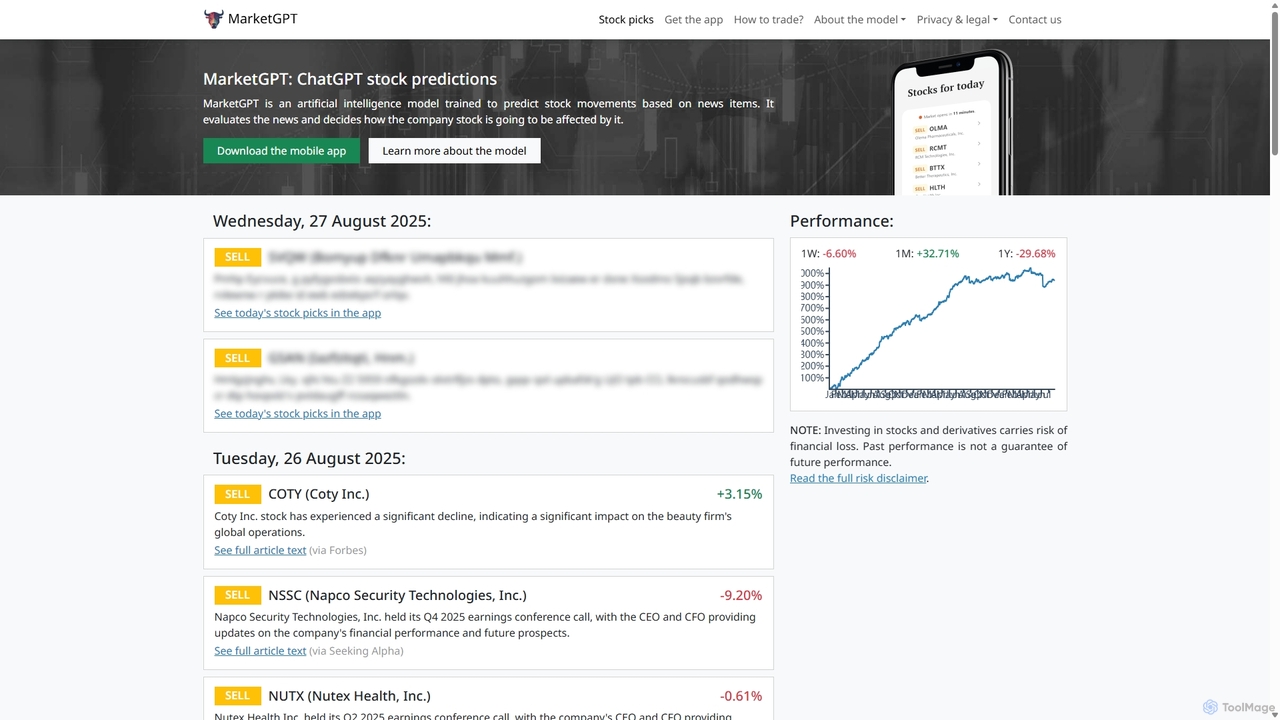
MarketGPT is an AI-powered mobile application that predicts daily stock market movements. By analyzing hundreds of financial news articles and press releases, it provides users with clear 'buy' or 'sell' signals for a curated list of stocks, simplifying day trading strategies.

Stock Market
Visits 7.5KFavorites 137Likes 135
Nucleum AI
Freemium

Nucleum AI

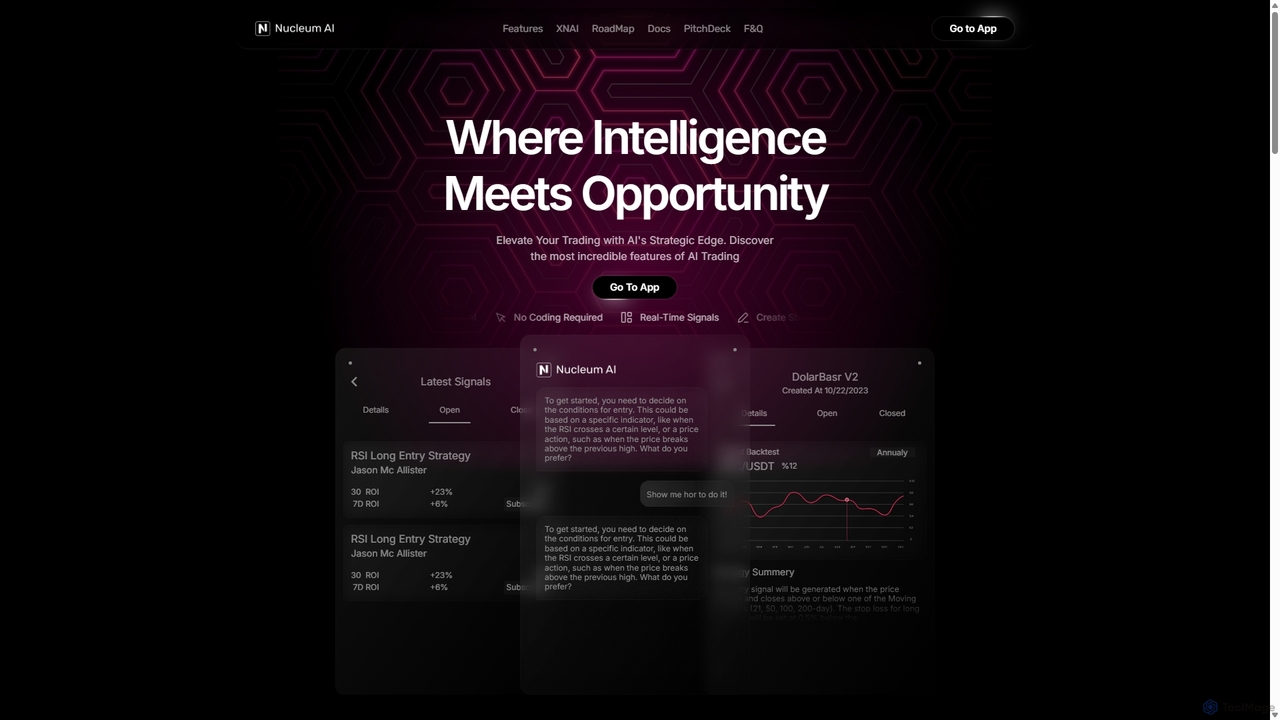
Nucleum AI is a no-code, AI-powered platform that enables users to create, backtest, and deploy algorithmic trading strategies for cryptocurrency markets through a simple conversational interface. Monetize your strategies or subscribe to others in a community-driven marketplace.

Crypto
Visits 6.2KFavorites 133Likes 145
Gunbot
Paid

Gunbot

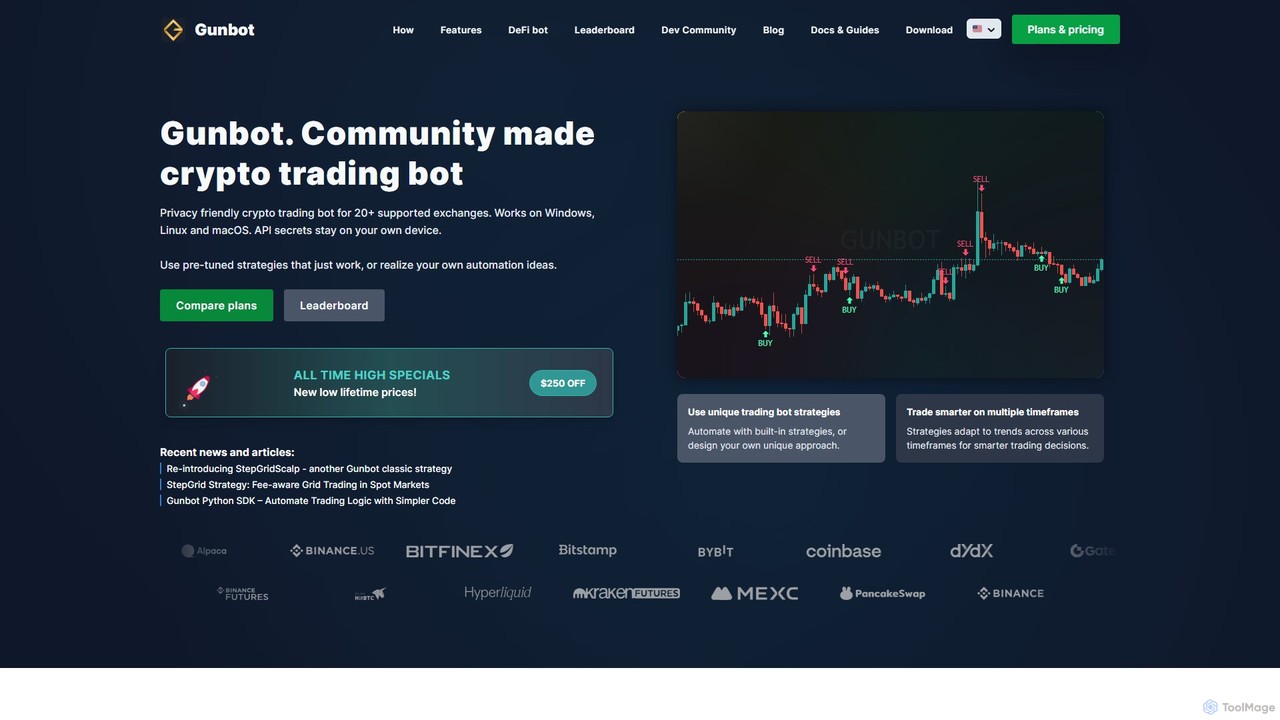
Gunbot is an advanced, privacy-focused crypto trading bot for serious traders. It runs locally on your device (Windows, Mac, Linux), offering total control over your API keys and strategies. Automate your trading 24/7 on 20+ exchanges with pre-built strategies or create your own using JavaScript or AI. It features a one-time payment for a lifetime license, eliminating monthly fees.

Api
Visits 54.6KFavorites 127Likes 141
ConvexValue
Paid

ConvexValue

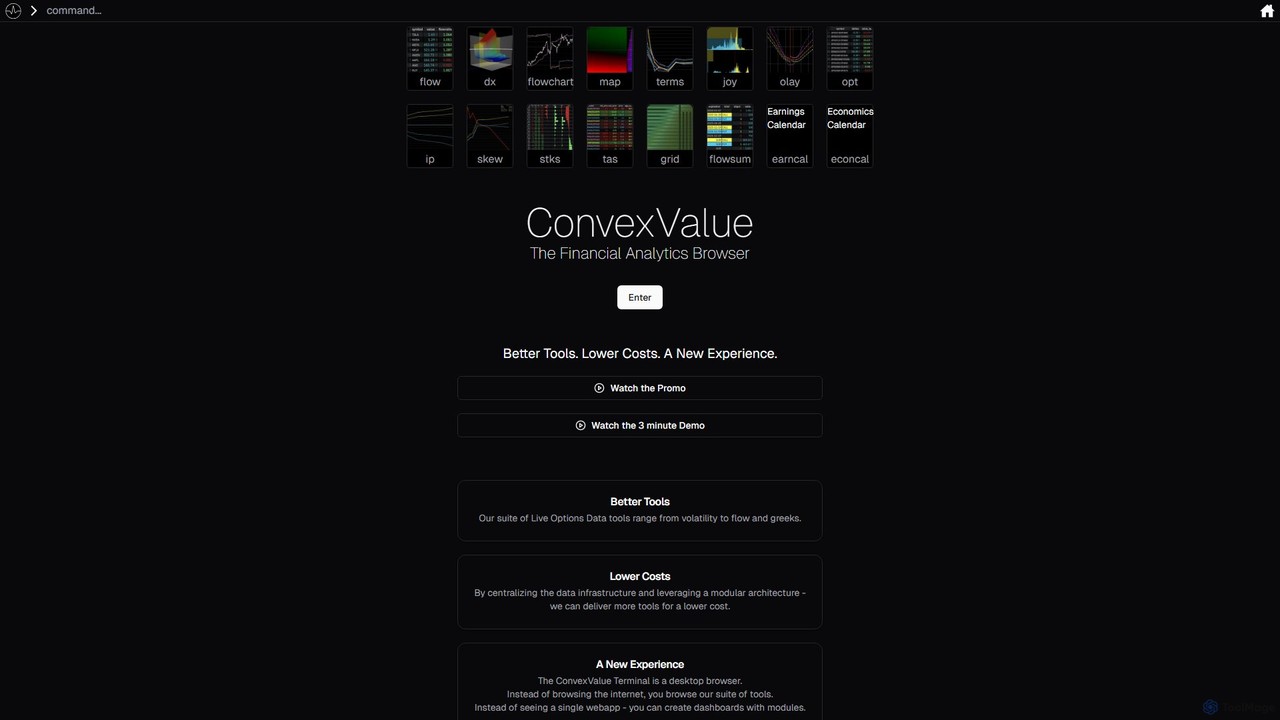
ConvexValue is a powerful financial analytics browser designed for serious traders and analysts. It operates as a desktop terminal, offering a suite of live options data tools for analyzing volatility, order flow, and Greeks. Its unique modular architecture allows users to build, save, and share custom dashboards, providing a highly flexible and cost-effective alternative to traditional financial data platforms.

Investment
Visits 7.1KFavorites 118Likes 114

About Trading

AI Trading tools are a class of software that utilize artificial intelligence to analyze financial markets and execute trades. These tools leverage machine learning algorithms, quantitative analysis, and predictive modeling to identify potential trading opportunities, often faster and more accurately than human traders. Their primary value lies in automating complex strategies, managing risk, and processing vast amounts of market data in real-time. This enables traders to make more informed decisions and react instantly to market fluctuations.

Core Features

  • Predictive Market Analysis: Uses machine learning models to forecast asset price movements based on historical data and market indicators.
  • Algorithmic Strategy Execution: Automatically places buy and sell orders based on predefined AI-driven rules and signals, without manual intervention.
  • Real-time Risk Management: Continuously monitors portfolio exposure and market volatility to automatically adjust positions or trigger stop-losses.
  • Market Sentiment Analysis: Scans news, social media, and financial reports to gauge market sentiment and predict its impact on asset prices.
  • AI-Powered Backtesting: Allows users to test and optimize trading strategies against historical market data to evaluate potential performance.

Use Cases

AI Trading tools are widely used by quantitative hedge funds, institutional investors, and experienced retail traders. They are essential for high-frequency trading (HFT), where execution speed is critical. Other common applications include automated portfolio rebalancing, cryptocurrency arbitrage, and developing complex options trading strategies based on predictive analytics.

How to Choose

When selecting an AI Trading tool, consider the following: the range of supported markets (stocks, forex, crypto), the level of strategy customization and coding required, the platform's execution speed and latency, data integration capabilities with different brokers and data feeds, and the security protocols in place to protect your capital and strategies.

Featured tool rankings

Trading use cases

1

Automating Crypto Arbitrage Trading

A cryptocurrency trader uses an AI trading bot to monitor prices for a specific coin, like BTC, across multiple exchanges simultaneously (e.g., Binance, Coinbase, Kraken). The AI identifies small, fleeting price discrepancies. When it detects that BTC is cheaper on Exchange A than on Exchange B, it instantly executes a buy order on A and a sell order on B, capturing the price difference as profit. This process runs 24/7, capitalizing on opportunities that are too fast for a human to manually execute, significantly increasing potential returns from market inefficiencies.

2

Dynamic Stock Portfolio Rebalancing

An investment manager uses an AI platform to oversee client portfolios. The AI continuously analyzes market data, economic indicators, and the performance of individual stocks within the portfolio against a predefined risk tolerance and investment goal (e.g., growth, income). When the portfolio's asset allocation drifts from the target, the AI automatically calculates and executes the necessary trades to rebalance it. This ensures the portfolio remains aligned with the client's strategy without constant manual review, while also reacting swiftly to significant market shifts.

3

Executing Forex Trades Based on Market Sentiment

A forex trader configures an AI tool to analyze real-time news feeds, central bank announcements, and social media trends related to specific currency pairs like EUR/USD. The AI's natural language processing (NLP) model assigns a sentiment score (positive, negative, neutral) to the incoming information. If a strong negative sentiment regarding the Eurozone economy is detected, coinciding with technical indicators showing a downtrend, the tool automatically executes a short (sell) position on EUR/USD to capitalize on the anticipated price drop.

4

Backtesting and Optimizing AI Trading Models

A quantitative analyst ('quant') develops a new trading algorithm designed to trade S&P 500 futures. Before risking real capital, they use an AI trading platform's backtesting engine. They run the algorithm against years of historical tick-by-tick market data. The AI not only simulates the trades but also uses genetic algorithms or reinforcement learning to automatically tweak the model's parameters (e.g., entry/exit points, risk levels) to find the optimal configuration for maximum profitability and minimal drawdown. This iterative process refines the strategy for real-world deployment.

5

Automated Risk Management for Options Trading

An experienced options trader uses an AI platform to manage a complex portfolio of options spreads. The AI continuously calculates the portfolio's overall risk exposure, including key metrics like Delta, Gamma, and Theta ('the Greeks'). The trader sets predefined thresholds for these metrics. If market volatility causes the portfolio's Delta to exceed the acceptable range, the AI automatically executes a hedging trade, such as buying or selling underlying stock futures, to bring the risk back within limits. This automates a critical but complex risk management task.

6

Executing High-Frequency Trading (HFT) Strategies

A quantitative hedge fund deploys an AI-powered HFT system co-located in the same data center as a major stock exchange to minimize latency. The system's algorithms analyze order book data and market microstructures in microseconds. It identifies tiny, short-lived arbitrage opportunities or liquidity imbalances and executes thousands of trades per second to profit from them. This level of speed and data processing is impossible for humans and relies entirely on sophisticated AI models and high-performance computing infrastructure to operate effectively.

Trading FAQ

What are AI Trading tools?

AI Trading tools are advanced software applications that use artificial intelligence, particularly machine learning, to analyze market data and execute trades. Unlike simple automated bots, they can learn from new data, adapt their strategies over time, and identify complex patterns that are not obvious to human traders. Their primary goal is to increase profitability, manage risk, and remove emotional decision-making from the trading process.

How do I choose the right AI Trading tool?

Choosing the right tool depends on your needs. Consider these factors:

  • Supported Markets: Ensure it works with the assets you trade (stocks, crypto, forex, etc.) and integrates with your broker.
  • Customization vs. Ease of Use: Decide if you need a platform to build complex custom strategies (requiring coding) or a user-friendly tool with pre-built models.
  • Backtesting Capabilities: A robust backtesting engine is crucial for validating strategies with historical data before risking real money.
  • Performance and Speed: For strategies like HFT, low latency and fast execution are non-negotiable.
  • Cost: Pricing models vary from monthly subscriptions to profit-sharing. Evaluate the cost against the features and your expected returns.
What's the difference between AI Trading bots and traditional algorithmic trading?

The key difference lies in adaptability. Traditional algorithmic trading typically relies on a fixed set of rules and predefined conditions (e.g., 'if the 50-day moving average crosses above the 200-day, buy'). AI Trading bots, however, use machine learning models. This allows them to learn from market data, identify new patterns, adapt to changing market conditions, and potentially make more nuanced decisions than a rigid, rule-based system. AI can evolve its strategy, whereas a traditional algorithm must be manually reprogrammed.

Are AI Trading tools suitable for beginners?

It varies. Some AI trading platforms are designed with user-friendly interfaces and pre-built strategies, making them accessible to beginners who understand the inherent risks of trading. However, many advanced tools require significant knowledge of quantitative finance, coding, and market dynamics. For a true beginner, it's often recommended to first gain a solid understanding of trading principles before relying on any automated tool. Using AI without understanding the underlying strategy can lead to significant losses.

What are the main risks of using AI Trading tools?

The primary risks include:

  • Model Risk: The AI model may be flawed or 'overfit' to historical data, causing it to perform poorly in live market conditions.
  • Technical Failures: Bugs, connectivity issues, or platform outages can lead to missed trades or erroneous orders, resulting in significant losses.
  • Market Volatility: Extreme, unforeseen market events (a 'black swan' event) can cause even sophisticated AI models to fail, as they may not have been trained on such data.
  • Lack of Oversight: Relying completely on automation without human supervision can be dangerous. A misconfigured bot could wipe out an account quickly.