ToolMage
Sign in

Best 1 Creativity AI tools for Fun

Popular Creativity AI tools in Fun include StoryBee, helping you work more efficiently.

StoryBee
Paid

StoryBee

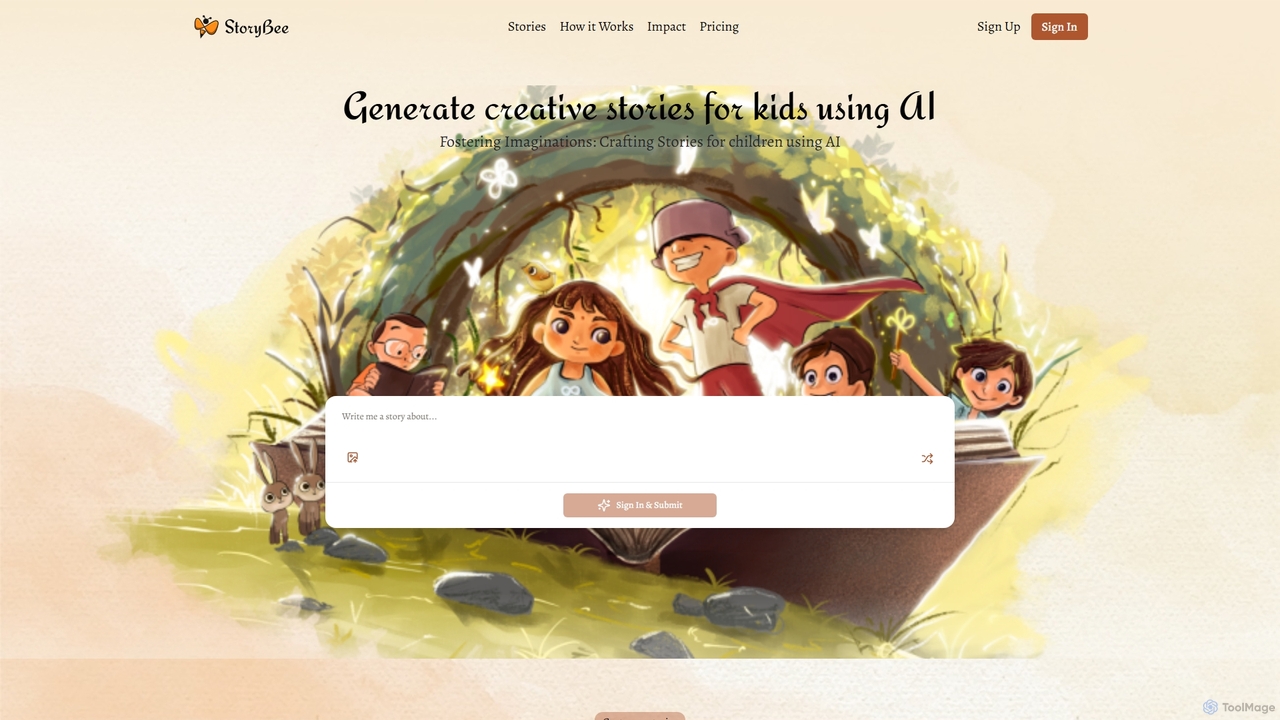
StoryBee is an AI-powered platform for creating personalized children's stories with unique illustrations and audio narration. Generate magical tales from simple prompts, customize genres and styles, and even clone your own voice to read stories aloud. Perfect for parents, educators, and young creators.

Voice Synthesis
Visits 14.1KFavorites 102Likes 97

About Creativity

AI Creativity tools are applications that leverage artificial intelligence to generate, augment, or inspire creative work. These tools often use generative models to produce novel content such as text, images, music, or code from simple user prompts. They serve as powerful partners for artists, writers, and designers, helping to overcome creative blocks and explore new artistic directions. While part of the Fun category due to their engaging and often surprising results, their primary purpose is to empower and accelerate the creative process.

Core Features

  • Idea Generation: Provides prompts, concepts, and brainstorming suggestions to kickstart creative projects.
  • Content Synthesis: Automatically creates original content like articles, poems, digital art, or musical compositions based on user input.
  • Style Transfer & Remixing: Applies the aesthetic style of one piece of content to another or combines multiple ideas into a new creation.
  • Iterative Refinement: Allows users to progressively refine AI-generated outputs by providing feedback or adjusting parameters.

Use Cases

These tools are widely used by content creators for generating social media visuals, writers for drafting story plots, and musicians for composing melodies. Marketing teams also use them for brainstorming slogans and ad copy, while developers might use them for generating code snippets or design mockups.

How to Choose

When selecting an AI Creativity tool, consider the primary output medium you need (e.g., text, image, audio). Evaluate the level of control and customization offered—some tools are simple one-click generators, while others provide advanced parameters. Also, assess the user interface's complexity and the tool's pricing model to ensure it aligns with your skills and budget.

Featured tool rankings

Creativity use cases

1

Brainstorming Story Plots and Characters

For authors and screenwriters facing writer's block, AI creativity tools can be an invaluable partner. By inputting a basic premise, genre, or character archetype, the user can generate dozens of potential plot twists, character backstories, and dialogue snippets. This process transforms a blank page into a rich landscape of ideas, allowing the writer to select, combine, and refine the most compelling elements. It significantly reduces ideation time and introduces unexpected narrative paths that can enrich the final story.

2

Creating Unique Digital Art for Social Media

Social media managers and content creators constantly need fresh, eye-catching visuals. AI creativity tools, particularly text-to-image generators, enable them to produce unique artwork without advanced graphic design skills. A user can simply describe a scene, mood, or concept—like 'a cat in a spacesuit floating in a galaxy, pop art style'—and the AI generates multiple visual interpretations. This allows for rapid creation of custom illustrations, banners, and posts that stand out in a crowded feed.

3

Composing Royalty-Free Music for Videos

Video creators on platforms like YouTube and TikTok often struggle to find affordable, high-quality background music. AI music generators solve this problem by creating original musical pieces on demand. Users can specify parameters such as genre (e.g., lo-fi, cinematic, electronic), mood (e.g., upbeat, melancholic), and duration. The AI then composes a unique, royalty-free track that can be used in their video projects, avoiding copyright issues and the high cost of stock music licenses.

4

Generating Slogans and Brand Names

For marketing professionals and entrepreneurs launching a new product or company, finding the perfect name or slogan is a critical challenge. AI creativity tools can accelerate this process by generating hundreds of options based on keywords, industry, and target audience. The AI can explore different linguistic styles, from witty and modern to classic and professional, providing a diverse pool of ideas that a human team might not have considered. This serves as a powerful brainstorming assistant to kickstart branding discussions.

5

Designing Concept Art for Games and Films

Concept artists in the gaming and film industries use AI tools to rapidly visualize worlds, characters, and props. By providing textual descriptions or rough sketches, an artist can generate numerous high-fidelity concept images in various styles. This allows for quick exploration of different creative directions before committing significant time to manual rendering. The AI acts as a multiplier of creative output, enabling artists to iterate on ideas at an unprecedented speed and present a wider range of possibilities to directors and stakeholders.

6

Crafting Personalized Poems and Greeting Cards

Individuals looking to create a heartfelt and unique message for a special occasion can use AI creativity tools. Whether for a birthday, anniversary, or holiday, a user can input details about the recipient, the event, and the desired tone. The AI can then draft a personalized poem, a witty greeting, or a touching message. This moves beyond generic store-bought cards, allowing anyone to express their feelings in a creative and customized way, even without strong writing skills.

Creativity FAQ

What are AI Creativity tools?

AI Creativity tools are software applications that use artificial intelligence to assist in or automate the creation of original content. They function as a creative partner, capable of generating text, images, music, and ideas from user prompts. Unlike traditional software that requires manual input for every detail, these tools can interpret abstract concepts and produce novel outputs, helping users overcome creative blocks and explore new possibilities.

How do I choose the right AI Creativity tool?

To choose the right tool, first identify your primary need: are you creating images, writing text, or composing music? Next, consider the level of control you require. Some tools offer simple, one-click generation, while others provide advanced settings for fine-tuning results. Also, evaluate the user interface for ease of use and check the pricing model (e.g., subscription, pay-per-use) to ensure it fits your budget. Finally, review the tool's policy on commercial use if you plan to use the creations for business.

What is the difference between AI Creativity tools and professional software like Adobe Photoshop?

The key difference lies in their core function: generation versus manipulation. AI Creativity tools excel at generating new content from scratch based on prompts (ideation and creation). Professional software like Photoshop excels at manipulating and refining existing or manually created assets with precision (editing and post-production). They are often complementary; an artist might generate a base image with an AI tool and then import it into Photoshop for detailed editing and composition.

Can I use AI-generated content for commercial purposes?

The ability to use AI-generated content commercially depends entirely on the specific tool's terms of service and licensing agreements. Some platforms grant users full ownership and commercial rights to the creations, while others may restrict usage to personal or non-commercial projects. The legal landscape around AI and copyright is also evolving. It is crucial to read and understand the terms of any tool before using its output for business purposes.

Do I need to be an artist or writer to use these tools?

No, you do not need to be a professional artist or writer. One of the main benefits of AI Creativity tools is that they lower the barrier to creative expression. They empower individuals without technical skills to visualize ideas, write stories, or compose music. For professionals, these tools act as powerful assistants that can speed up workflows, provide inspiration, and automate repetitive tasks, allowing them to focus on higher-level creative decisions.