ToolMage
Sign in

Best 1 Content Creation AI tools for Generative Ai

Popular Content Creation AI tools in Generative Ai include Yugong, helping you work more efficiently.

Yugong
Free

Yugong

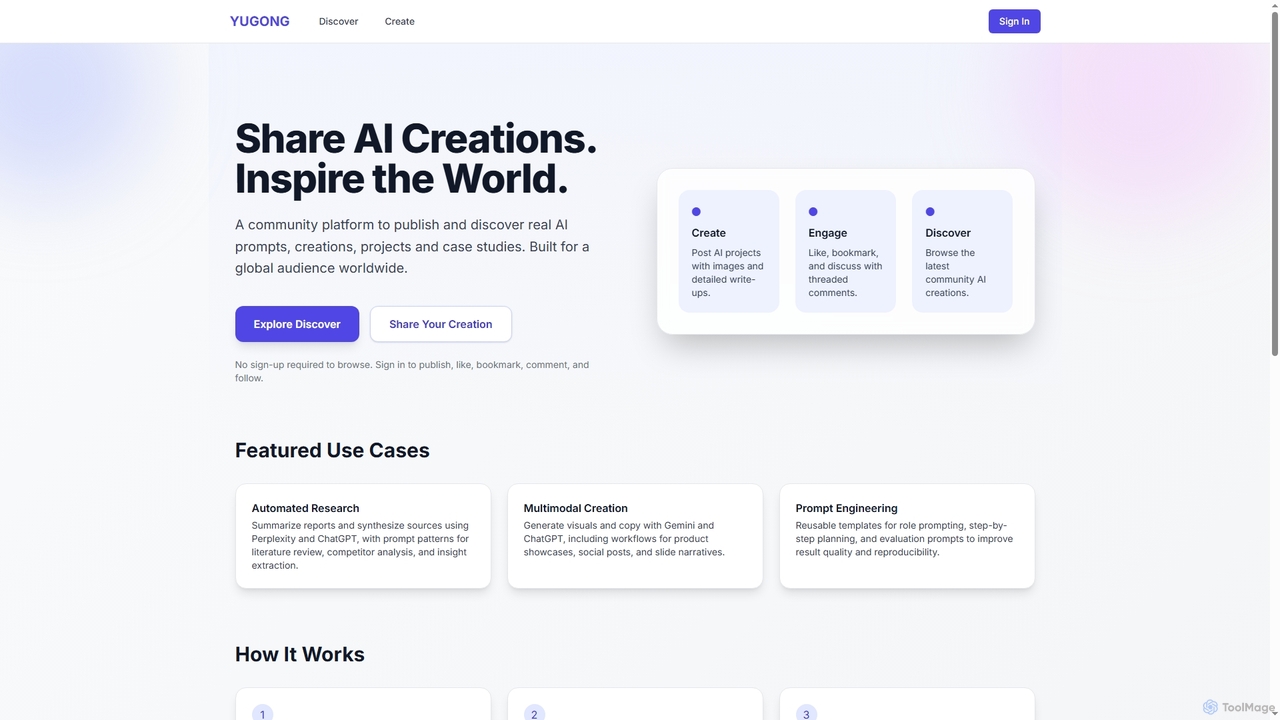
Yugong is a global community platform for discovering and sharing AI creations, prompts, projects, and case studies. It enables users to publish detailed AI workflows, engage with a worldwide audience, and explore innovative applications of AI tools like ChatGPT, Gemini, and Perplexity.

Prompt Sharing
Visits 3.9KFavorites 114Likes 109

About Content Creation

Content Creation tools are AI-powered applications designed to generate, assist, and optimize various forms of digital content. Leveraging advanced generative AI models, these tools can produce text, images, audio, and video from simple prompts or existing data. They significantly accelerate the content production workflow, enhance creative output, and ensure brand consistency across multiple platforms.

Core Features

  • Text Generation: Automatically writes articles, marketing copy, social media posts, and scripts based on user input.
  • Image & Video Synthesis: Creates unique visuals, illustrations, and short video clips from textual descriptions or reference media.
  • Audio Production: Generates voiceovers, background music, and sound effects, often with customizable tones and styles.
  • Content Optimization: Analyzes existing content for SEO, readability, and engagement, suggesting improvements.
  • Multi-modal Generation: Combines text, image, and audio generation to produce integrated content pieces.

Use Cases

Content Creation AI tools are invaluable for marketing teams, individual content creators, and businesses aiming to scale their digital presence. They are used to quickly draft blog posts, design social media graphics, produce engaging video scripts, and generate personalized email campaigns, drastically reducing manual effort and time-to-market for new content initiatives.

How to Choose

When selecting a Content Creation AI tool, consider its specific content types (text, image, video, audio), the quality and customizability of its output, and its integration capabilities with existing workflows. Evaluate the ease of use, the range of templates or styles offered, and the pricing model, ensuring it aligns with your budget and content volume needs.

Featured tool rankings

Content Creation use cases

1

Generating Marketing Copy for Campaigns

Marketing professionals often need to produce a high volume of diverse copy for various campaigns, including ad headlines, social media posts, email newsletters, and landing page content. AI content creation tools allow them to input key product features or campaign themes and instantly generate multiple copy variations, saving hours of manual writing and brainstorming. This accelerates campaign launches and enables A/B testing of different messages to optimize performance.

2

Generate Marketing Copy for Campaigns

Marketing specialists can use AI content creation tools to rapidly generate diverse ad copy, headlines, and product descriptions for various marketing channels. By inputting key product features and target audience details, the AI produces multiple compelling variations, allowing teams to quickly test and optimize campaign performance without extensive manual writing.

3

Drafting Blog Posts and Articles

Content writers and bloggers frequently face writer's block or tight deadlines for producing engaging long-form content. AI writing assistants can generate initial drafts, outlines, or even full articles based on a topic and keywords. Users can then refine, fact-check, and add their unique voice, significantly reducing the time spent on research and initial composition. This helps maintain a consistent publishing schedule and explore new topics efficiently.

4

Automate Blog Post Drafts and Outlines

Content writers and bloggers leverage these tools to overcome writer's block and accelerate the initial drafting phase. By providing a topic and a few keywords, the AI can generate comprehensive outlines, introductory paragraphs, or even full first drafts of articles, significantly reducing the time spent on research and structuring content, enabling faster publication cycles.

5

Creating Unique Visuals for Social Media

Social media managers constantly require fresh, eye-catching visuals to accompany their posts and stories. AI image generation tools enable them to describe desired scenes, styles, or concepts in text and receive unique images or illustrations. This eliminates the need for extensive stock photo searches or graphic design skills, allowing for rapid content production that stands out and aligns perfectly with brand messaging.

6

Create Social Media Content at Scale

Social media managers can utilize AI to produce a high volume of engaging posts, captions, and relevant hashtags across platforms. The tools help maintain a consistent brand voice, adapt content for different audiences, and even suggest optimal posting times, ensuring a vibrant and active online presence with minimal manual effort.

7

Design Unique Visuals for Digital Media

Graphic designers and digital artists can employ AI content creation tools to generate unique images, illustrations, and background graphics from text prompts. This accelerates the conceptualization phase, provides endless creative variations, and helps in quickly producing visuals for websites, presentations, or marketing materials without needing extensive manual design skills.

8

Personalizing E-commerce Product Descriptions

E-commerce businesses with large product catalogs struggle to write unique, compelling descriptions for every item. AI content generators can take basic product information (name, features, benefits) and automatically create engaging, SEO-friendly descriptions tailored to different target audiences or platforms. This not only saves immense time but also improves product discoverability and conversion rates by providing richer, more persuasive content.

9

Produce Voiceovers and Audio Content

Podcasters, video producers, and e-learning developers use AI to generate realistic voiceovers for their projects. By simply typing in the script, the AI can produce natural-sounding speech in various languages and voices, eliminating the need for recording studios or professional voice actors, and speeding up audio production significantly.

10

Developing Video Scripts and Storyboards

Video content creators, from YouTubers to corporate trainers, can leverage AI to streamline the pre-production phase. AI tools can generate detailed video scripts, scene descriptions, and even storyboard ideas based on a given topic, target audience, and desired video length. This helps in structuring narratives, ensuring key messages are covered, and visualizing the final product before filming, accelerating the entire video creation process.

11

Personalize Email Marketing Campaigns

Email marketers can use AI to craft highly personalized email subject lines, body content, and calls-to-action for different customer segments. The AI analyzes customer data and preferences to generate tailored messages, increasing open rates, click-through rates, and overall engagement, leading to more effective and targeted communication.

12

Localizing Content for Global Audiences

Businesses expanding into international markets need to adapt their content for different languages and cultural nuances. AI content creation tools with advanced translation and localization capabilities can translate marketing materials, website content, and product documentation while maintaining context and tone. This ensures that global audiences receive relevant and culturally appropriate messages, facilitating broader market reach and engagement.

Content Creation FAQ

What are AI Content Creation tools?

AI Content Creation tools are software applications that use artificial intelligence, particularly generative AI, to automate and assist in the production of various forms of digital content. This includes generating text (articles, marketing copy), images, videos, and audio from user prompts, significantly streamlining the content development process and enhancing creative output.

What are AI Content Creation tools?

AI Content Creation tools are software applications that use artificial intelligence, particularly generative AI, to assist in producing various forms of content. They can generate text, images, video scripts, and audio based on user prompts, helping to automate and accelerate the content production workflow for individuals and businesses alike. These tools aim to boost creativity and efficiency across different content formats.

How do AI Content Creation tools work?

AI Content Creation tools typically work by leveraging large language models (LLMs) for text generation or diffusion models for image/video generation. Users provide prompts, keywords, or existing content, and the AI processes this input using its trained data to generate new, relevant, and often unique output. The underlying algorithms learn patterns, styles, and information from vast datasets to produce human-like or visually coherent content.

How do AI Content Creation tools differ from traditional content creation methods?

Traditional content creation relies heavily on manual human effort, requiring significant time for brainstorming, writing, designing, and editing. AI Content Creation tools, conversely, leverage algorithms to generate content rapidly, offer diverse variations, and automate repetitive tasks, drastically reducing time and resources while often providing new creative directions.

What types of content can AI Content Creation tools generate?

These tools are highly versatile and can generate a wide range of content types. This includes written content like blog posts, articles, social media captions, ad copy, and scripts; visual content such as images, illustrations, and short videos; and audio content like voiceovers, podcasts, and background music. Many tools also support multi-modal content generation.

What are the main benefits of using AI for content creation?

The main benefits of using AI for content creation include significant time savings by automating repetitive tasks like drafting and brainstorming, enhanced productivity allowing for higher content volume, and improved content quality through AI-driven suggestions and optimization. AI can also help overcome creative blocks, personalize content at scale, and ensure consistency in tone and style across different pieces.

How do AI Content Creation tools differ from traditional content creation methods?

AI Content Creation tools differ from traditional methods primarily in their automation and generative capabilities. Traditional methods rely entirely on human effort for ideation, drafting, and execution, which can be time-consuming and resource-intensive. AI tools, conversely, can generate content autonomously or semi-autonomously, providing drafts, ideas, or even final pieces much faster, allowing human creators to focus on refinement, strategy, and unique insights.

How can I ensure the quality and originality of AI-generated content?

To ensure quality and originality, it's crucial to provide clear, detailed prompts to the AI. Always review and edit the generated content for accuracy, tone, factual correctness, and brand voice. Many tools offer customization options and plagiarism checks. Human oversight remains essential to refine AI output and add a unique, authentic touch.

Who benefits most from using AI Content Creation tools?

A wide range of professionals and organizations benefit, including marketing teams, content creators, social media managers, bloggers, e-commerce businesses, and small business owners. Anyone needing to produce high volumes of diverse content efficiently, enhance creativity, or maintain brand consistency across platforms will find these tools highly valuable.

Can AI Content Creation tools replace human content creators?

While AI Content Creation tools are powerful assistants, they are not designed to fully replace human content creators. AI excels at generating drafts, automating repetitive tasks, and providing data-driven insights. However, human creators bring critical thinking, emotional intelligence, nuanced understanding of brand voice, cultural context, and ethical judgment that AI currently lacks. The most effective approach is often a collaboration, where AI handles the heavy lifting and humans provide the strategic oversight and creative refinement.