Fauxto Labs
Fauxto Labs is a comprehensive AI creative suite offering over 50 tools and 10+ models for generating images, …
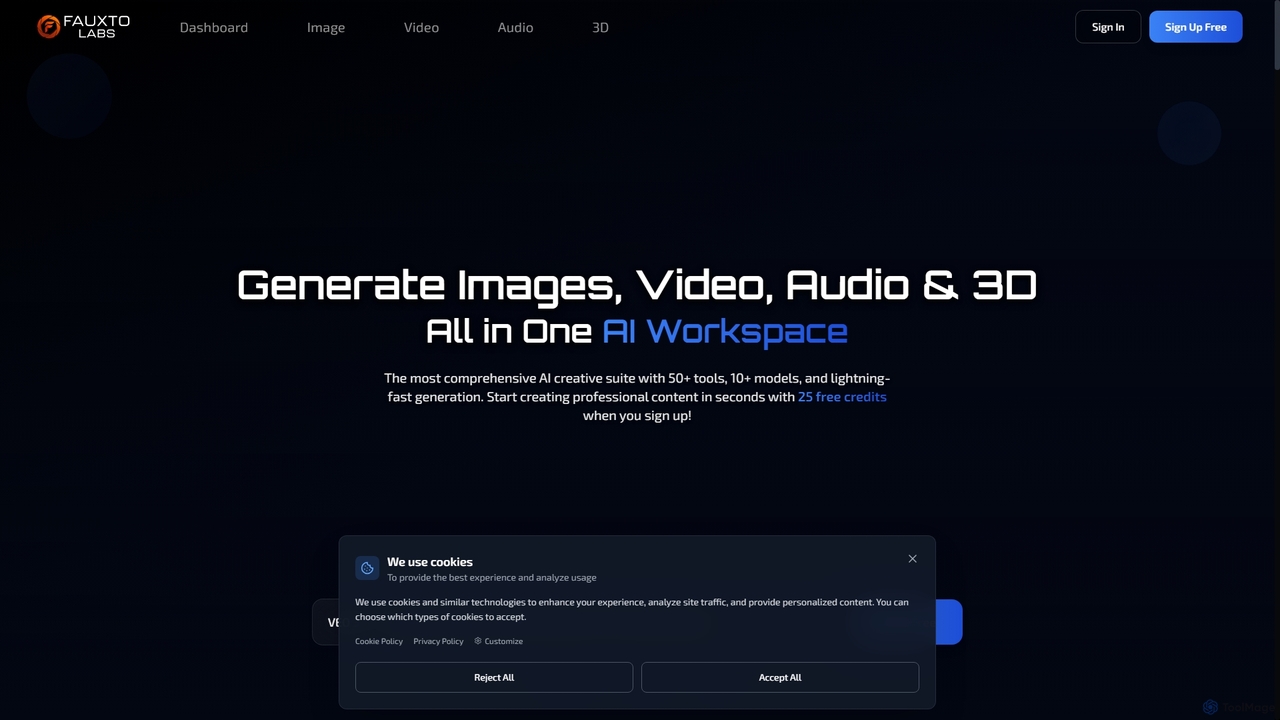
Fauxto Labs is a comprehensive AI creative suite offering over 50 tools and 10+ models for generating images, videos, audio, and 3D content. It provides lightning-fast generation, advanced editing capabilities, and personalized AI models, empowering creators to transform ideas into professional content efficiently.
About 3D Generation
AI 3D Generation tools are a class of software that automatically create three-dimensional models from inputs like text, images, or videos. These tools utilize advanced generative models, such as NeRFs and GANs, to interpret user prompts and construct complex 3D assets. This technology dramatically accelerates workflows in game development, product design, and virtual reality, enabling rapid prototyping and content creation without extensive manual modeling. It bridges the gap between a simple idea and a tangible 3D object.
Core Features
- Text-to-3D: Generates 3D models directly from descriptive text prompts.
- Image-to-3D: Converts single or multiple 2D images into a 3D object.
- Video-to-3D: Reconstructs 3D scenes or objects from video footage using techniques like photogrammetry.
- Automatic Texturing: Creates and applies plausible textures and materials to the generated models.
- Mesh Optimization: Provides options to control the polygon count and topology for different use cases.
Use Cases
These tools are frequently used by game developers for rapid asset creation, architects for conceptual visualization, and e-commerce businesses for generating 3D product models for AR viewers. They also empower VFX artists and animators to quickly produce background elements or character prototypes, significantly reducing production time.
How to Choose
When selecting an AI 3D Generation tool, consider the quality and detail of the output models, the variety of supported input types (text, image, video), and available export formats (e.g., OBJ, FBX, glTF). Also, evaluate the platform's ease of use, processing speed, and pricing model, which is often based on generation credits or a subscription.

3D GenerationUse Cases
Rapid Prototyping for Game Assets
An indie game developer needs to create dozens of unique props like chests, barrels, and furniture for a new game level. Instead of spending weeks modeling each item manually, they use a text-to-3D tool. By inputting prompts such as "a weathered wooden treasure chest with iron fittings" or "a glowing fantasy potion bottle," they can generate a wide variety of assets. This process allows them to produce a library of over 50 unique, low-poly assets in a single day, drastically accelerating the world-building phase of development.
Creating 3D Models for E-commerce
An e-commerce manager wants to implement an "AR View in Your Room" feature for a new furniture line. Traditionally, this would require expensive photoshoots and 3D artists. By using an image-to-3D tool, they can upload standard product photos of chairs and tables. The AI processes these images and generates web-ready 3D models. This allows the company to create 3D/AR versions for its entire product catalog at a fraction of the cost, enhancing customer engagement and potentially increasing conversion rates by allowing virtual try-ons.
Architectural Concept Visualization
An architect needs to quickly visualize a building concept for a client presentation. Instead of spending days creating a detailed model in CAD software, they use an AI 3D generator. By inputting a simple sketch or a text prompt like "a modern glass-facade office building with a rooftop garden," the tool produces multiple 3D conceptual models within minutes. This allows for rapid iteration and effective communication of design ideas, helping clients visualize the project's form and scale early in the design process.
Generating Assets for VFX and Animation
A VFX artist is tasked with populating a digital scene with numerous background elements like rocks, trees, and debris. Manually modeling or sourcing each unique asset would be time-consuming. Using an AI 3D generation tool, the artist can create a large library of variations from a few base images or text prompts. This allows them to quickly build a diverse and natural-looking environment, saving significant production time and ensuring a unique visual style for the project without relying solely on stock models.
Digital Twin Creation from Video Scans
An industrial engineer needs to create a digital twin of a piece of machinery for maintenance planning. Instead of using expensive laser scanners, they use a video-to-3D tool. By capturing video footage while walking around the object with a smartphone, the AI can process the video to reconstruct a detailed 3D model. This provides an accurate 3D representation of the physical asset, facilitating remote inspections, simulation of maintenance procedures, and planning for equipment upgrades without needing to be physically present.
Custom 3D Printing and Prototyping
A product designer or hobbyist wants to create a unique physical object, like a custom phone stand or a tabletop miniature, for 3D printing. They might lack advanced skills in traditional 3D modeling software. Using a text-to-3D tool, they can simply describe the desired object, such as "a phone stand shaped like a dragon holding a shield." The tool generates a 3D model that can then be exported as an STL file, ready for a 3D printer. This democratizes product design, allowing anyone to turn a creative idea into a physical prototype in hours.