ToolMage
Sign in

Best 1 Enterprise Ai AI tools for Generative Ai

Popular Enterprise Ai AI tools in Generative Ai include TransOrg, helping you work more efficiently.

TransOrg

TransOrg

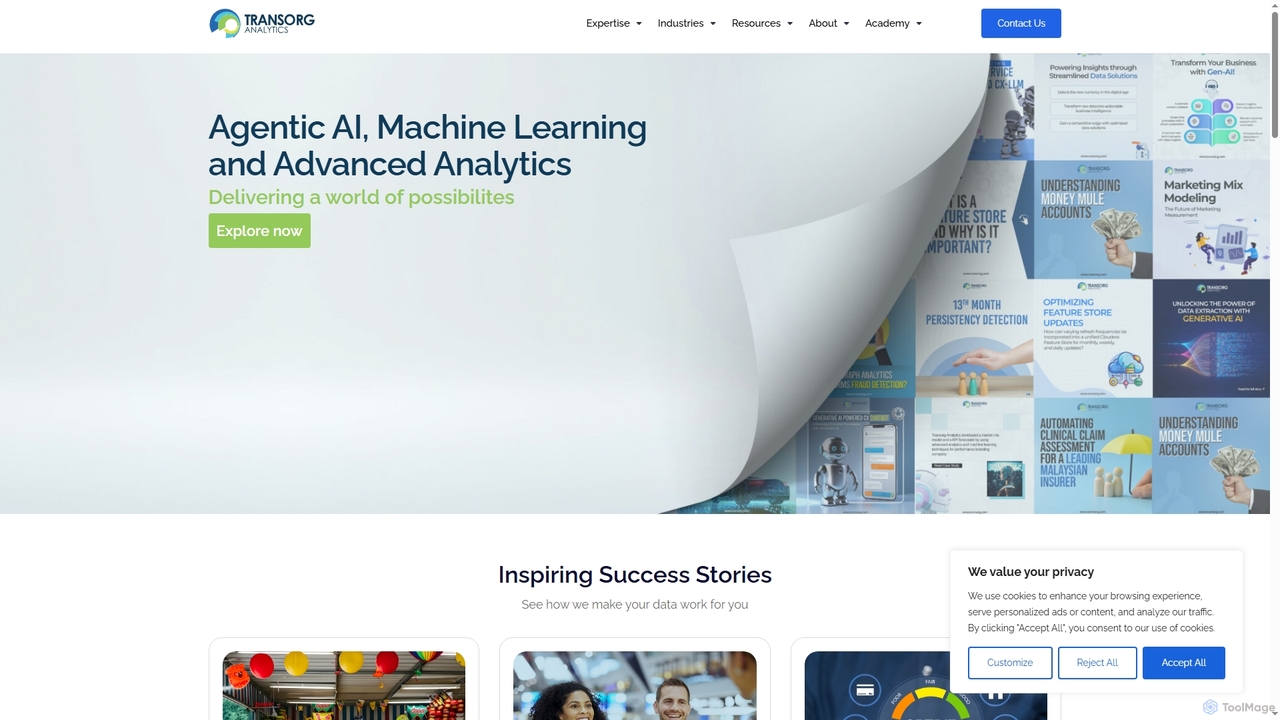
TransOrg specializes in advanced analytics, machine learning, and generative AI solutions, empowering enterprises to transform data into actionable insights. It offers services like Agentic AI, feature extraction, voice bot analytics, and robust data engineering to drive operational efficiency and enhance customer experiences across diverse industries.

3D
Visits 7.8KFavorites 162Likes 155

About Enterprise Ai

Enterprise AI refers to AI-powered solutions specifically designed and deployed within large organizations to solve complex business problems and drive strategic outcomes. While often leveraging generative AI capabilities, these tools are tailored for enterprise-grade scalability, security, and seamless integration with existing IT infrastructures. They enable businesses to automate intricate processes, enhance data-driven decision-making, and unlock significant new value across various departments, from operations to customer service. This category focuses on robust, reliable, and highly customizable AI applications built for the unique demands of corporate environments, ensuring compliance and performance at scale.

Core Features

  • Scalability & Performance: Designed to handle massive volumes of data and concurrent user requests efficiently, ensuring consistent performance as enterprise needs grow.
  • Security & Compliance: Adheres to stringent industry regulations and data privacy standards, offering advanced security protocols, access controls, and audit trails for sensitive corporate data.
  • Integration Capabilities: Seamlessly connects with existing enterprise resource planning (ERP), customer relationship management (CRM), human resources (HR), and other proprietary IT systems.
  • Customization & Fine-tuning: Provides tools and frameworks for businesses to train, adapt, and fine-tune AI models using their proprietary data, ensuring relevance and accuracy for specific internal use cases.
  • Advanced Analytics & Reporting: Offers deep insights into operational data, market trends, and customer behavior, supporting strategic planning and informed decision-making with comprehensive dashboards.

Applicable Scenarios

Enterprise AI is utilized across diverse sectors like finance, manufacturing, healthcare, and retail to transform core operations. Financial institutions deploy it for sophisticated fraud detection, real-time risk assessment, and personalized wealth management. Manufacturers leverage it for predictive maintenance of machinery, optimizing complex supply chains, and improving quality control. In healthcare, it aids in accelerating drug discovery, personalizing treatment plans, and streamlining administrative tasks. Retailers use it for hyper-personalized customer experiences, dynamic pricing strategies, and efficient inventory management, driving both efficiency and innovation.

How to Choose

Selecting an Enterprise AI solution requires a thorough evaluation of several critical factors. Prioritize solutions offering high scalability and robust security features to protect sensitive corporate data and ensure regulatory compliance. Assess the integration capabilities with your current IT ecosystem, including APIs and connectors, to guarantee seamless workflow and data exchange. Consider the level of customization and fine-tuning available, allowing the AI to adapt precisely to unique business processes and data sets. Finally, evaluate vendor support, comprehensive compliance certifications, and the total cost of ownership, including implementation and maintenance, for long-term viability and return on investment.

Enterprise Ai use cases

1

Automating Customer Service Operations

Large enterprises often face high volumes of customer inquiries. Enterprise AI-powered virtual assistants and chatbots can handle routine questions, process service requests, and guide customers through complex issues 24/7. This frees human agents to focus on more complex cases, significantly reducing response times and improving customer satisfaction while cutting operational costs by up to 30%.

2

Automate Enterprise Customer Service with AI

Large enterprises often face high volumes of customer inquiries across multiple channels. Enterprise AI tools, such as intelligent chatbots and virtual assistants, can automate the handling of routine questions, provide instant support, and efficiently route complex issues to human agents. This significantly reduces operational costs, improves response times, and enhances overall customer satisfaction by offering 24/7 personalized assistance, freeing up human agents for more complex tasks.

3

Optimizing Supply Chain & Logistics

For global manufacturers and retailers, managing complex supply chains is critical. Enterprise AI analyzes vast datasets from inventory, logistics, weather, and market demand to predict disruptions, optimize routing, and manage stock levels. This leads to reduced shipping costs, minimized waste, and improved on-time delivery rates, enhancing overall operational resilience and efficiency.

4

Optimize Supply Chain with Predictive AI

For global corporations, managing complex supply chains is critical for efficiency and cost control. Enterprise AI solutions analyze vast datasets from inventory, logistics, and market trends to predict demand fluctuations, optimize routing, and identify potential disruptions before they occur. This enables proactive decision-making, reduces waste, improves delivery efficiency, and minimizes risks associated with unforeseen events, leading to substantial cost savings and improved resilience.

5

Enhance Strategic Decisions with AI Analytics

Business leaders require timely and accurate insights from their vast enterprise data to make informed strategic decisions. Enterprise AI platforms can process and analyze structured and unstructured data from various sources, identifying patterns, anomalies, and correlations that human analysis might miss. This provides actionable intelligence for strategic planning, market entry, product development, and resource allocation, empowering more informed and effective business decisions that drive growth.

6

Enhancing Financial Fraud Detection

Financial institutions are constantly battling sophisticated fraud schemes. Enterprise AI systems analyze transaction patterns, user behavior, and external data sources in real-time to identify anomalies and potential fraudulent activities with high accuracy. This proactive approach helps prevent significant financial losses, protects customer assets, and ensures compliance with regulatory requirements, strengthening trust and security.

7

Personalizing Marketing & Sales at Scale

Enterprises need to engage millions of customers with relevant content. AI tools analyze customer data, purchase history, and online behavior to generate hyper-personalized marketing campaigns, product recommendations, and sales pitches across multiple channels. This increases conversion rates, improves customer loyalty, and drives revenue growth by delivering tailored experiences efficiently.

8

Personalize Marketing and Sales at Scale

Enterprises aim to deliver highly personalized experiences to a diverse customer base to drive engagement and loyalty. AI tools analyze customer behavior, preferences, and purchase history to segment audiences, recommend products, and tailor marketing messages across channels. This hyper-personalization drives higher engagement, conversion rates, and customer loyalty, while optimizing marketing spend by targeting the most receptive segments and improving overall campaign effectiveness.

9

Streamline Internal Knowledge Management

Large organizations often struggle with fragmented internal knowledge bases and information silos, hindering employee productivity. Enterprise AI solutions can centralize, categorize, and make internal documents, policies, and expert knowledge easily searchable and accessible through intelligent search engines or Q&A systems. This empowers employees with quick access to accurate information, reduces training time for new hires, and fosters a more efficient and collaborative work environment, improving overall operational fluency.

10

Streamlining HR Talent Acquisition

Recruiting top talent efficiently is a major challenge for large corporations. Enterprise AI assists HR departments by automating resume screening, identifying best-fit candidates based on skills and experience, and even conducting initial AI-powered interviews. This accelerates the hiring process, reduces unconscious bias, and ensures a more diverse and qualified talent pool, saving significant time and resources.

11

Detect and Prevent Financial Fraud with AI

Financial institutions face constant threats from sophisticated fraud schemes, leading to significant losses and reputational damage. Enterprise AI systems continuously monitor transaction data, user behavior, and network activities in real-time to detect unusual patterns and anomalies indicative of fraudulent activity. By leveraging advanced machine learning algorithms, these tools can identify and flag potential fraud much faster and more accurately than traditional methods, protecting assets and maintaining customer trust.

12

Predictive Maintenance in Manufacturing

In industrial settings, equipment downtime can lead to massive losses. Enterprise AI monitors sensor data from machinery in real-time, predicting potential failures before they occur. By analyzing vibration, temperature, and performance metrics, AI schedules maintenance proactively, minimizing unexpected breakdowns, extending equipment lifespan, and significantly reducing operational costs and production interruptions.

Enterprise Ai FAQ

What is Enterprise AI?

Enterprise AI refers to artificial intelligence solutions specifically developed and deployed to address the complex needs and challenges of large organizations. Unlike general AI tools, Enterprise AI focuses on delivering business value through enhanced scalability, robust security, seamless integration with existing corporate systems, and adherence to strict regulatory compliance. It leverages advanced algorithms to automate processes, optimize operations, and inform strategic decision-making across various departments.

What is Enterprise AI?

Enterprise AI refers to artificial intelligence solutions specifically designed for large organizations, focusing on robust scalability, stringent security, and seamless integration with existing business systems. Unlike general AI tools, Enterprise AI addresses complex, large-scale business challenges such as optimizing supply chains, automating customer service, and enhancing data-driven decision-making. It prioritizes data governance, compliance, and delivering measurable business value across the entire organization, often incorporating advanced machine learning and sometimes generative AI capabilities.

How does Enterprise AI differ from general Generative AI?

While Enterprise AI can incorporate generative AI capabilities, its primary distinction lies in its application context and operational requirements. General Generative AI focuses on creating new content (text, images, code) based on learned patterns. Enterprise AI, however, is designed for the specific demands of a business environment, emphasizing data privacy, security, integration with proprietary systems, auditability, and the ability to operate at scale within a company's existing infrastructure. It's about applying AI to solve specific, measurable business problems rather than just content generation.

How does Enterprise AI differ from general AI or consumer AI?

Enterprise AI differs significantly from general or consumer AI in its scale, security, and purpose. General AI tools are often broad in application, while consumer AI focuses on individual user experiences (e.g., voice assistants). Enterprise AI, however, is built for organizational deployment, handling massive datasets, integrating with complex IT infrastructures, and meeting strict regulatory compliance. Its primary goal is to solve specific business problems, drive ROI, and operate within a secure, managed environment, often requiring extensive customization and dedicated support tailored to corporate needs.

What are the key benefits of implementing Enterprise AI?

Implementing Enterprise AI offers numerous benefits, including significant operational efficiency gains through automation of repetitive tasks, leading to cost reductions. It enhances decision-making by providing deep, data-driven insights and predictive analytics, allowing for more informed strategic planning. Furthermore, Enterprise AI improves customer experiences through personalization and faster service, fosters innovation by enabling new business models, and strengthens compliance and risk management through advanced monitoring and detection capabilities. It ultimately drives competitive advantage.

What are the key benefits of implementing Enterprise AI?

Implementing Enterprise AI offers several key benefits for large organizations. It significantly enhances operational efficiency through automation of repetitive tasks and optimization of complex processes like supply chain management. AI provides deeper insights from vast datasets, enabling more informed strategic decision-making. Furthermore, it improves customer experiences through personalized interactions and faster service, while also bolstering security measures like fraud detection. Ultimately, Enterprise AI drives innovation, reduces costs, and creates new revenue opportunities, contributing to a competitive advantage.

How to choose the right Enterprise AI solution for my business?

Choosing the right Enterprise AI solution involves evaluating several critical factors. First, assess its scalability and performance to ensure it can handle your organization's data volume and user load. Second, prioritize robust security features and compliance certifications relevant to your industry. Third, verify its integration capabilities with your existing IT infrastructure and data sources. Fourth, consider the level of customization and fine-tuning options available to align with your unique business processes. Finally, evaluate the vendor's support, implementation roadmap, and total cost of ownership.

What are the main challenges in adopting Enterprise AI?

Adopting Enterprise AI presents several challenges. Data quality and availability are crucial, as AI models require clean, comprehensive datasets. Integration with legacy systems can be complex and time-consuming. Organizations also face a shortage of skilled AI talent for development and maintenance. Ensuring data privacy, security, and compliance with regulations like GDPR is paramount. Additionally, managing organizational change and demonstrating a clear return on investment (ROI) are critical hurdles that require careful planning and execution to overcome.

How to choose the right Enterprise AI solution for my business?

Choosing the right Enterprise AI solution involves evaluating several critical factors. First, assess your specific business needs and the problems you aim to solve. Prioritize solutions with robust data security and compliance features relevant to your industry. Evaluate the tool's integration capabilities with your existing IT infrastructure and data sources. Consider the vendor's reputation, support, and the solution's proven scalability. Finally, analyze the total cost of ownership, including implementation and maintenance, and ensure there's a clear path to measurable ROI before making a decision.

What are the main challenges in deploying Enterprise AI?

Deploying Enterprise AI solutions comes with several challenges. Data quality and availability are crucial, as AI models require vast amounts of clean, relevant data. Integration with legacy systems can be complex and time-consuming. Ensuring data privacy and regulatory compliance across different regions is another significant hurdle. Additionally, securing internal buy-in, managing organizational change, and addressing the need for specialized AI talent are common challenges that require careful planning and execution for successful implementation.