AWS
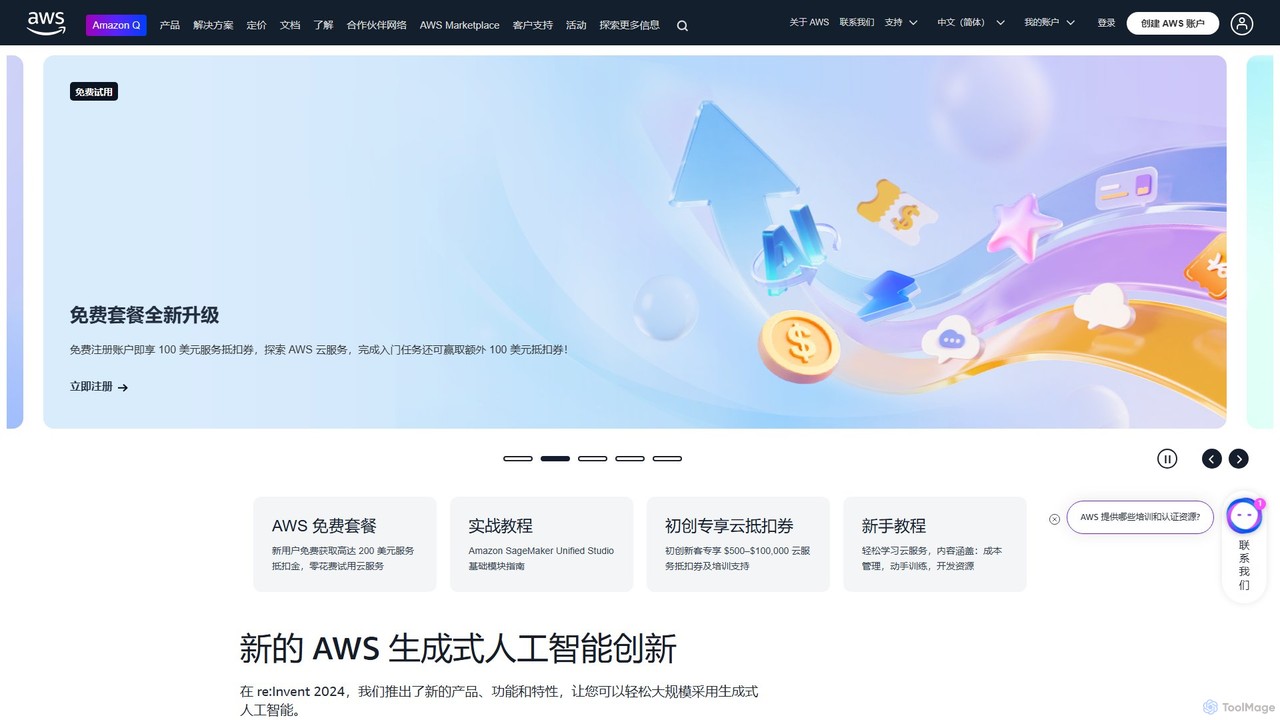
Amazon Web Services (AWS) is the world's most comprehensive and broadly adopted cloud platform, offering over 200 fully …
Amazon Web Services (AWS) is the world's most comprehensive and broadly adopted cloud platform, offering over 200 fully featured services from data centers globally. It provides a vast suite of AI and machine learning tools, including Amazon Bedrock for building generative AI applications with leading foundation models, Amazon SageMaker for the complete ML lifecycle, and the powerful Amazon Nova models for advanced text, image, and video generation.
About Foundation Models
Foundation Models are a class of large-scale AI models trained on vast quantities of broad, unlabeled data, designed to serve as a base for a wide range of downstream applications. These models, such as large language models (LLMs) or diffusion models, learn general patterns and representations of data, allowing them to be adapted to specific tasks through fine-tuning or prompting with minimal additional training. Their primary value lies in providing a powerful, pre-trained starting point that significantly accelerates the development of specialized AI tools. This approach democratizes access to advanced AI capabilities, enabling developers to build sophisticated applications without creating massive models from scratch.
Core Features
- General-Purpose Capability: Pre-trained to perform a wide array of tasks like text generation, summarization, translation, and image creation out-of-the-box.
- Adaptability (Fine-Tuning): Can be specialized for specific domains or tasks by training on a smaller, task-specific dataset.
- In-Context Learning: Ability to learn new tasks from a few examples (few-shot learning) provided directly in the input prompt.
- Scalability: Performance and capabilities generally improve with increases in model size, training data, and computational resources.
- Cross-Modal Understanding: Many advanced models can process and connect information from multiple modalities, such as text, images, and audio.
Applicable Scenarios
Foundation Models are primarily used by developers, researchers, and enterprises as the core engine for building AI-powered applications. For instance, a tech company might use a foundation model to build a customer service chatbot, while a research lab could adapt one to analyze scientific papers. They are the foundational layer for many generative AI tools, from code assistants to content creation platforms.
Selection Criteria
When choosing a Foundation Model, consider its primary modality (text, code, image, etc.) and its performance on relevant benchmarks. Evaluate the trade-offs between open-source models (offering greater control and customization) and proprietary models (often providing cutting-edge performance via APIs). Also, assess the costs associated with API usage or self-hosting, and the availability of documentation and community support for fine-tuning and integration.

Foundation ModelsUse Cases
Develop a Custom Customer Service Chatbot
A retail company aims to reduce support ticket volume and improve response times. Developers use a powerful language foundation model and fine-tune it on the company's internal knowledge base, past support conversations, and product documentation. The result is a highly accurate, context-aware chatbot that can handle complex customer queries, understand brand-specific terminology, and escalate issues to human agents seamlessly. This application automates over 60% of routine inquiries, freeing up support staff to focus on high-priority cases.
Build a Niche Content Generation Application
A marketing tech startup wants to create a specialized tool for generating high-quality real estate listings. Instead of building a model from scratch, they integrate a leading text-generation foundation model via its API. They develop a user-friendly interface that prompts the model with structured data (property type, size, features, location). The application uses advanced prompting techniques to ensure the output is persuasive, SEO-friendly, and adheres to a consistent brand voice. This allows them to launch a competitive product in months, not years, by leveraging the pre-existing power of the foundation model.
Accelerate Scientific Research and Discovery
A team of biomedical researchers is investigating complex diseases by analyzing thousands of scientific papers. They use a foundation model specialized in scientific literature to perform large-scale analysis. The model helps them summarize findings, extract relationships between genes and proteins, and identify previously unnoticed patterns across disparate studies. This AI-powered approach allows the team to generate new hypotheses much faster than manual review, significantly accelerating the pace of their research and potentially leading to breakthroughs in disease understanding and treatment.
Create an Internal Code Assistant for Developers
A large software company wants to boost developer productivity and maintain code consistency across teams. They take an open-source, code-specialized foundation model and fine-tune it on their entire proprietary codebase, including internal libraries and coding standards. The resulting tool is deployed as an IDE plugin. It provides developers with highly relevant code completions, explains complex code blocks in plain language, and helps debug issues by suggesting fixes that adhere to the company's best practices. This internal assistant reduces onboarding time for new engineers and speeds up development cycles.
Power a Multilingual Enterprise Search Engine
A multinational corporation struggles with information silos across its global intranet. Employees find it difficult to locate documents written in different languages. The IT department builds a new search engine powered by a foundation model with strong multilingual and embedding capabilities. The model converts all documents (regardless of language) into numerical representations (embeddings). When a user searches in their native language, the system finds semantically similar documents in any language, providing real-time translations for the results. This breaks down language barriers and makes a unified knowledge base accessible to all employees worldwide.
Prototype New AI-Powered Product Features
A product team at a SaaS company wants to test the viability of an AI-powered feature that summarizes long documents within their application. Instead of committing extensive engineering resources, they use a foundation model's API to build a quick functional prototype. This allows them to conduct user testing and gather feedback on the feature's utility and quality in a matter of days. Based on the positive feedback, they can then make an informed decision to invest in a full-scale integration, using the prototype as a validated proof-of-concept. This approach drastically reduces development risk and time-to-market for new AI features.