Babbly
Babbly is an AI-powered application designed for parents to monitor their infant's speech and brain development. By analyzing …
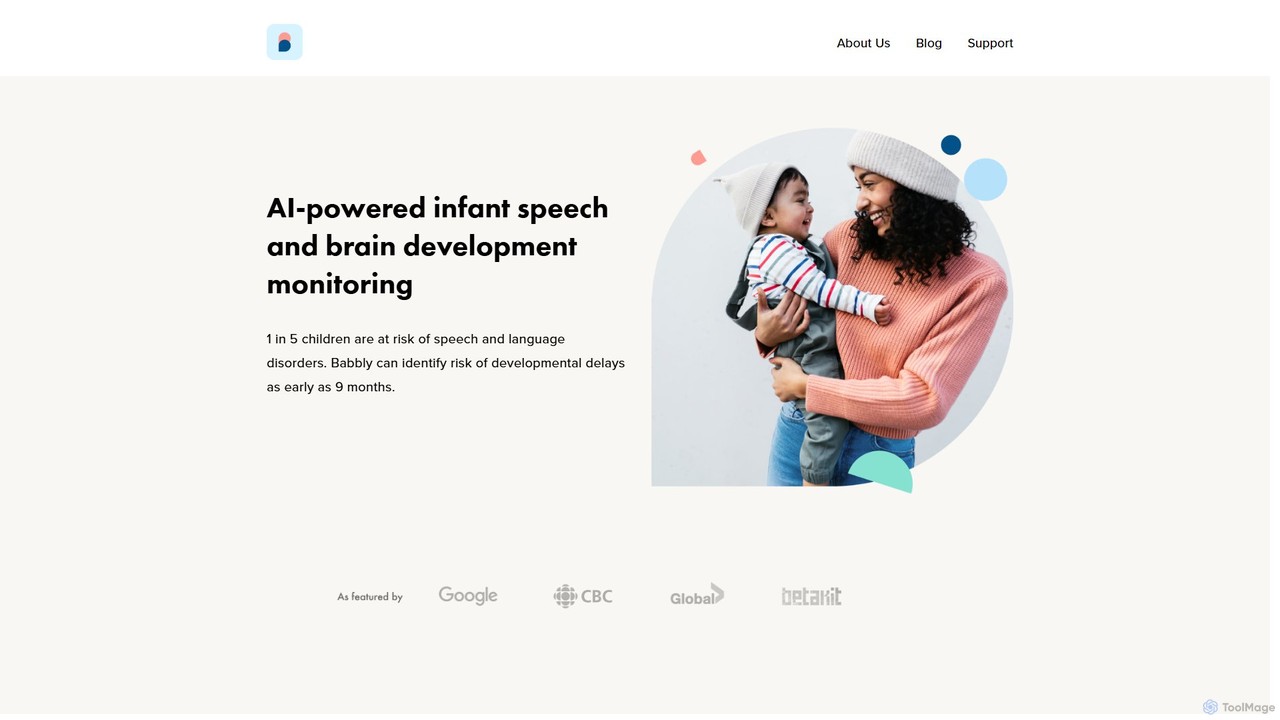
Babbly is an AI-powered application designed for parents to monitor their infant's speech and brain development. By analyzing a baby's babbling, it can identify the risk of developmental delays, such as speech and language disorders, as early as 9 months. The tool provides data-driven insights and personalized activities to support a child's growth.
About Child Development
AI Child Development tools are a specialized category of software designed to monitor, support, and enhance a child's growth from infancy through adolescence. Leveraging machine learning algorithms, these tools analyze developmental data such as speech patterns, motor skills, and social interactions to provide personalized insights and activities. Their primary value lies in offering parents, educators, and clinicians objective data for early identification of potential delays and creating tailored learning experiences. These tools act as a digital supplement within the broader health ecosystem, focusing specifically on pediatric developmental milestones.
Core Features
- Milestone Tracking & Analysis: Automatically tracks developmental progress against standardized benchmarks using input like videos and parent reports.
- Personalized Learning Activities: Generates adaptive games, stories, and exercises tailored to a child's specific learning needs and pace.
- Early Delay Screening: Uses behavioral and speech analysis to identify early signs of potential developmental delays or learning differences.
- Speech & Language Practice: Provides interactive, AI-guided exercises to improve articulation, vocabulary, and communication skills.
- Social-Emotional Skill Building: Offers interactive scenarios and games to help children understand and manage emotions and social cues.
Use Cases
These tools are used by parents for at-home monitoring, by educators in preschools and special education programs to create individualized plans, and by pediatric therapists (speech, occupational) to supplement clinical sessions with guided home practice. They are particularly valuable for early intervention and supporting children with diverse learning needs.
How to Choose
When selecting a tool, consider the specific developmental area to focus on (e.g., speech, cognitive, social), the age appropriateness of the content, the scientific validation behind its methods, and its data privacy policies. It's also important to assess how the tool integrates into your existing routines and whether it provides actionable feedback for parents or professionals.

Child DevelopmentUse Cases
At-Home Developmental Milestone Tracking
Parents of toddlers use an AI-powered app to record short videos of their child playing, walking, and babbling. The tool's AI analyzes these clips for key motor and language milestones, comparing them to age-appropriate benchmarks. It generates a visual progress report, highlights achievements, and provides parents with evidence-based activity suggestions to encourage the next stage of development, offering peace of mind and a structured way to monitor growth.
Personalized Early Literacy & Numeracy Plans
A kindergarten teacher uses an AI platform to support a diverse classroom. Each child interacts with a series of short, engaging games that assess their foundational literacy and math skills. The AI then creates a unique learning path for every student, assigning activities that target their specific challenge areas—whether it's letter recognition for one child or simple addition for another. This allows the teacher to provide differentiated instruction at scale.
Augmenting Speech Therapy with AI Practice
A speech-language pathologist works with a child on specific articulation challenges. As part of the treatment plan, the therapist assigns an AI app for at-home practice. The app presents target words in a game format, using speech recognition to provide instant feedback on the child's pronunciation. It records progress and sends a detailed report to the therapist, who can then adjust the next in-person session based on the data.
Early Screening for Social Communication Delays
During a routine pediatric check-up, a healthcare provider uses a tablet-based AI tool to engage a young child. The tool presents interactive scenarios that prompt specific social behaviors, such as eye contact and joint attention. The AI analyzes the child's responses in real-time, providing the clinician with an objective risk score for conditions like autism spectrum disorder. This facilitates earlier referrals for comprehensive diagnostic evaluation.
Developing Social Skills for Neurodivergent Children
A child with social anxiety or on the autism spectrum uses an AI-powered app featuring conversational avatars. The app simulates common social situations, like joining a game or asking for help. The child can practice conversations in a safe, non-judgmental environment, receiving gentle feedback from the AI on interpreting social cues and formulating appropriate responses. This helps build confidence for real-world interactions.
Enhancing Cognitive Functions through Adaptive Games
An educational psychologist recommends an AI-driven brain-training app for a child struggling with attention and working memory. The app offers a suite of games that challenge these cognitive skills. The AI continuously adjusts the difficulty level based on the child's performance, ensuring they are always engaged in a 'just-right' challenge zone. This personalized approach helps strengthen neural pathways related to focus and problem-solving.