ToolMage
Sign in

Best 1 Clinical Assistance AI tools for Health

Popular Clinical Assistance AI tools in Health include Avey, helping you work more efficiently.

Avey
Paid

Avey

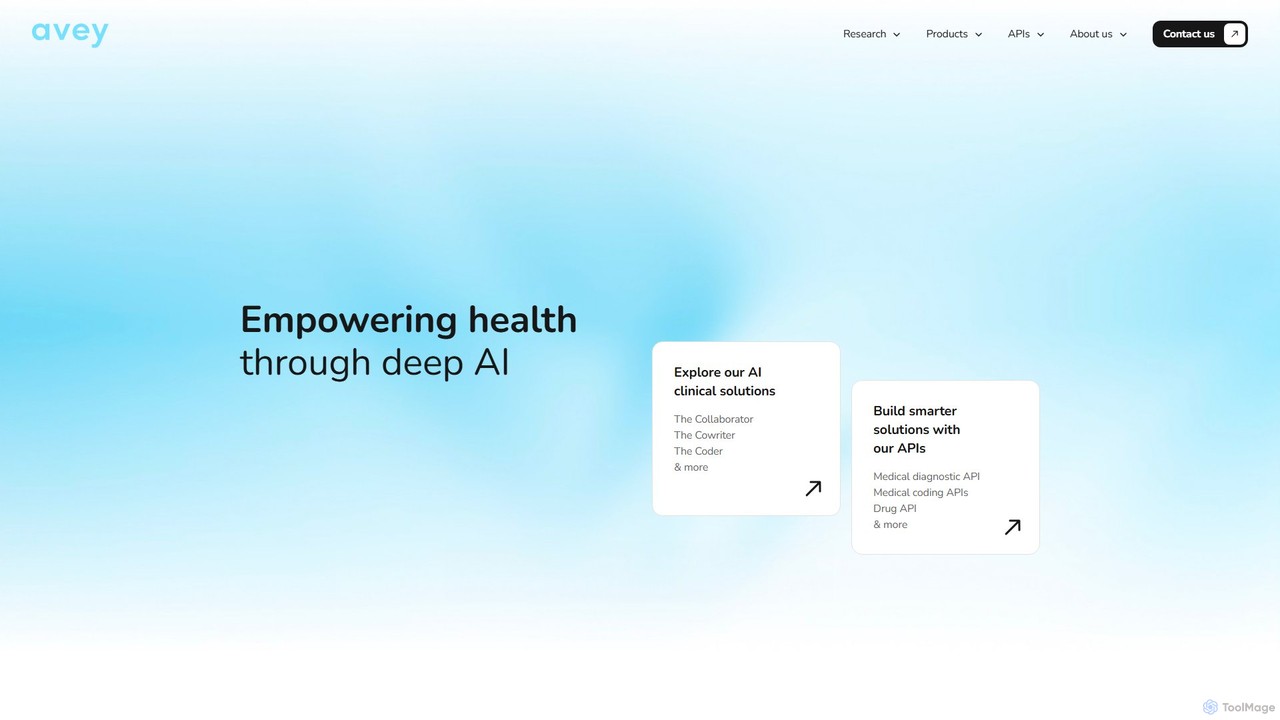
Avey is a comprehensive AI platform for healthcare, offering a suite of tools (C-Suite) to assist clinicians with diagnostics (Collaborator), automate clinical documentation (Cowriter), and streamline medical billing and coding (Coder). Avey also provides powerful APIs for developers to build custom healthcare solutions.

Healthcare Apis
Visits 9.9KFavorites 141Likes 148

About Clinical Assistance

Clinical Assistance tools are a specialized class of AI designed to directly support healthcare professionals in their diagnostic, treatment, and administrative workflows. These systems leverage machine learning models trained on vast medical datasets, including medical imaging, electronic health records (EHRs), and genomic data, to identify patterns imperceptible to the human eye. Their primary value lies in enhancing diagnostic accuracy, personalizing treatment plans, and automating clinical documentation. Within the broader Health AI category, these tools are distinguished by their focus on professional medical practice rather than general consumer wellness.

Core Features

  • Diagnostic Support & Image Analysis: Analyzes medical images (X-rays, MRIs, CT scans) and patient data to suggest potential diagnoses and highlight areas of concern for clinicians.
  • Treatment Plan Recommendation: Processes patient-specific data against clinical guidelines and research to propose personalized therapeutic strategies.
  • Clinical Documentation Automation: Utilizes Natural Language Processing (NLP) to transcribe doctor-patient conversations into structured clinical notes, reducing administrative burden.
  • Predictive Analytics: Forecasts disease progression, patient risk for conditions like sepsis, or hospital readmission rates to enable proactive care.
  • Genomic Data Analysis: Interprets complex genetic information to assist in diagnosing hereditary diseases and guiding precision medicine.

Use Cases

These tools are integral in high-stakes environments like hospitals, specialized clinics, and research laboratories. They are used daily by radiologists for image screening, oncologists for creating tailored cancer treatments, pathologists for analyzing tissue samples, and ICU staff for monitoring patient risk levels.

How to Choose

When selecting a Clinical Assistance tool, prioritize regulatory compliance (e.g., FDA clearance, CE mark) and data security (e.g., HIPAA, GDPR). Evaluate its ability to integrate seamlessly with existing systems like EHRs and PACS. Scrutinize the tool's clinical validation through peer-reviewed studies and ensure its algorithms are trained on diverse and relevant datasets for your patient population.

Clinical Assistance use cases

1

Automated Radiology Image Screening

A radiologist in a busy hospital department uses an AI clinical assistance tool to analyze a queue of chest X-rays. The AI automatically flags images with potential abnormalities, such as early-stage lung nodules or pneumonia, and prioritizes them for review. This allows the radiologist to focus their expertise on the most critical cases first, significantly reducing turnaround times for urgent diagnoses and improving the early detection rate of serious conditions. The system acts as a vigilant second reader, enhancing diagnostic confidence without replacing the final clinical judgment.

2

Personalized Oncology Treatment Planning

An oncologist treating a patient with a rare form of cancer uses an AI platform to devise a treatment strategy. By inputting the patient's genomic profile, tumor markers, and clinical history, the AI analyzes thousands of similar cases, clinical trials, and research papers. It then generates a report recommending a personalized combination of targeted therapies and immunotherapies most likely to be effective, along with supporting evidence. This data-driven approach helps the oncologist make a more informed decision, moving beyond standard protocols to offer a highly tailored and potentially more successful treatment plan.

3

AI-Powered Medical Scribing in Primary Care

A primary care physician uses an ambient AI scribe during patient consultations. The device, placed discreetly in the exam room, listens to the natural conversation between the doctor and patient. The AI processes the dialogue in real-time, distinguishing between speakers and identifying clinically relevant information. Immediately after the visit, it automatically generates a structured, accurate, and comprehensive clinical note directly in the Electronic Health Record (EHR). This eliminates hours of manual data entry, reduces physician burnout, and allows the doctor to maintain eye contact and build better rapport with the patient.

4

Sepsis Prediction in Intensive Care Units (ICU)

In an ICU, a predictive AI model continuously analyzes real-time data streams from a patient's monitors, including vital signs, lab results, and medication records. The model is trained to detect subtle patterns that precede the onset of sepsis, a life-threatening condition. When the patient's risk score crosses a critical threshold, the system sends an immediate alert to the nursing staff's mobile devices. This early warning allows the clinical team to initiate sepsis protocols hours earlier than they might have otherwise, drastically improving the patient's chances of survival and reducing the length of their hospital stay.

5

Accelerating Drug Discovery Research

A team of clinical researchers at a pharmaceutical company uses an AI platform to identify new drug targets for Alzheimer's disease. The platform ingests and analyzes millions of data points from genomic databases, scientific literature, and clinical trial results. It identifies a previously overlooked protein pathway strongly correlated with the disease's progression. This allows the research team to bypass months of manual literature review and hypothesis testing, focusing their lab work directly on a high-potential target. The use of AI significantly shortens the preclinical research phase, accelerating the journey towards a potential new therapy.

6

Digital Pathology Slide Analysis for Cancer Diagnosis

A pathologist uploads high-resolution digital scans of tissue biopsy slides to an AI-powered analysis platform. The AI assists by automatically identifying and counting mitotic figures, quantifying tumor cell proliferation, and highlighting regions of interest that may indicate malignancy. This provides the pathologist with objective, quantitative data to supplement their qualitative assessment. The tool reduces the time spent on manual counting tasks and improves the consistency and accuracy of cancer grading, leading to more reliable diagnoses and better-informed treatment decisions for patients.

Clinical Assistance FAQ

What are AI Clinical Assistance tools?

AI Clinical Assistance tools are sophisticated software applications designed to help healthcare professionals make faster, more accurate decisions. Unlike general health apps for consumers, these tools are built for clinical settings to analyze complex medical data such as MRI scans, EHR notes, and genomic sequences. Their core functions include supporting diagnoses, recommending personalized treatments, and automating administrative tasks like clinical documentation. They act as an intelligent assistant to augment, not replace, the expertise of doctors and clinicians.

How to choose a reliable Clinical Assistance AI tool?

Choosing a reliable tool requires careful evaluation of several key factors. Prioritize tools with the necessary regulatory approvals for your region, such as FDA clearance or CE marking. It's also critical to assess data security and compliance with standards like HIPAA. Consider the following points:

  • Clinical Validation: Look for evidence from peer-reviewed studies or real-world clinical trials that demonstrate the tool's accuracy and effectiveness.
  • System Integration: Ensure the tool can integrate seamlessly with your existing Electronic Health Record (EHR) or Picture Archiving and Communication System (PACS).
  • Data & Algorithm Transparency: Understand the data the model was trained on. A model trained on a diverse patient population is generally more robust.
  • Usability: The tool should have an intuitive interface that fits naturally into the clinical workflow without causing disruption.
What's the difference between Clinical Assistance AI and general Health AI?

The primary difference lies in the target user and regulatory requirements. Clinical Assistance AI is designed for healthcare professionals (doctors, nurses, researchers) and is often integrated into hospital systems like EHRs. These tools directly influence medical decisions and therefore require rigorous clinical validation and regulatory approval (e.g., FDA). General Health AI, on the other hand, is typically consumer-facing. This category includes wellness apps, fitness trackers, and symptom checkers that provide general health advice but are not intended for medical diagnosis or treatment. They have a lower regulatory barrier and focus on lifestyle management rather than professional medical practice.

What are the main functions of Clinical Assistance AI?

Clinical Assistance AI tools perform a range of critical functions to support healthcare professionals. The most common applications include:

  • Diagnostic Support: Analyzing medical images (like X-rays or pathology slides) to detect signs of disease, often with superhuman accuracy for specific tasks.
  • Treatment Recommendation: Sifting through vast amounts of clinical data and research to suggest personalized treatment plans, especially in complex fields like oncology.
  • Predictive Analytics: Using patient data to forecast risks, such as the likelihood of developing a condition like sepsis or readmission to the hospital.
  • Administrative Automation: Streamlining workflows by automating tasks like transcribing patient conversations into clinical notes (AI scribing), freeing up clinicians' time.
Who are the primary users of Clinical Assistance AI tools?

The primary users are licensed healthcare professionals who work in diagnostic, treatment, or research capacities. This includes a wide range of specialists and generalists. For example:

  • Radiologists and Pathologists: Use AI for image analysis to detect cancer, fractures, or other abnormalities more efficiently.
  • Oncologists: Leverage AI to analyze genomic data and clinical trials to find personalized cancer treatments.
  • Intensive Care (ICU) Physicians and Nurses: Rely on predictive models to get early warnings for critical events like sepsis or cardiac arrest.
  • Primary Care Physicians: Use AI scribes to automate note-taking, allowing them to focus more on patient interaction.
  • Clinical Researchers: Employ AI to analyze large datasets to accelerate drug discovery and the development of new therapies.