Avey
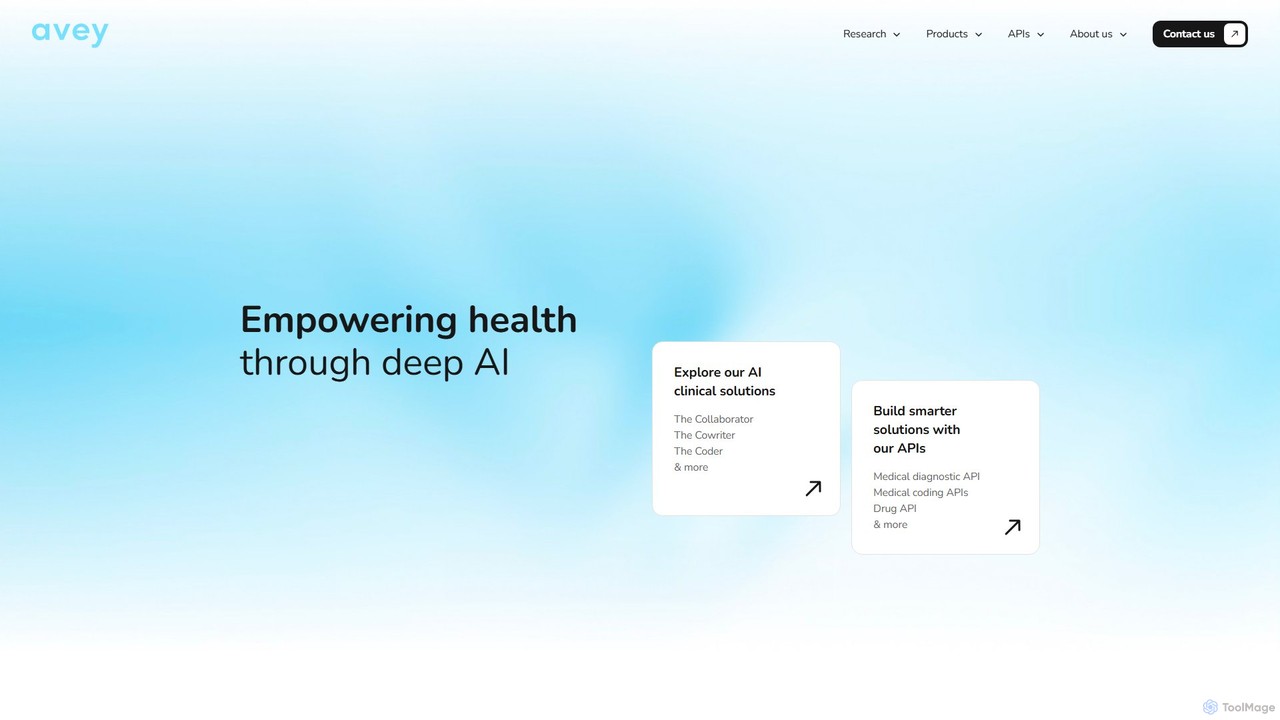
Avey is a comprehensive AI platform for healthcare, offering a suite of tools (C-Suite) to assist clinicians with …
Avey is a comprehensive AI platform for healthcare, offering a suite of tools (C-Suite) to assist clinicians with diagnostics (Collaborator), automate clinical documentation (Cowriter), and streamline medical billing and coding (Coder). Avey also provides powerful APIs for developers to build custom healthcare solutions.
About Healthcare Apis
Healthcare APIs are a specialized set of developer tools that enable secure access, exchange, and manipulation of electronic health information. These APIs act as bridges between different healthcare systems, applications, and data sources, using standardized protocols like FHIR and HL7 to ensure interoperability. Their primary value lies in empowering developers to build innovative applications for patient care, clinical research, and healthcare administration while adhering to strict regulatory compliance such as HIPAA. This allows for the creation of connected health ecosystems where data flows securely and efficiently.
Core Features
- Data Interoperability: Facilitates seamless data exchange between disparate systems like Electronic Health Records (EHRs), lab systems, and patient apps using standards like FHIR and HL7.
- Regulatory Compliance: Provides built-in safeguards and protocols to ensure adherence to healthcare regulations such as HIPAA in the US and GDPR in Europe.
- Patient Data Access: Offers secure endpoints for retrieving patient demographics, medical history, lab results, allergies, and medication information.
- Clinical Decision Support Integration: Allows for the integration of AI models and clinical guidelines to provide real-time diagnostic or treatment suggestions within a workflow.
- Secure Authentication & Authorization: Implements robust security measures, often using OAuth 2.0, to control access and ensure only authorized users or systems can view patient data.
Use Cases
Healthcare APIs are primarily used by health tech companies, hospital IT departments, and medical research institutions. They are essential for developing patient-facing mobile apps, integrating third-party services into existing EHR systems, building telehealth platforms, and creating data analytics tools for population health management.
How to Choose
When selecting a Healthcare API, prioritize providers that guarantee compliance with relevant regulations (e.g., HIPAA certification). Evaluate their support for modern interoperability standards like FHIR. Assess the quality of their developer documentation, SDKs, and support. Also, consider the API's scalability, reliability (uptime), and a transparent pricing model that aligns with your application's usage.

Healthcare ApisUse Cases
Developing a Patient Portal Application
A health tech startup aims to create a mobile application that allows patients to view their medical records, schedule appointments, and communicate with their doctors. By using a Healthcare API, their developers can securely connect to a hospital's Electronic Health Record (EHR) system. They utilize specific API endpoints to fetch lab results, medication history, and appointment availability. This approach significantly reduces development time and ensures the application is HIPAA-compliant from the start, enabling a faster launch into the market.
Integrating AI for Medical Image Analysis
A medical research institution is developing an AI model to detect early signs of disease in MRI scans. To train and validate their model, they need access to a large, diverse dataset of anonymized images. They use a Healthcare API to connect to a hospital's Picture Archiving and Communication System (PACS). The API allows them to programmatically query and retrieve specific types of scans based on predefined criteria, streamlining the data collection process while maintaining patient privacy and data security.
Powering a Telehealth Platform
A company providing telehealth services needs to give its doctors real-time access to patient information during virtual consultations. They integrate a Healthcare API into their platform. Before a video call, the API securely fetches the patient's relevant medical history, allergies, and current medications from their primary care provider's EHR. This ensures the consulting physician has a complete clinical picture, leading to safer and more effective remote care. The API can also be used to send consultation summaries and new prescriptions back to the patient's EHR.
Automating Insurance Claim Processing
An insurance company wants to accelerate its claims adjudication process. Their analysts currently spend hours manually cross-referencing claims with patient medical records to verify treatments. By implementing a Healthcare API, they can automate this workflow. The system uses the API to programmatically pull necessary data, such as dates of service and procedure codes, from a provider's EHR. This allows for instant verification against the patient's policy, reducing manual review time by over 70% and minimizing payment errors.
Facilitating Clinical Trial Recruitment
A pharmaceutical company is struggling to find eligible participants for a new drug trial. A clinical research coordinator uses a platform powered by Healthcare APIs to solve this. The platform connects to multiple hospital networks and uses the APIs to query anonymized patient data based on the trial's specific inclusion criteria (e.g., age, diagnosis, specific lab values). This allows the coordinator to quickly identify potential patient cohorts across different healthcare systems without compromising privacy, significantly accelerating the recruitment phase of the trial.
Building a Chronic Disease Management App
A digital health company is creating an app for patients with diabetes. The app needs to consolidate data from various sources: glucose readings from a continuous glucose monitor (CGM), activity data from a smartwatch, and medication history from the patient's EHR. They use a combination of consumer device APIs and a Healthcare API. The Healthcare API securely pulls prescribed insulin dosages and lab results (like HbA1c) from the clinic's system. This creates a holistic view for both the patient and their care team, enabling personalized feedback and timely interventions.