ToolMage
Sign in

Best 1 Cognitive Support AI tools for Health

Popular Cognitive Support AI tools in Health include recallify, helping you work more efficiently.

recallify
Freemium

recallify

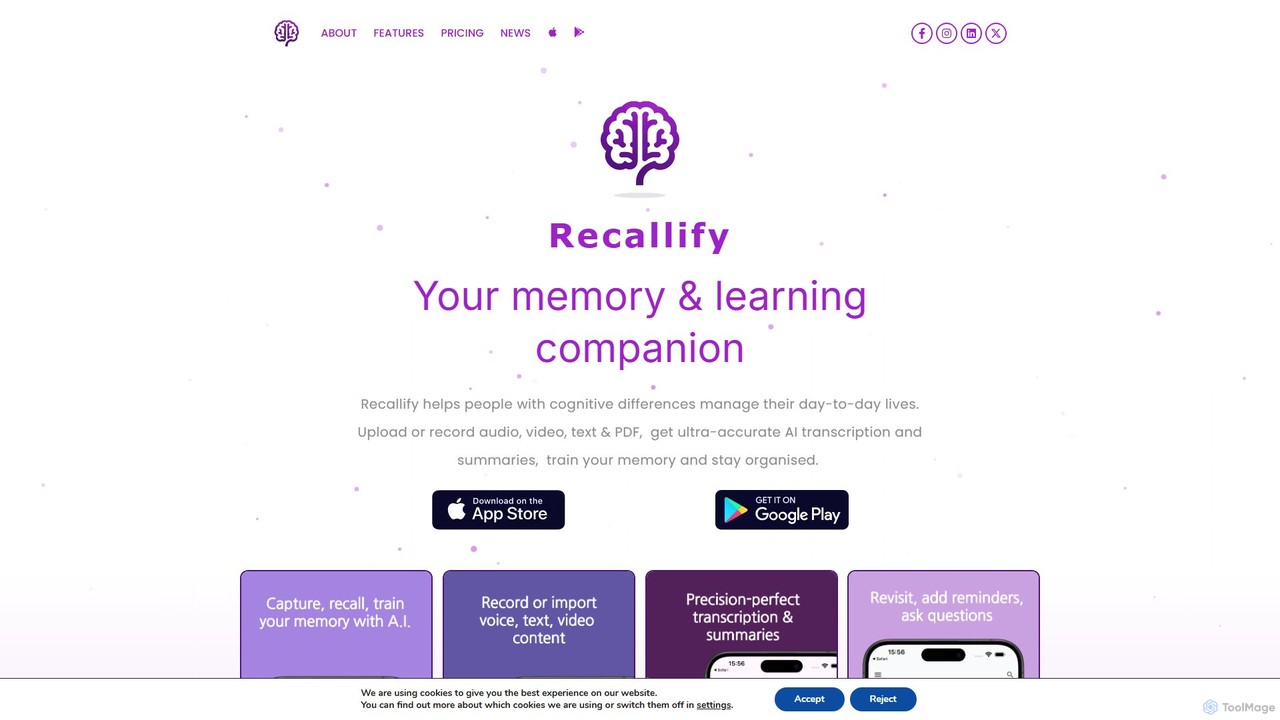
Recallify is an AI-powered memory and learning companion designed to support individuals with cognitive differences and boost productivity for everyone. It records, transcribes, and summarizes audio, video, and text, turning your experiences into reviewable notes. Using science-backed techniques like spaced repetition and auto-generated quizzes, it helps you strengthen memory recall, stay organized, and enhance learning. Ideal for students, professionals, and daily life management.

Learning Tools
Visits 30.9KFavorites 117Likes 129

About Cognitive Support

Cognitive Support tools are a class of AI applications designed to assist and enhance human cognitive functions. Leveraging machine learning, these tools help manage tasks related to memory, attention, organization, and learning. They are valuable for individuals seeking to overcome cognitive challenges, manage information overload, or optimize their mental performance. As a specialized area within Health, these tools act as digital aids for everyday cognitive processes, focusing specifically on brain function and mental clarity.

Core Features

  • Memory Augmentation: Helps users recall information through smart reminders, contextual notes, and spaced repetition systems.
  • Attention Management: Provides features to minimize distractions, track focus periods, and create an optimal work environment.
  • Executive Function Assistance: Aids in planning, prioritizing tasks, and breaking down complex projects into manageable steps.
  • Adaptive Learning: Personalizes educational content and information delivery to match an individual's learning pace and style.
  • Decision Support: Analyzes information to present clear options and potential outcomes, reducing mental strain.

Use Cases

These tools are widely used by students with learning differences like ADHD, professionals in data-intensive fields, and researchers organizing complex information. They are also beneficial for anyone looking to improve daily productivity and mental organization, including older adults aiming to maintain cognitive sharpness through structured activities.

How to Choose

When selecting a Cognitive Support tool, first identify your primary need, such as focus, memory, or planning. Evaluate its integration with your existing digital ecosystem, like calendars and note apps. Assess the level of personalization the AI offers to adapt to your specific patterns. Prioritize tools with a simple, intuitive interface that reduces cognitive load rather than adding to it.

Cognitive Support use cases

1

Managing Academic Workloads for Students

Students, especially those with executive function challenges like ADHD, often struggle with organizing large projects and managing deadlines. A cognitive support tool can help by breaking down a major assignment, like a research paper, into smaller, daily tasks. The AI can analyze the project requirements and timeline, then automatically populate a calendar with manageable steps such as 'Research sources,' 'Create outline,' and 'Write first draft.' This structured approach reduces overwhelm, improves time management, and helps ensure all components of the assignment are completed on schedule.

2

Overcoming Information Overload for Professionals

Professionals in fields like consulting, law, or research constantly deal with vast amounts of information from meetings, reports, and articles. A cognitive support tool with AI summarization can distill lengthy documents into key bullet points or a concise paragraph. For example, after a one-hour meeting, an AI note-taker can provide a summary of decisions made and action items assigned within minutes. This saves hours of manual review, reduces cognitive load, and allows professionals to focus on strategic thinking rather than information processing.

3

Supporting Daily Organization for Individuals with ADHD

Individuals with ADHD often face challenges with executive functions like planning, prioritization, and task initiation. An AI-powered cognitive support tool can act as a dynamic personal assistant. It can send context-aware reminders, such as prompting to pack a gym bag the night before a scheduled workout. The tool can also help prioritize a daily to-do list by analyzing deadlines and estimated effort, suggesting the most critical task to start with. This externalizes the organizational burden, making daily life more manageable and reducing the anxiety associated with staying on track.

4

Enhancing Vocabulary Retention for Language Learners

Language learners need consistent practice to move vocabulary from short-term to long-term memory. An AI-powered spaced repetition system (SRS) optimizes this process. Instead of reviewing words at fixed intervals, the AI tracks the learner's performance on each word. It then schedules reviews at the precise moment the learner is about to forget it. This adaptive scheduling makes study sessions highly efficient, personalizes the learning curve, and significantly improves long-term retention compared to traditional flashcard methods.

5

Structuring Complex Research Projects

Researchers and academics often work with hundreds of sources, making it difficult to see connections and structure arguments. A cognitive support tool can function as a second brain. By inputting notes, articles, and data, the AI can help visualize connections between concepts using mind maps or knowledge graphs. It can identify recurring themes, suggest related literature, and help structure a paper or thesis by organizing evidence around key arguments. This transforms a chaotic collection of information into a structured, coherent knowledge base, accelerating the research process.

6

Aiding Seniors in Daily Task Management

For seniors aiming to maintain independence and cognitive health, managing daily routines like appointments and medication schedules can be challenging. A cognitive support tool with a simple interface can provide crucial assistance. It can offer voice-activated reminders for taking pills, attending doctor's appointments, or social events. The AI can also learn routines and provide gentle prompts, for example, suggesting a walk if the user has been inactive for a long time. This provides a safety net that supports memory and routine, promoting well-being and reducing reliance on caregivers for simple organizational tasks.

Cognitive Support FAQ

What are AI Cognitive Support tools?

AI Cognitive Support tools are software applications designed to assist, augment, or enhance human cognitive functions like memory, attention, and organization. Unlike passive tools, they use artificial intelligence to actively learn a user's patterns and needs, offering personalized assistance. For example, they might intelligently schedule tasks based on your energy levels or remind you of information in the context of your current activity. They serve as digital aids to help manage cognitive load and improve mental performance in daily life.

How do I choose the right Cognitive Support tool?

Choosing the right tool depends on your specific needs. Consider the following factors:

  • Primary Goal: Are you looking to improve focus, memory, planning, or learning? Select a tool that specializes in your target area.
  • Integration: Does the tool connect with your existing calendar, email, or note-taking apps? Seamless integration reduces friction.
  • Adaptability: Look for a tool with strong AI personalization that learns from your behavior and adjusts its support accordingly.
  • User Interface: The interface should be simple, intuitive, and non-distracting. A complex tool can increase cognitive load, defeating its purpose.
  • Privacy Policy: Since these tools may handle sensitive personal data, ensure they have a clear and trustworthy privacy policy.
What's the difference between Cognitive Support tools and standard productivity apps?

The key difference lies in their approach. Standard productivity apps (like a basic calendar or to-do list) are passive; they require the user to manually input, organize, and manage all information. AI Cognitive Support tools are active and adaptive. They use AI to understand context, learn user habits, and proactively offer assistance. For example, a standard to-do list just shows your tasks. An AI-powered one might re-prioritize your list based on your energy levels throughout the day or suggest breaking a large task into smaller steps because it knows you tend to procrastinate on big projects.

Who can benefit most from using AI Cognitive Support tools?

While anyone can benefit from optimizing their cognitive processes, these tools are particularly helpful for certain groups. This includes:

  • Students: For managing coursework, studying more effectively, and organizing research.
  • Professionals in high-demand jobs: To manage information overload, prioritize tasks, and maintain focus.
  • Individuals with neurodevelopmental conditions: Such as ADHD or dyslexia, to get support with executive functions like planning and organization.
  • Seniors: To help maintain cognitive sharpness and manage daily routines, appointments, and medications.
  • Lifelong learners: To acquire and retain new knowledge more efficiently.
How does AI enhance cognitive support functions?

AI enhances cognitive support by moving beyond static rules to provide dynamic, personalized assistance. It achieves this through several mechanisms:

  • Machine Learning: The tool learns your personal work rhythms, attention spans, and common mistakes, then tailors its suggestions to you.
  • Natural Language Processing (NLP): This allows you to interact with the tool using everyday language and enables features like summarizing text or transcribing speech.
  • Predictive Analytics: By analyzing past behavior, the AI can anticipate future needs, such as suggesting you prepare for an upcoming meeting or warning you about a potential scheduling conflict.
  • Context Awareness: The AI can use data from your calendar, location, or current application to provide relevant, timely support instead of generic notifications.