Health Best in category 2 results Knowledge Base AI Tool

Popular AI tools in the Knowledge Base field of Health include Ask Huberman Lab、fuushyn_hubermanlit_main_8yrooa, etc., helping you quickly improve efficiency.

Free
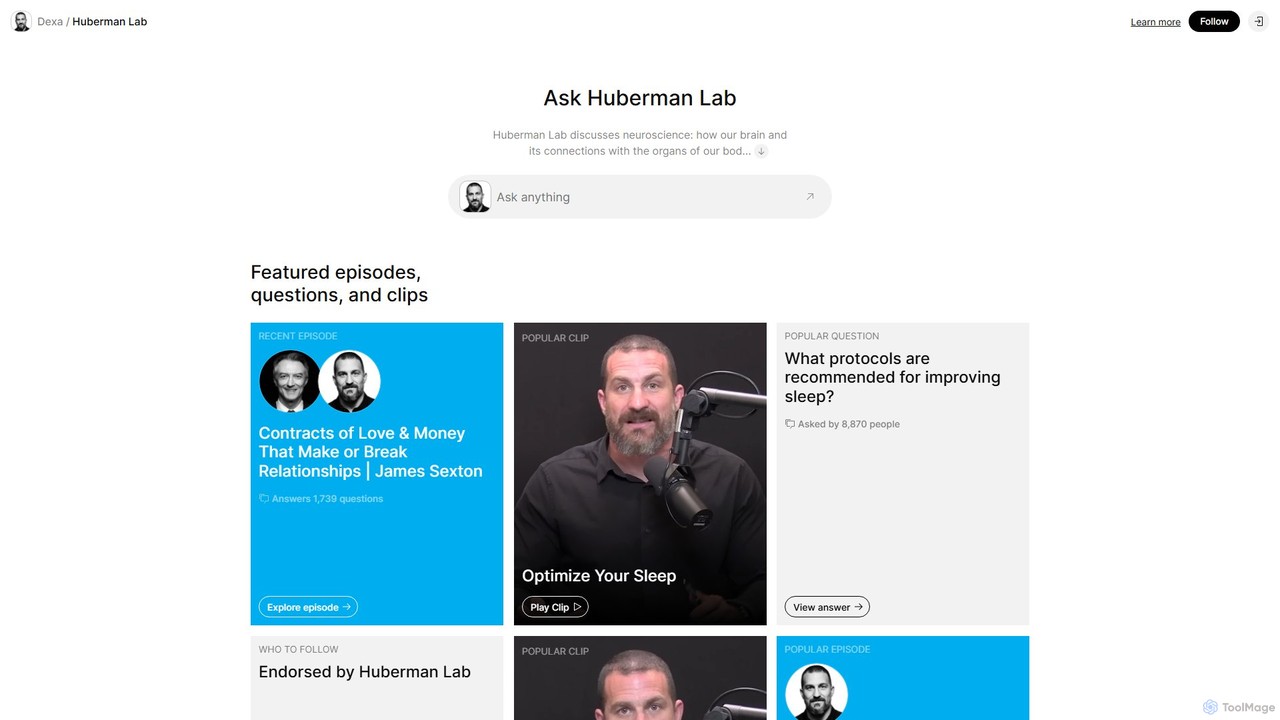
Ask Huberman Lab

Ask Huberman Lab

An AI-powered search engine for the Huberman Lab podcast. Ask any health or neuroscience question in natural language …

182.6K
Free
fuushyn_hubermanlit_main_8yrooa

fuushyn_hubermanlit_main_8yrooa

An AI-powered search engine and knowledge base specifically for the Huberman Lab podcast. Ask any question about neuroscience, …

2.9K

About Knowledge Base

AI Health Knowledge Bases are specialized platforms that provide instant, evidence-based answers to complex medical and health questions. These tools utilize large language models trained on vast libraries of verified medical literature, clinical guidelines, and research papers. They empower healthcare professionals and patients to access reliable information quickly, supporting clinical decisions and health education. Their primary value lies in synthesizing complex medical data into clear, actionable insights while citing the original sources for verification.

Core Features

  • Natural Language Query: Ask complex medical questions in conversational language and receive precise answers.
  • Evidence-Based Responses: Answers are generated from and linked to peer-reviewed journals, textbooks, and clinical guidelines.
  • Symptom & Condition Analysis: Provides information on symptoms, potential conditions, and treatment options based on established medical data.
  • Drug Interaction Checker: Analyzes potential adverse interactions between multiple medications.
  • Data Synthesis: Aggregates and summarizes information from numerous sources to provide a comprehensive overview of a topic.

Use Cases

These tools are primarily used by healthcare professionals like doctors, nurses, and pharmacists for quick clinical reference and decision support. Medical students and researchers use them for study and literature review. Additionally, patients and caregivers can use them to better understand health conditions and treatment plans from a reliable source, distinct from general web search engines.

How to Choose

When selecting an AI Health Knowledge Base, consider the breadth and quality of its underlying data sources—ensure they are reputable and up-to-date. Evaluate the accuracy and clarity of its answers and its ability to cite sources. For professional use, look for features like integration with Electronic Health Records (EHR) and compliance with health data regulations like HIPAA. Finally, assess the user interface for ease of use during time-sensitive situations.

Knowledge BaseUse Cases

1

Clinical Decision Support for Physicians

A primary care physician is seeing a patient with a complex history and multiple medications. Using an AI Health Knowledge Base, the doctor can quickly ask, 'What are the potential interactions between metformin, lisinopril, and a new antibiotic?' The tool instantly provides a summarized list of potential interactions, citing specific clinical studies. This allows the physician to make a safer, more informed prescribing decision in minutes, directly improving patient safety without leaving the examination room to consult physical textbooks or multiple databases.

2

Empowering Patients with Reliable Health Information

A patient newly diagnosed with Type 2 diabetes feels overwhelmed and confused by conflicting information online. They use a patient-focused AI Health Knowledge Base to ask, 'Explain Type 2 diabetes management for a beginner.' The tool provides a structured, easy-to-understand summary covering diet, exercise, medication, and monitoring, all based on guidelines from reputable health organizations. This empowers the patient to have more productive conversations with their doctor and take an active role in managing their health, reducing anxiety and improving adherence to their treatment plan.

3

Accelerating Medical Research and Literature Review

A researcher is investigating the link between a specific gene and a rare disease. Instead of manually searching through thousands of papers, they use an AI Health Knowledge Base to ask, 'Summarize all studies from the last 5 years on the relationship between gene XYZ and disease ABC.' The AI synthesizes findings from hundreds of relevant papers, highlighting key results, methodologies, and conflicting evidence. This process reduces weeks of manual literature review to a few hours, allowing the researcher to focus on analysis and hypothesis generation, thereby accelerating the pace of scientific discovery.

4

Training Aid for Medical Students and Residents

A medical student is preparing for their board exams and needs to understand the differential diagnosis for chest pain. They use an AI Health Knowledge Base to explore various causes, from cardiac to gastrointestinal. The tool presents information in a structured way, comparing and contrasting symptoms, typical patient profiles, and diagnostic tests for each condition. It acts as an interactive, always-available tutor, allowing the student to query complex topics and receive evidence-based explanations, deepening their understanding far more effectively than static textbooks.

5

Creating Accurate Health Content for Public Education

A health writer for a hospital's blog needs to create an article about the benefits of a new type of vaccine. To ensure accuracy and avoid misinformation, they use an AI Health Knowledge Base to gather foundational information. They query the tool for the vaccine's mechanism of action, efficacy rates from clinical trials, and common side effects. The AI provides a synthesized summary with direct links to the source publications (e.g., CDC, WHO, and peer-reviewed journals). This allows the writer to produce trustworthy, evidence-based content for the public efficiently and responsibly.

6

Triage Support for Nurses and Paramedics

A triage nurse in a busy emergency room is assessing a patient presenting with unusual neurological symptoms. To quickly build a list of potential causes, the nurse uses an AI Health Knowledge Base on a tablet. They input the key symptoms and patient vitals. The tool rapidly generates a list of possible differential diagnoses, ranked by probability based on the provided data, and suggests critical next steps or diagnostic tests. This doesn't replace the nurse's clinical judgment but acts as a powerful cognitive aid, helping to ensure no rare but critical conditions are overlooked during a high-pressure situation.

Knowledge BaseFrequently Asked Questions