Linguamatics
Linguamatics is an advanced AI-powered text mining and Natural Language Processing (NLP) platform, specializing in extracting actionable insights …
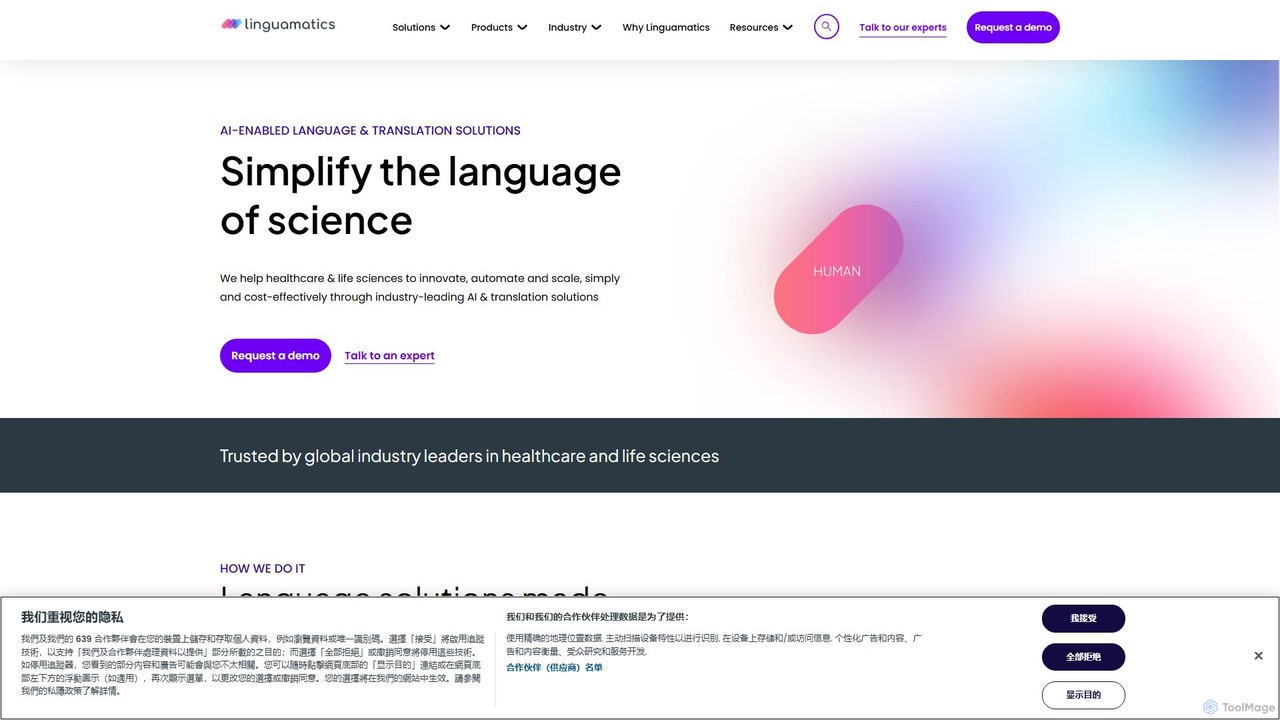
Linguamatics is an advanced AI-powered text mining and Natural Language Processing (NLP) platform, specializing in extracting actionable insights from unstructured text for the life sciences and healthcare industries. It helps organizations accelerate research, improve decision-making, and reduce costs by automating the analysis of scientific literature, patents, clinical trial data, and more.
About Life Sciences
Life Sciences AI tools are a specialized category of artificial intelligence applications designed to accelerate discovery, analysis, and development across biological, medical, and pharmaceutical domains. Leveraging advanced machine learning, bioinformatics, and computational biology, these tools process vast datasets to uncover insights, predict outcomes, and automate complex tasks. They are instrumental in transforming research methodologies, enhancing diagnostic capabilities, and streamlining drug development pipelines within the broader healthcare ecosystem.
Core Features
- Genomic & Proteomic Analysis: Advanced algorithms for sequencing data interpretation, variant calling, protein structure prediction, and functional annotation.
- Drug Discovery & Development: AI-driven compound screening, target identification, lead optimization, and prediction of drug efficacy and toxicity.
- Medical Image Interpretation: Computer vision models for analyzing MRI, CT, X-ray, and pathology slides to assist in disease detection and diagnosis.
- Clinical Trial Optimization: Predictive analytics for patient recruitment, trial design, and real-time monitoring to improve efficiency and success rates.
- Bioinformatics & Data Integration: Tools for integrating and analyzing diverse biological datasets, from gene expression to patient records, for holistic insights.
Applicable Scenarios
Researchers in academic institutions utilize these tools for fundamental biological discovery and hypothesis generation. Pharmaceutical companies employ them to drastically reduce the time and cost associated with drug development, from initial target identification to preclinical testing. Clinical laboratories leverage AI for faster and more accurate diagnostic interpretations, while biotechnology firms use them to optimize bioprocesses and develop novel therapeutic solutions.
How to Choose
When selecting Life Sciences AI tools, consider the specific research or development phase you are targeting, such as early discovery or clinical trials. Evaluate the tool's data compatibility and integration capabilities with existing bioinformatics pipelines. Assess the underlying AI models for their accuracy, interpretability, and validation against relevant biological datasets. Finally, factor in scalability, regulatory compliance, and the level of technical expertise required for implementation and operation.

Life SciencesUse Cases
Accelerating Drug Target Identification
Pharmaceutical researchers use AI to analyze vast genomic and proteomic datasets, identifying novel disease targets and potential therapeutic pathways with higher precision. This significantly shortens the initial discovery phase by predicting protein-ligand interactions and disease mechanisms, leading to more focused and efficient drug development efforts.
Automated Medical Image Diagnosis
Radiologists and pathologists employ AI-powered computer vision tools to automatically detect anomalies in medical scans (e.g., tumors in MRI, lesions in X-rays) or microscopic pathology slides. This augments human expertise, reduces diagnostic errors, and enables faster screening of large patient cohorts, particularly in resource-constrained settings.
Optimizing Clinical Trial Patient Recruitment
Clinical research organizations utilize AI to analyze patient demographic, genetic, and medical history data to identify ideal candidates for specific clinical trials. This predictive matching improves recruitment efficiency, reduces dropout rates, and ensures a more representative and suitable patient population, thereby accelerating trial completion.
Personalized Medicine Treatment Planning
Oncologists and genetic counselors use AI to integrate a patient's genomic profile, medical history, and treatment response data to recommend highly personalized therapies. AI predicts the most effective drug regimens and dosages, minimizing adverse effects and maximizing treatment success based on individual biological markers.
Predicting Protein Structure and Function
Structural biologists and biochemists leverage AI models, such as deep learning networks, to predict the complex 3D structures of proteins from their amino acid sequences. This capability is crucial for understanding protein function, designing new enzymes, and developing targeted therapies, overcoming the limitations of traditional experimental methods.
Enhancing Agricultural Crop Disease Detection
Agricultural scientists and farmers deploy AI-powered image analysis tools to identify early signs of plant diseases or pest infestations from drone imagery or field sensors. This allows for timely intervention, precise application of treatments, and minimizes crop loss, contributing to food security and sustainable farming practices.