
ToolMage
Sign in

Best 1 Medical Ai AI tools for Healthcare

Popular Medical Ai AI tools in Healthcare include ModAstera, helping you work more efficiently.

ModAstera
Freemium

ModAstera

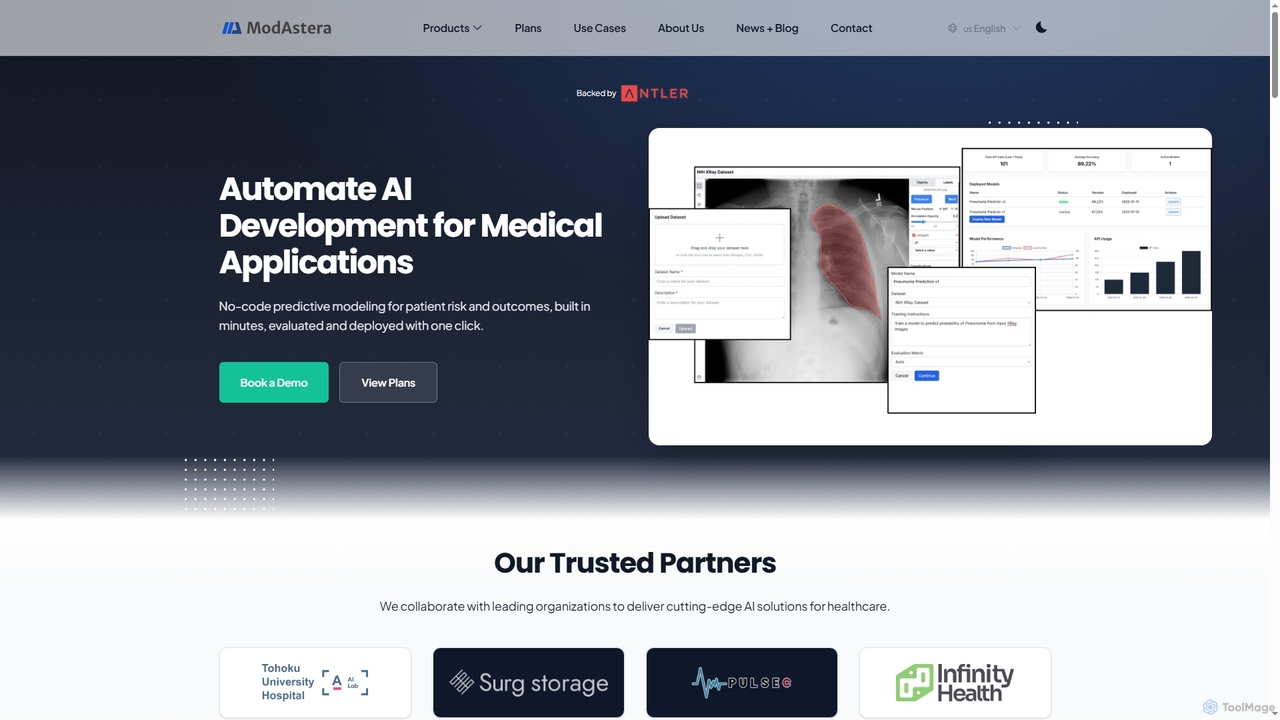
ModAstera is a no-code AI development platform designed for medical applications. It automates predictive modeling for patient risk and outcomes, featuring AI-assisted data annotation and one-click deployment to significantly reduce development time and costs for health tech innovators.

Machine Learning
Visits 6.2KFavorites 107Likes 104

About Medical Ai

Medical AI refers to artificial intelligence technologies specifically designed and applied within the healthcare sector. These tools leverage machine learning, deep learning, and natural language processing to analyze vast amounts of medical data, from patient records to imaging scans. Their primary value lies in enhancing diagnostic accuracy, accelerating drug discovery, and enabling personalized treatment plans, ultimately improving patient outcomes and operational efficiency in healthcare.

Core Features

  • Diagnostic Assistance: Analyzes medical images and patient data for early disease detection and accurate diagnosis.
  • Drug Discovery & Development: Accelerates research by predicting molecular interactions and identifying potential drug candidates.
  • Personalized Treatment Plans: Tailors therapies based on individual patient genetics, lifestyle, and disease progression.
  • Predictive Analytics: Forecasts disease outbreaks, patient deterioration, or treatment responses to enable proactive care.

Use Cases

Hospitals utilize Medical AI for faster and more accurate analysis of medical images, aiding radiologists in identifying subtle anomalies. Pharmaceutical companies employ these tools to significantly accelerate their research and development cycles, bringing new drugs to market more efficiently. Clinicians benefit from AI-powered insights that support complex decision-making in patient management and treatment selection.

How to Choose

When selecting Medical AI tools, prioritize solutions with robust data security and privacy compliance (e.g., HIPAA, GDPR). Evaluate their clinical validation and proven accuracy in real-world medical settings. Ensure seamless integration with existing electronic health records (EHRs) and picture archiving and communication systems (PACS). Consider scalability and customization options to adapt to various medical specialties and patient volumes.

Medical Ai use cases

1

Early Disease Detection from Medical Imaging

Radiologists use Medical AI to analyze X-rays, MRIs, and CT scans, identifying subtle anomalies indicative of diseases like cancer or neurological disorders at an earlier stage. This aids in prompt diagnosis and intervention, potentially improving patient prognosis and treatment outcomes.

2

Accelerating Drug Discovery and Repurposing

Pharmaceutical researchers employ Medical AI platforms to screen vast libraries of compounds, predict their efficacy and toxicity, and identify potential drug candidates or repurpose existing drugs for new conditions. This significantly reduces the time and cost associated with traditional research and development processes.

3

Personalized Oncology Treatment Planning

Oncologists utilize Medical AI to analyze a patient's genetic profile, tumor characteristics, and treatment history, generating personalized recommendations for chemotherapy, radiation, or immunotherapy. This ensures therapies are precisely tailored for maximum effectiveness and minimal side effects, optimizing patient care.

4

Predictive Analytics for Hospital Readmission Risk

Hospital administrators and care teams use Medical AI models to identify patients at high risk of readmission based on their medical history, socio-economic factors, and discharge plans. This allows for targeted post-discharge support and interventions, improving patient recovery and reducing healthcare costs.

5

AI-Assisted Surgical Precision

Surgeons integrate Medical AI-powered robotic systems for enhanced precision during complex procedures, such as minimally invasive surgeries. These systems provide real-time guidance, stabilize instruments, and can perform repetitive tasks with superhuman accuracy, leading to better surgical outcomes and faster patient recovery.

6

Automated Analysis of Electronic Health Records (EHRs)

Healthcare providers use Medical AI to extract and synthesize critical information from unstructured EHR data, such as physician notes and lab results. This helps in identifying trends, flagging potential drug interactions, and supporting clinical decision-making, streamlining administrative tasks and improving data utilization.

Medical Ai FAQ

What is Medical AI?

Medical AI refers to the application of artificial intelligence technologies, including machine learning, deep learning, and natural language processing, within the healthcare sector. It is designed to analyze complex medical data to assist with tasks such as diagnosis, treatment planning, drug discovery, and operational efficiency, aiming to improve patient outcomes and healthcare delivery.

What are the main benefits of using Medical AI in healthcare?

The primary benefits of Medical AI include significantly improved diagnostic accuracy and speed, accelerated drug discovery and development, the ability to create highly personalized treatment plans, and enhanced predictive analytics for patient care and disease management. It also helps in automating administrative tasks, reducing human error, and optimizing resource allocation within healthcare systems.

What are the challenges and ethical considerations for Medical AI?

Key challenges for Medical AI involve ensuring robust data privacy and security compliance (e.g., HIPAA, GDPR), addressing potential algorithmic biases that could lead to health disparities, and navigating complex regulatory approval processes. Ethical considerations include accountability for AI-driven decisions, transparency in how AI models arrive at conclusions, and maintaining patient trust in AI-assisted care.

How does Medical AI assist in medical diagnosis?

Medical AI assists in diagnosis by analyzing vast datasets of medical images like X-rays, MRIs, CT scans, and pathology slides, as well as patient records and genomic data. It identifies subtle patterns, anomalies, or risk factors that might be missed by human observation, providing clinicians with valuable insights, second opinions, and flagging potential areas of concern for further investigation, thereby enhancing diagnostic precision and speed.

What is the future outlook for Medical AI?

The future outlook for Medical AI is highly promising, with continuous advancements expected across various domains. This includes more sophisticated precision medicine, highly accurate predictive models for preventative care, widespread adoption of AI-powered virtual assistants for patient engagement, and increasingly autonomous robotic systems for surgery and rehabilitation. Medical AI is poised to become an integral and transformative force in global healthcare, making care more accessible, efficient, and personalized.