
ToolMage
Sign in

Best 1 Medical Scribing AI tools for Healthcare

Popular Medical Scribing AI tools in Healthcare include Notewand, helping you work more efficiently.

Notewand
Freemium

Notewand

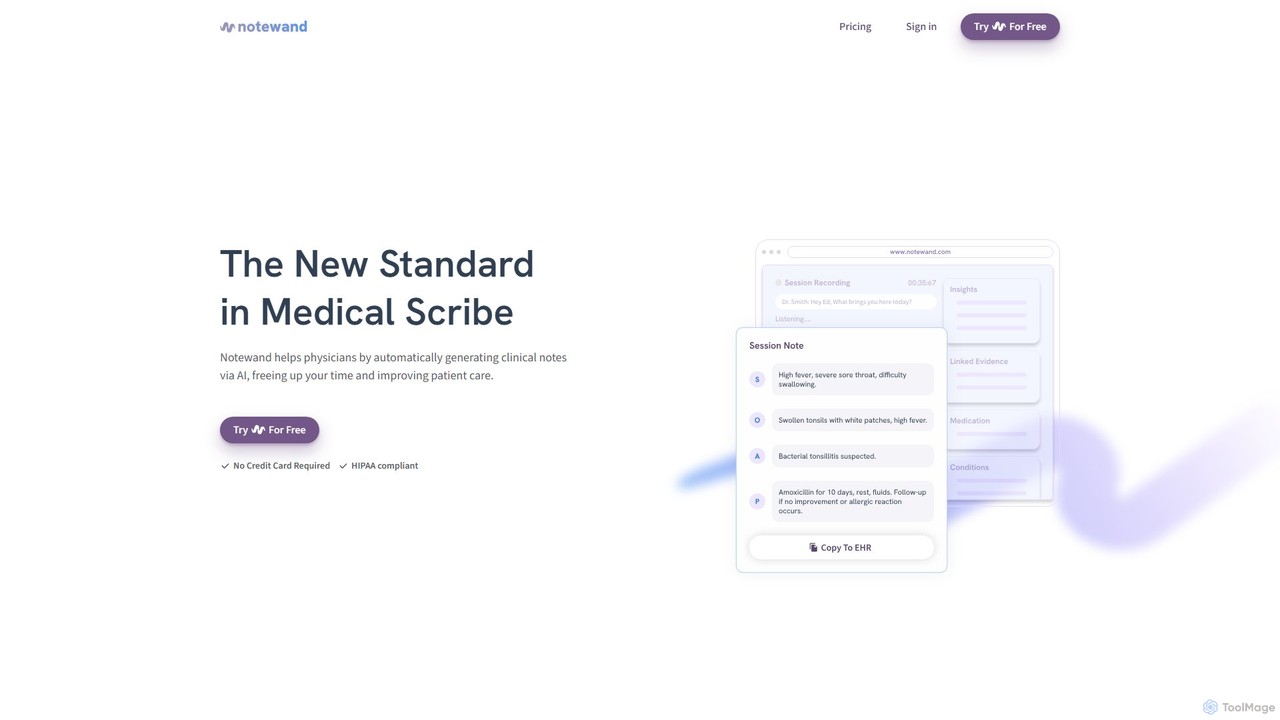
Notewand is an AI-powered medical scribe that listens to doctor-patient conversations and automatically generates structured clinical notes in real-time. Designed for physicians, it helps reduce documentation time, minimize burnout, and improve the quality of patient care. The platform is HIPAA and GDPR compliant, ensuring the highest level of data security for sensitive patient information.

Clinical Documentation
Visits 6.5KFavorites 151Likes 146

About Medical Scribing

AI Medical Scribing tools are specialized applications that automatically convert doctor-patient conversations into structured clinical notes. These tools leverage advanced speech recognition (ASR) and natural language processing (NLP) to accurately identify medical terminology, symptoms, diagnoses, and treatment plans from natural dialogue. Their primary value is automating the burdensome task of clinical documentation, allowing healthcare providers to focus more on patient interaction and care. This technology significantly reduces administrative workload and improves the accuracy and timeliness of medical records.

Core Features

  • Ambient Listening & Real-time Transcription: Captures conversations during patient encounters and converts them into text in real-time.
  • Structured Note Generation: Automatically organizes transcribed text into standard clinical formats, such as SOAP (Subjective, Objective, Assessment, Plan) notes.
  • Medical Terminology Recognition: Accurately identifies and interprets complex medical terms, medications, and abbreviations specific to various specialties.
  • EHR/EMR Integration: Seamlessly syncs generated notes with Electronic Health Record (EHR) or Electronic Medical Record (EMR) systems for streamlined workflows.

Applicable Scenarios

These tools are primarily used by physicians, nurse practitioners, and physician assistants across various healthcare settings, including primary care clinics, specialty practices (e.g., cardiology, orthopedics), and hospitals. They are particularly effective in fast-paced environments like emergency departments and for documenting telehealth consultations, ensuring consistent and thorough record-keeping regardless of the setting.

Selection Criteria

When choosing an AI Medical Scribing tool, consider its accuracy rate for your specific medical specialty and accent. Evaluate the depth and reliability of its integration with your existing EHR/EMR system. Ensure the tool is fully compliant with privacy regulations like HIPAA, and assess its user interface for ease of use and minimal disruption to the clinical workflow.

Medical Scribing use cases

1

Automating Primary Care SOAP Notes

A general practitioner uses an AI medical scribing tool during a routine patient check-up. The tool runs ambiently on a tablet or computer, capturing the entire conversation. It automatically distinguishes between the doctor's speech, the patient's responses, and small talk. After the visit, a complete SOAP note is drafted and ready for review in the EHR system. The physician only needs to spend a minute or two verifying the details and signing off, saving an average of 10-15 minutes of manual typing per patient and reducing documentation burnout.

2

Documenting Specialist Consultations

A cardiologist consults with a patient about complex test results and a new medication plan. The AI scribe accurately captures specific cardiac terminology, such as 'ejection fraction' and 'atrial fibrillation,' along with medication names and dosages. It structures the information into a consultation letter format, highlighting the assessment and plan. This ensures that the detailed nuances of the specialist's recommendations are recorded accurately for the referring physician and the patient's record, preventing potential misinterpretations from manual note-taking.

3

Streamlining Emergency Department Charting

In a busy emergency department, an ER physician uses a mobile-enabled AI scribe while moving between patients. The tool captures critical information during initial assessments, including patient history, symptoms, and vital signs discussed. This allows for near-instantaneous charting, enabling the physician to make faster decisions and communicate more effectively with the care team. The quick turnaround of accurate notes improves patient handoffs during shift changes and reduces the time spent on documentation at the end of a long shift.

4

Enhancing Telehealth Documentation

During a virtual consultation, a healthcare provider uses an AI scribing tool that integrates with their telehealth platform. The AI captures the audio from the video call and generates a clinical note in real-time. This is especially useful for mental health sessions, where maintaining eye contact and engagement is crucial. The therapist can focus entirely on the patient's narrative without the distraction of typing. The tool helps create a comprehensive summary of the session, ensuring billing codes and treatment plans are accurately documented for continuity of care.

5

Training Medical Residents and Students

In a teaching hospital, medical residents use AI scribing tools as a learning aid. After seeing a patient, the resident reviews the AI-generated note and compares it with their own manually drafted note. This process helps them identify gaps in their documentation, learn correct terminology, and understand how to structure clinical notes efficiently. Attending physicians can also use the AI notes as a consistent baseline to evaluate the residents' charting skills, providing more targeted feedback for improvement.

6

Assisting with In-Home Care Documentation

A home health nurse uses a portable AI scribing device during a visit to an elderly patient's home. The nurse can speak their observations and the patient's status updates aloud, and the tool captures it all. It helps document wound care progress, medication adherence, and changes in a patient's condition without the need to juggle a laptop or notepad. This allows the nurse to provide more hands-on care while ensuring that the documentation required for insurance and care coordination is complete and accurate.

Medical Scribing FAQ

What is an AI Medical Scribing tool?

An AI Medical Scribing tool is a software application that uses artificial intelligence, specifically speech recognition and natural language processing, to automatically document clinical encounters. Instead of a human scribe, the AI listens to the conversation between a healthcare provider and a patient and transforms it into a structured, medically relevant note. These tools are designed to integrate directly into clinical workflows and EHR systems to reduce the administrative burden on physicians.

How to choose the right AI Medical Scribing tool?

Choosing the right tool involves several key considerations:

  • Accuracy: Check its accuracy rates, especially for your specific medical specialty and for various accents.
  • EHR/EMR Integration: Ensure it offers deep and seamless integration with your current electronic health record system to avoid manual data transfer.
  • Compliance: Verify that the tool is fully HIPAA compliant (or compliant with local privacy laws) and that the vendor will sign a Business Associate Agreement (BAA).
  • Ease of Use: The tool should be intuitive for clinicians to use and should not disrupt the natural flow of a patient consultation.
What's the difference between AI Medical Scribing and general medical transcription services?

The key difference lies in the timing, structure, and integration. AI Medical Scribing is typically an 'ambient' or real-time process that happens during the patient encounter. It automatically structures the conversation into clinical formats like SOAP notes and integrates directly with EHRs. In contrast, general medical transcription is usually a post-encounter service where a recorded audio file is sent to a human transcriptionist who types it out verbatim. This transcript often lacks clinical structure and requires manual formatting and entry into the EHR.

What are the main benefits of using AI for medical scribing?

The primary benefits include:

  • Reduced Administrative Burden: It significantly cuts down the time physicians spend on documentation, allowing them to see more patients or finish their workday on time.
  • Improved Physician-Patient Interaction: By freeing clinicians from typing, it allows for better eye contact, active listening, and a more empathetic patient experience.
  • Enhanced Note Quality: AI can capture more detail than a busy physician might type, leading to more comprehensive and accurate clinical notes.
  • Faster Chart Completion: Notes are often ready for review immediately after a visit, speeding up the entire billing and clinical workflow cycle.
Are AI Medical Scribing tools compliant with privacy regulations like HIPAA?

Reputable AI Medical Scribing tools designed for healthcare are built with HIPAA (Health Insurance Portability and Accountability Act) compliance as a core requirement. This involves features like end-to-end data encryption, secure data storage, access controls, and audit trails. It is crucial for any healthcare organization to verify a vendor's compliance claims and to sign a Business Associate Agreement (BAA) with them. This agreement legally obligates the vendor to protect all patient health information they handle.