hibambi
hibambi is an AI-powered software designed for the Non-Emergency Medical Transportation (NEMT) industry. It simplifies and automates scheduling, …
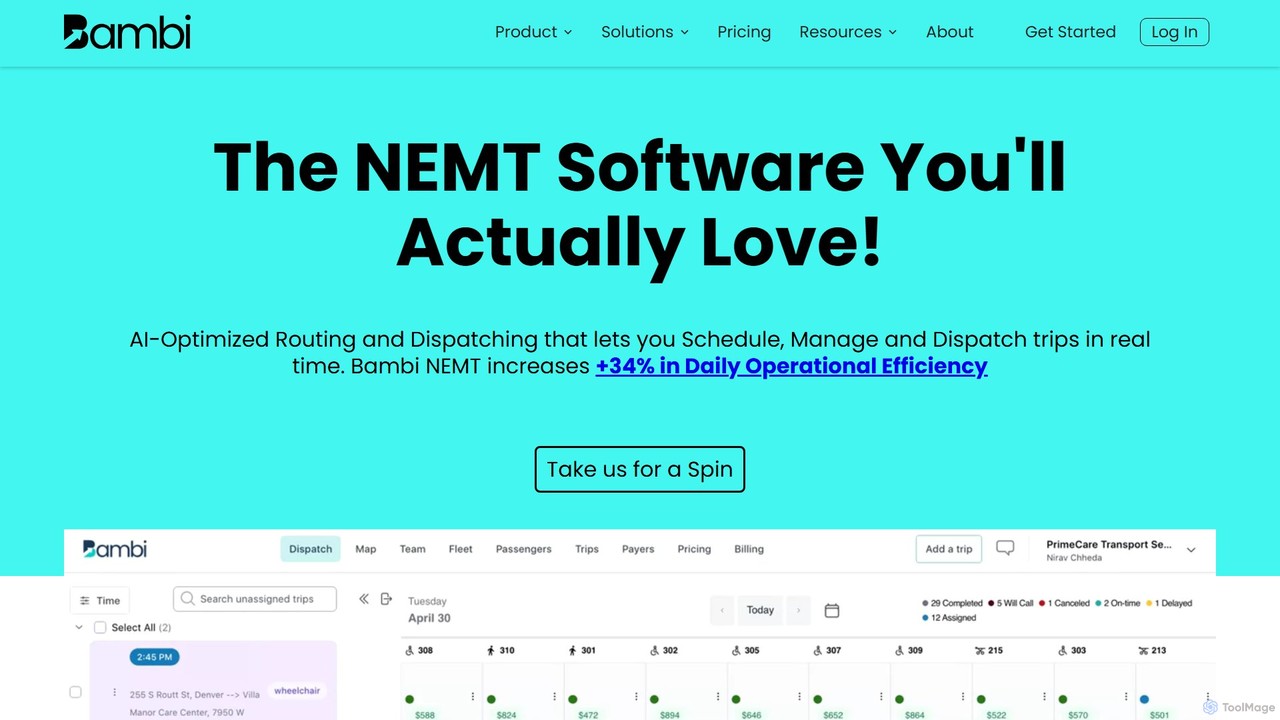
hibambi is an AI-powered software designed for the Non-Emergency Medical Transportation (NEMT) industry. It simplifies and automates scheduling, routing, and dispatching with its one-click "Run Bambi Run" feature. The platform offers real-time vehicle tracking, a dedicated driver app, fleet management, and transparent pricing, helping NEMT businesses increase efficiency, save time, and improve service quality.
About Transportation
AI Transportation tools for healthcare are specialized systems designed to optimize the movement of patients, medical supplies, and personnel. These tools leverage machine learning algorithms for route planning, demand forecasting, and real-time traffic analysis to ensure timely and efficient transit. Their primary value lies in improving patient access to care, reducing operational costs for providers, and enhancing the reliability of medical logistics. They are crucial for managing non-emergency medical transport (NEMT), ambulance dispatch, and the delivery of critical supplies like organs or pharmaceuticals.
Core Features
- Route Optimization: Dynamically calculates the most efficient routes for medical vehicles, considering traffic, patient appointments, and vehicle capacity.
- Demand Forecasting: Predicts transport needs based on historical data, seasonal trends, and public health events to allocate resources proactively.
- Automated Dispatching: Intelligently assigns transport requests to the most suitable vehicle and crew based on location, urgency, and required medical equipment.
- Real-time Tracking & ETA: Provides live tracking of vehicles and accurate estimated times of arrival for patients and receiving facilities.
- Supply Chain Logistics: Manages the transportation of sensitive medical goods, ensuring temperature control and chain of custody.
Use Cases
These tools are essential for hospitals, ambulance services, NEMT providers, and medical logistics companies. For example, a hospital can use them to coordinate patient transfers between facilities, while an NEMT provider can optimize daily routes for dozens of patients with different appointment times. They are also used by specialty couriers for time-sensitive delivery of lab samples and organs for transplant.
How to Choose
When selecting an AI Transportation tool for healthcare, consider its integration capabilities with existing Electronic Health Record (EHR) and scheduling systems. Evaluate the sophistication of its optimization algorithms and its ability to handle specific constraints like patient mobility or special equipment needs. Also, assess the platform's compliance with healthcare data privacy regulations like HIPAA and the quality of its real-time data reporting and analytics features.

TransportationUse Cases
Optimizing Non-Emergency Medical Transport (NEMT) Routes
NEMT providers manage daily transportation for numerous patients with different appointment times and locations. Using an AI transportation tool, a dispatcher can automatically generate the most efficient multi-stop routes for their entire fleet. The system considers factors like patient pickup windows, appointment times, traffic predictions, and vehicle capacity. This leads to reduced fuel consumption, lower operational costs, and significantly improved on-time performance, ensuring patients arrive at their appointments stress-free and on schedule.
Automating Emergency Ambulance Dispatch
In emergency response, every second counts. An AI-powered dispatch system can analyze the location of an incident, real-time traffic conditions, and the availability and location of all ambulances simultaneously. It instantly identifies and dispatches the nearest, most appropriate unit, providing the crew with an optimized route to the scene and then to the best-suited hospital. This automation reduces human response time, minimizes travel time, and ultimately improves patient outcomes in critical situations.
Managing Time-Sensitive Medical Courier Services
Medical couriers transport critical items like blood samples, lab specimens, and organs for transplant, where delivery time is paramount. An AI logistics platform can manage the entire workflow, from scheduling pickups to providing real-time tracking and proof of delivery. It optimizes routes to avoid delays and can dynamically re-route couriers if conditions change. The system also ensures chain of custody and can monitor environmental factors like temperature for sensitive shipments, ensuring integrity and compliance.
Predicting Patient Transportation Demand for Hospitals
Hospital administrators need to plan for patient transport needs, including discharges, inter-facility transfers, and outpatient appointments. An AI tool can analyze historical data, admission rates, and scheduled surgeries to forecast future transportation demand. This allows the hospital to schedule in-house transport staff more effectively or book third-party NEMT services in advance. Proactive resource allocation prevents delays in patient flow, reduces bed blocking, and improves overall operational efficiency.
Coordinating In-Hospital Patient Transport
Within a large hospital, porters are constantly moving patients between wards, imaging departments, and operating rooms. An AI system can manage these internal transport requests, creating an optimized schedule for the portering team. It prioritizes urgent requests, batches nearby tasks, and provides porters with clear instructions on their mobile devices. This ensures patients get to their appointments on time, reduces staff idle time, and improves the overall flow and efficiency of hospital operations.
Enhancing Medical Supply Chain Visibility
For a pharmaceutical distributor, ensuring the timely and safe delivery of vaccines or temperature-sensitive drugs is critical. An AI transportation management system provides end-to-end visibility. It tracks shipments in real-time, monitors temperature and humidity via IoT sensors, and predicts potential delays. If a deviation occurs, such as a temperature excursion, the system sends an immediate alert, allowing for corrective action to be taken before the product is compromised. This enhances product safety, ensures regulatory compliance, and reduces costly spoilage.