Clara Health
Clara Health is a no-code, HIPAA-compliant AI platform designed for healthcare teams. It enables providers to build and …
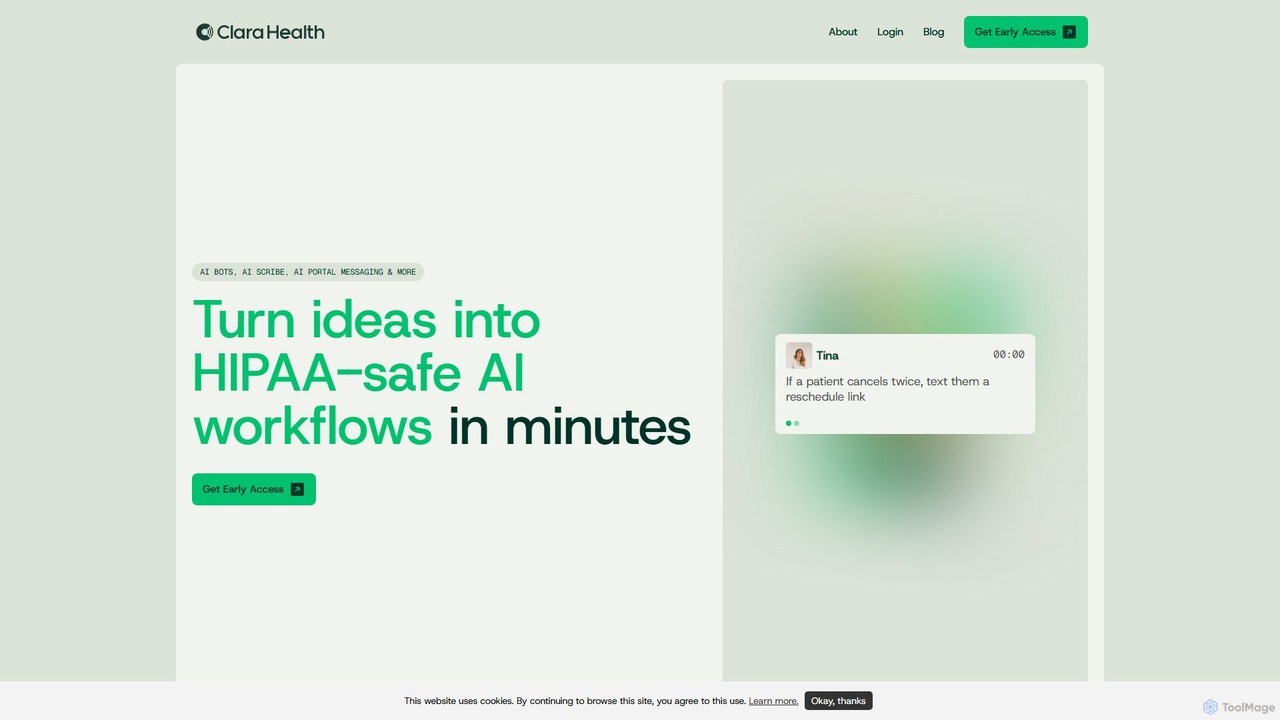
Clara Health is a no-code, HIPAA-compliant AI platform designed for healthcare teams. It enables providers to build and deploy custom AI workflows in minutes using a simple chat interface, automating tasks like patient scheduling, billing follow-ups, prior authorizations, and clinical documentation without needing any engineering resources.
About Workflow Automation
Workflow Automation in healthcare refers to AI-powered tools designed to streamline and optimize repetitive administrative, clinical, and operational tasks. These solutions leverage artificial intelligence, machine learning, and robotic process automation to automate data entry, manage patient interactions, and orchestrate complex processes. By reducing manual effort and human error, workflow automation enhances operational efficiency, improves data accuracy, and allows healthcare professionals to focus more on patient care, ultimately leading to better outcomes and reduced costs within medical settings.
Core Features
- Automated Data Capture: Extracts and processes information from various sources like patient forms, medical records, and insurance documents.
- Intelligent Task Routing: Automatically assigns tasks, approvals, and notifications to the correct personnel or systems based on predefined rules and AI insights.
- System Integration: Seamlessly connects with existing Electronic Health Records (EHR), Hospital Information Systems (HIS), and other legacy platforms.
- Compliance & Audit Trails: Ensures adherence to regulatory standards (e.g., HIPAA, GDPR) by automating documentation and providing comprehensive audit logs.
- Predictive Analytics: Utilizes AI to forecast resource needs, patient flow, and potential bottlenecks, enabling proactive management.
Applicable Scenarios
Healthcare providers, administrators, and billing departments utilize these tools to transform their daily operations. Specific applications include automating patient intake and registration processes, streamlining medical claims submission and adjudication, and managing the complex logistics of medical supply inventory. These tools are crucial for reducing administrative burdens and improving service delivery across hospitals, clinics, and specialized care facilities.
How to Choose
When selecting a Workflow Automation solution for healthcare, prioritize robust integration capabilities with existing IT infrastructure, strong data security and compliance features (e.g., HIPAA), and proven scalability to handle growing patient volumes. Evaluate the level of customization offered to adapt to unique departmental workflows and ensure the vendor provides comprehensive support and training for healthcare-specific implementations.
Workflow AutomationUse Cases
Automated Patient Onboarding & Registration
For hospital administrative staff, this involves automating the entire patient intake process, from initial demographic data collection and insurance verification to consent form processing. AI tools extract information from scanned documents or online forms, populate EHRs, and trigger necessary follow-up tasks, significantly reducing manual data entry errors and patient wait times during registration.
Intelligent Appointment Scheduling & Reminders
Clinic managers can leverage workflow automation to optimize physician schedules, automatically book appointments based on patient needs and doctor availability, and send personalized reminders via SMS or email. The system can also intelligently manage cancellations and reschedule requests, minimizing no-shows and ensuring efficient utilization of clinical resources.
Streamlined Medical Claims Processing
Billing departments use these tools to automate the submission, verification, and tracking of insurance claims. AI can identify potential errors or missing information before submission, reducing rejections and accelerating reimbursement cycles. This frees up billing specialists to focus on complex cases and appeals, improving financial health.
Automated Medical Supply Inventory Management
Hospital logistics teams can automate the monitoring of medical supply stock levels, from medications to surgical instruments. The system tracks consumption patterns, triggers automatic reorder alerts or direct orders to suppliers when thresholds are met, and updates inventory records, preventing critical shortages and optimizing procurement costs.
Efficient Clinical Documentation & Charting Support
Clinicians benefit from automation by streamlining the documentation process. AI can extract key data points from dictated notes or patient interactions, populate relevant fields in the EHR, and generate summary reports. This reduces the time spent on administrative tasks, allowing doctors and nurses to dedicate more time to direct patient care.
Automated Patient Referral Management
For primary care physicians and specialists, workflow automation simplifies the complex process of managing patient referrals. The system can automatically route referral requests, track their status, ensure all necessary documentation is attached, and send automated updates to both referring and receiving providers, improving care coordination and patient continuity.